
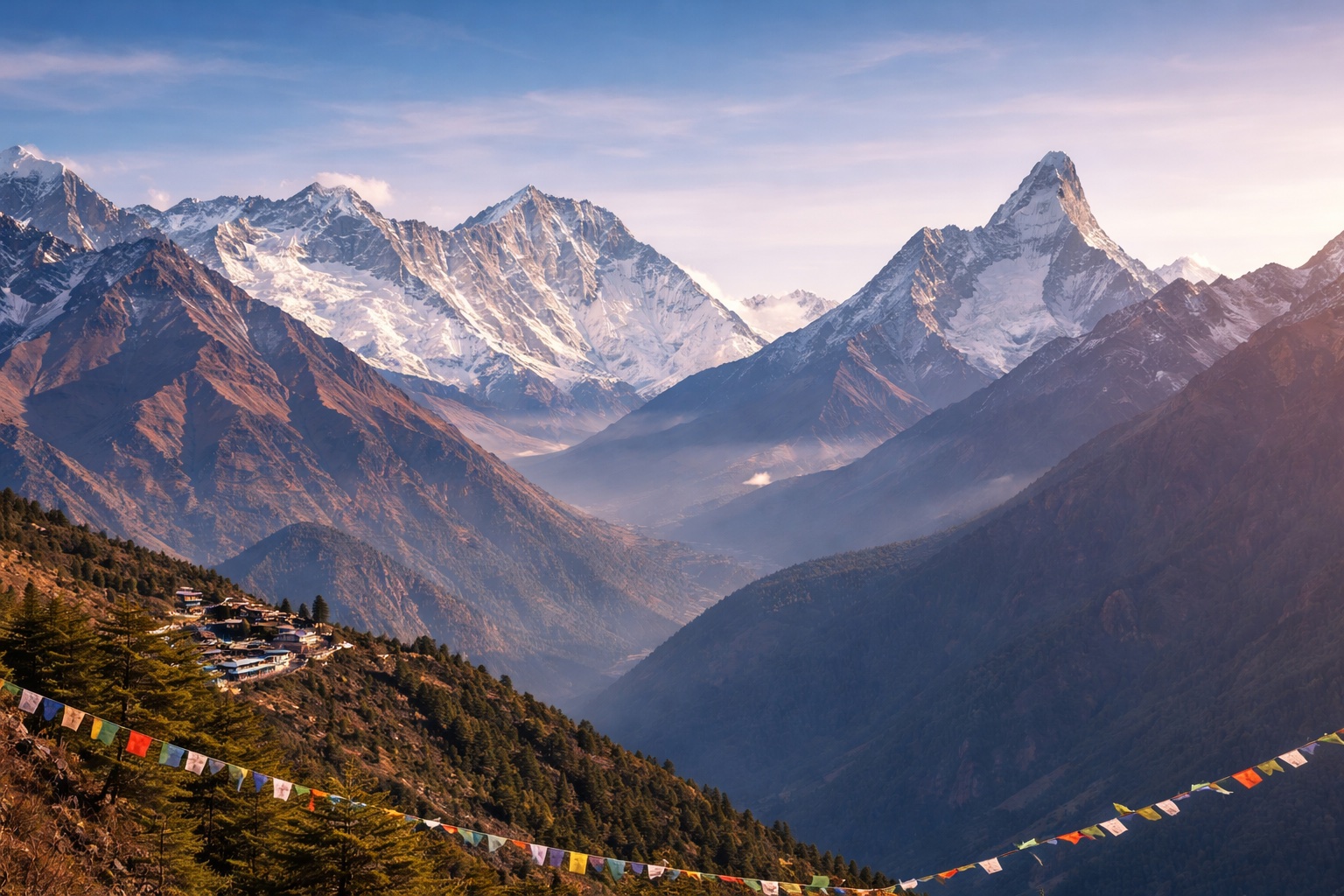
Hike from Phewa Lake's southern shore through dense sub-tropical forest to the World Peace Pagoda (Shanti Stupa) at 1,100 m — a gleaming white Japanese Buddhist stupa on the Anadu hill ridge with the finest view of the full Annapurna range, Phewa Lake, and the Pokhara city spread available from any point accessible on foot. A 2.5-hour return hike combining forest, meditation, and Nepal's most photographed pagoda in a classic Pokhara half-day.
The World Peace Pagoda — known formally as the Shanti Stupa — stands on the forested Anadu ridge south of Phewa Lake at 1,100 metres, its gleaming white dome visible from almost every point in the Pokhara valley and the surrounding hills. Built by the Nipponzan Myohoji Buddhist Order of Japan between 1973 and 1996 (construction took more than two decades due to the remote ridge location and the manual labour required), the pagoda is one of 80 World Peace Pagodas that the Nipponzan Myohoji Order has built globally since the 1940s as a form of post-war Buddhist peace activism. The Pokhara pagoda is among the most dramatically situated of the 80, and is the one most frequently cited as the finest single viewpoint in the Pokhara valley — a claim that the panorama from the pagoda terrace supports without difficulty.
The view from the pagoda terrace is the most comprehensive single vista available in Pokhara: directly to the north, the full Annapurna range (Annapurna I through IV, Annapurna South, Machapuchare, Hiunchuli, and the Lamjung Himal) fills the horizon from northwest to northeast in an unobstructed arc. Below the pagoda to the north, Phewa Lake lies in the valley floor — its entire 4 km² surface visible from above, the Barahi Temple island tiny in the centre, and the Lakeside district visible along the northern shore. Further north, the Pokhara valley spreads in its entirety — the city, the airport, the agricultural plains, and the low hills of the Harpan valley — providing a geographical orientation for the entire Pokhara basin that no ground-level viewpoint can achieve. Experienced Pokhara visitors consistently rate this as the single view to see from the valley, above even Sarangkot, because it combines the mountain panorama with the full topographical context of the valley below.
The most rewarding route to the World Peace Pagoda is the hiking trail from the southern shore of Phewa Lake — beginning at the boat landing on the Damside side of the lake (accessible by a 10-minute rowboat crossing from the main Lakeside ghat) and climbing through 2.5 km of continuous sub-tropical forest to the pagoda ridge. The forest on the Anadu hillside is dense, shaded, and exceptionally rich in birdlife: scarlet minivet, blue-throated barbet, green magpie, rufous treepie, and the brilliant common kingfisher along the forest streams are regularly encountered on the trail. In spring (February–April), the forest floor and lower canopy are alive with migrating and resident passerines, and the trail through the flowering rhododendron understorey is one of Pokhara's finest birding walks. The gradient is moderate and consistent — no scrambling, no exposed sections — with the trail gaining approximately 300 metres over 2.5 km through a series of stone-stepped switchbacks and forest paths.
The pagoda complex at the top consists of the main stupa (the large white dome with four niches housing Buddha images in different postures), a resident Japanese monk's meditation centre, a caretaker's house, and a small tea house serving simple snacks and drinks. The monk community — typically 2–4 Japanese monks in residence — welcomes visitors for meditation and prayer, and the sound of the drum and chanting that the Nipponzan Myohoji Order performs at dawn and dusk carries across the hillside in a way that adds a profound acoustic dimension to the visual experience of the ridge.
The traditional approach to the World Peace Pagoda includes a short boat crossing of Phewa Lake — a 10-minute row in a traditional wooden boat from the main Lakeside ghat (by the Barahi Temple jetty) to the Damside southern shore, where the forest trail begins. The boat crossing is itself one of Pokhara's most atmospheric small experiences: the lake is glass-still in the early morning, the mountains reflect in the surface, and the unhurried pace of the wooden rowing boat — with the pagoda's white dome visible on the ridge ahead — creates a moment of genuine tranquility that contrasts sharply with the activity of the Lakeside promenade. We include the boat crossing in our World Peace Pagoda hiking package as an integral part of the experience rather than a road approach from the south.
They offer different and complementary views. Sarangkot (1,592 m) is higher and provides a more elevated perspective of the Annapurna range — the peaks appear larger and the angle is more direct. The World Peace Pagoda (1,100 m) provides a more comprehensive view of the Pokhara valley as a whole — because it sits south of Phewa Lake rather than north of it, you can see the entire lake, the city, and the mountains simultaneously in a single panoramic composition that Sarangkot cannot provide. Many Pokhara visitors choose: Sarangkot for sunrise (early morning, mountain focus) and the World Peace Pagoda for late morning or afternoon (mountain + valley context, boat crossing experience, forest hiking). Both in one day is a very satisfying Pokhara hiking programme.
The total time from hotel departure to hotel return is approximately 3–3.5 hours: 10 minutes to the ghat, 10-minute boat crossing, 45–60 minutes hiking up, 30–45 minutes at the pagoda, 35–45 minutes descending, 10-minute boat return, and 20–30 minutes for a lakeside lunch. This makes it an ideal half-day activity that returns you to your hotel by 11:30 am–1:00 pm, leaving the afternoon completely free. The hike is also available as a late-afternoon experience (departing at 3:30–4:00 pm) for sunset views from the pagoda — the evening light on the Annapurna range from the pagoda terrace, with the lake surface turning orange below, is one of Pokhara's finest sunset experiences.
Yes — a vehicle road approaches the pagoda from the south, and taxis can drive to within 100 metres of the stupa. However, the road approach misses the Phewa Lake boat crossing (one of Pokhara's most atmospheric small experiences) and the forest trail (which is the botanical and ornithological heart of the hike). We strongly recommend the trail approach for the full experience. If mobility limitations preclude the forest trail, we arrange the road approach with a short walk from the vehicle drop-off to the pagoda terrace — this still delivers the view and the cultural experience.
Yes — the World Peace Pagoda and the surrounding Nipponzan Myohoji compound are open to all visitors regardless of religion. The Japanese monk community welcomes visitors for respectful exploration of the stupa, photography, and quiet contemplation. The main stupa has four niches, each housing a large gilded Buddha image in a different posture (birth, enlightenment, teaching, and passing into nirvana) — visitors of all backgrounds engage with these as cultural and artistic objects as well as religious ones. A small donation box at the stupa entrance is the suggested contribution for maintenance of the complex. Remove shoes before entering the stupa terrace; dress modestly (shoulders and knees covered).