
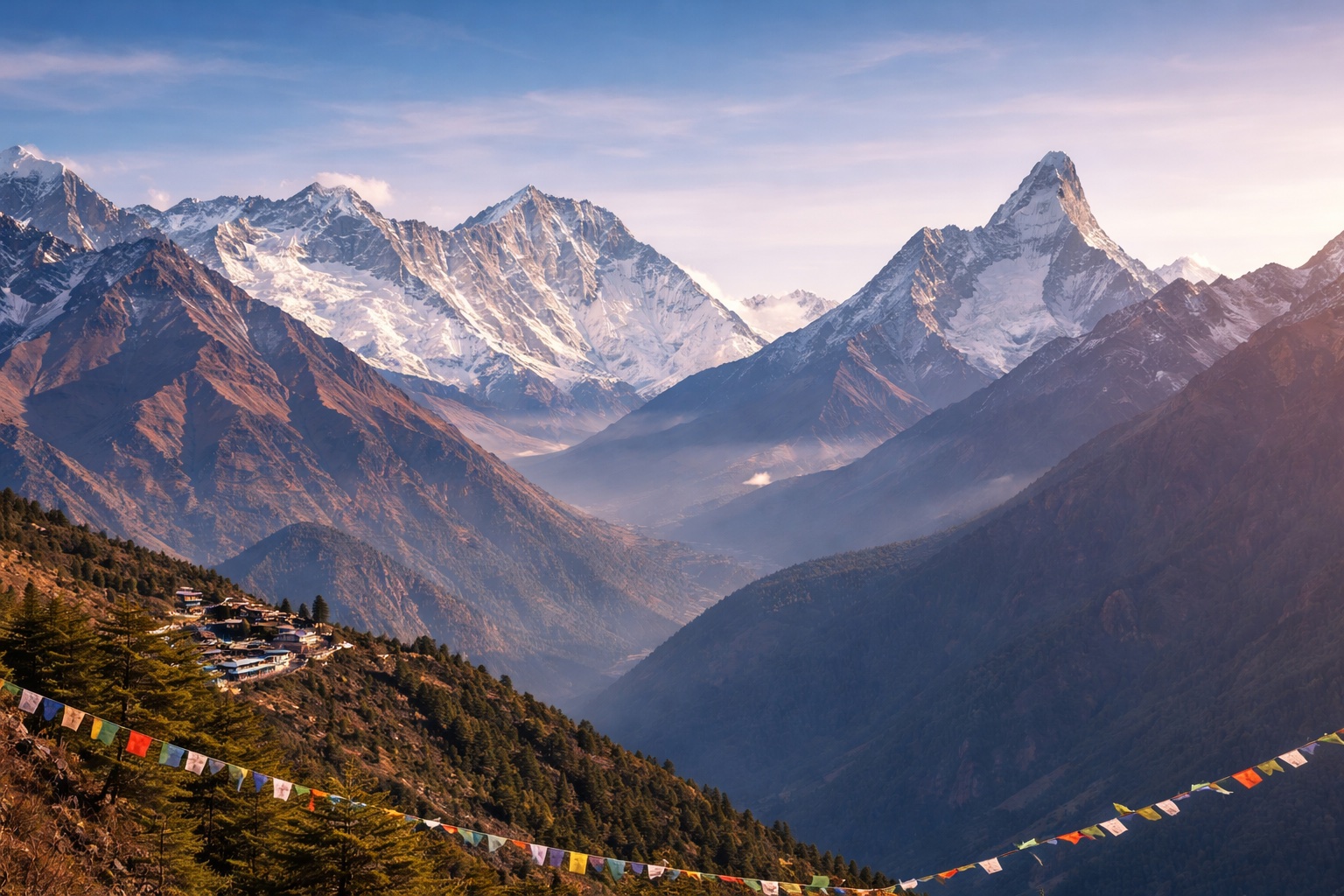
Balthali (1,700 m) — a traditional Newari farming village on a sun-drenched ridge 30 km southeast of Kathmandu with unobstructed views of the eastern Himalaya — by the forested hillside trail from Panauti, one of Nepal's finest surviving medieval Newari towns. Rice terraces, stone-paved village lanes, community home-stay lunch, and a Himalayan horizon from Gauri Shankar to Numbur. Nepal's most rewarding combination of rural cultural immersion and day hiking accessible from Kathmandu.
Balthali village sits on a broad, south-facing ridge at 1,700 metres in the Kavrepalanchok district, approximately 30 km southeast of Kathmandu by road and connected to the valley floor by a hillside trail from the medieval town of Panauti (1,360 m) — one of Nepal's finest and least-visited Newari heritage towns. The village is small (approximately 200 households of the Newar, Tamang, and Chhetri communities), traditional in its agricultural practices (hand-ploughed rice and wheat terraces, community-managed irrigation channels, the harvest and planting cycles that have organised rural life in these hills for millennia), and set in a position that provides an unobstructed panorama of the eastern Himalaya — Gauri Shankar (7,134 m), Melungtse (7,181 m), Numbur (6,957 m), Gyachung Kang (7,952 m), and the distant silhouette of the Everest group — from the ridge's northern viewpoint fields. The combination of the cultural experience in Panauti and Balthali, the easy hillside trail, and the Himalayan ridge setting makes Balthali the finest rural cultural day hike accessible from Kathmandu.
Panauti — the starting point for the trail — is one of Nepal's most perfectly preserved medieval Newari settlements and one of the least visited of the valley's heritage sites despite holding a collection of 15th–17th century temples that rivals anything in Bhaktapur or Patan. The Indreshwar Mahadev Temple at Panauti — a three-tiered pagoda dedicated to Shiva, dating from the 14th century and one of the oldest surviving temples in the Kathmandu Valley — stands in the town's central square surrounded by smaller shrines, stone-paved courtyards, and the carved wood architecture that characterises Newari sacred building at its finest. The town's position at the confluence of the Punyamati and Rosi Khola rivers gives it the sacred status of a tirth (sacred river confluence) in the Hindu tradition, and the riverbank ghats (cremation platforms) and the continuous cycle of ritual bathing and prayer at the confluence give Panauti a quality of active religious life that UNESCO-listed sites closer to Kathmandu, overwhelmed by tourism, no longer possess.
The hiking trail from Panauti to Balthali climbs 340 metres over 5 km through a landscape that changes from the immediate hinterland of the medieval town (kitchen gardens, marigold fields for temple offerings, small shrines at every trail junction) to the open agricultural terraces and mixed pine-oak hillside forest of the middle section, before emerging on the broad Balthali ridge for the final kilometre to the village. The trail is easy to moderate — predominantly on compacted earth and stone paths — and is one of the few day-hike routes from Kathmandu that genuinely feels rural rather than periurban. No roads, no electricity pylons, no development intrudes for the 5 km between Panauti and Balthali — the trail is as unchanged as any within 50 km of the capital.
The home-stay lunch at Balthali is the cultural centrepiece of the day — a meal prepared by a local family in their traditional stone-and-timber house, served on a woven mat or low timber table in the courtyard, consisting of dal bhat (lentil soup, steamed rice, vegetable curry, pickles), gundruk (Nepal's traditional fermented dried greens), and seasonal vegetables from the family's own terraced fields. The meal is cooked over a wood-fired stove in a kitchen that has not changed in fundamental character since the house was built three generations ago. The home-stay model — in which a small number of Balthali families have been trained as official community hospitality hosts with support from rural tourism initiatives — distributes income directly to the village community and provides a quality of personal, un-commercialised cultural encounter that no restaurant in Kathmandu can replicate. Eating in a Balthali home, surrounded by the family's agricultural implements, the religious objects on the altar shelf, and the mountain view through the courtyard gate, is one of the most humanly satisfying experiences a Nepal visitor can have.
Bhaktapur and Patan are the Kathmandu Valley's two most visited heritage towns, and both are extraordinary. Panauti's distinction is not fame or architectural scale but authenticity of daily life — it receives very few international visitors compared to Bhaktapur, and the absence of tourism infrastructure (no souvenir shops, no performance "for tourists," no entry fee at the time of writing) means the medieval urban environment is encountered in the context of its actual function: a living community that uses the temples for daily worship, the river confluence for ritual bathing and cremation, and the stone lanes for the movement of agricultural produce and the conduct of ordinary life. The Indreshwar Mahadev Temple's 14th-century pagoda structure is architecturally comparable to Bhaktapur's famous Nyatapola but without the crowds. For visitors who want to understand Newari culture as it actually exists rather than as it is presented for tourism, Panauti is the most important site in the valley.
Yes — all home-stay lunches are pre-arranged through our partnership with the Balthali Community Home-Stay programme. This ensures the host family is expecting you, has prepared the appropriate meal, and has allocated adequate time for the visit. We do not recommend simply arriving at a random village house and asking for lunch — the home-stay model works because the families have chosen to participate and have been trained in welcoming guests. The fee for the lunch is paid directly to the host family, not to us — this is a deliberate design to ensure maximum community benefit.
Yes — the Balthali home-stay programme offers overnight accommodation in traditional village houses with dinner and breakfast included. The overnight experience adds the morning light on the Himalayan horizon (often clearer than afternoon, with mist below the ridge), the village evening routine (cattle return from the fields, cooking fires, the community social gathering at the water tap), and the profoundly dark, quiet night at 1,700 m away from any city light. We offer the Balthali overnight extension as a 2-day add-on to the day hike itinerary — enquire for pricing.
Both Balthali and Namobuddha are in the Kavrepalanchok district east of Kathmandu and offer a combination of agricultural landscape and cultural content. Namobuddha is primarily a Buddhist pilgrimage destination — the monastery, the Jataka story site, and the walking meditation character of the ridge make it more spiritually focused. Balthali is primarily a rural cultural immersion — the Panauti town (Hindu temple architecture), the village home-stay, and the agricultural landscape engagement are the heart of the experience. Both offer Himalayan views from similar elevations and similar trail character. Many visitors do both on consecutive days as a two-day Kavrepalanchok exploration based in Dhulikhel — we offer this as a combined package.