
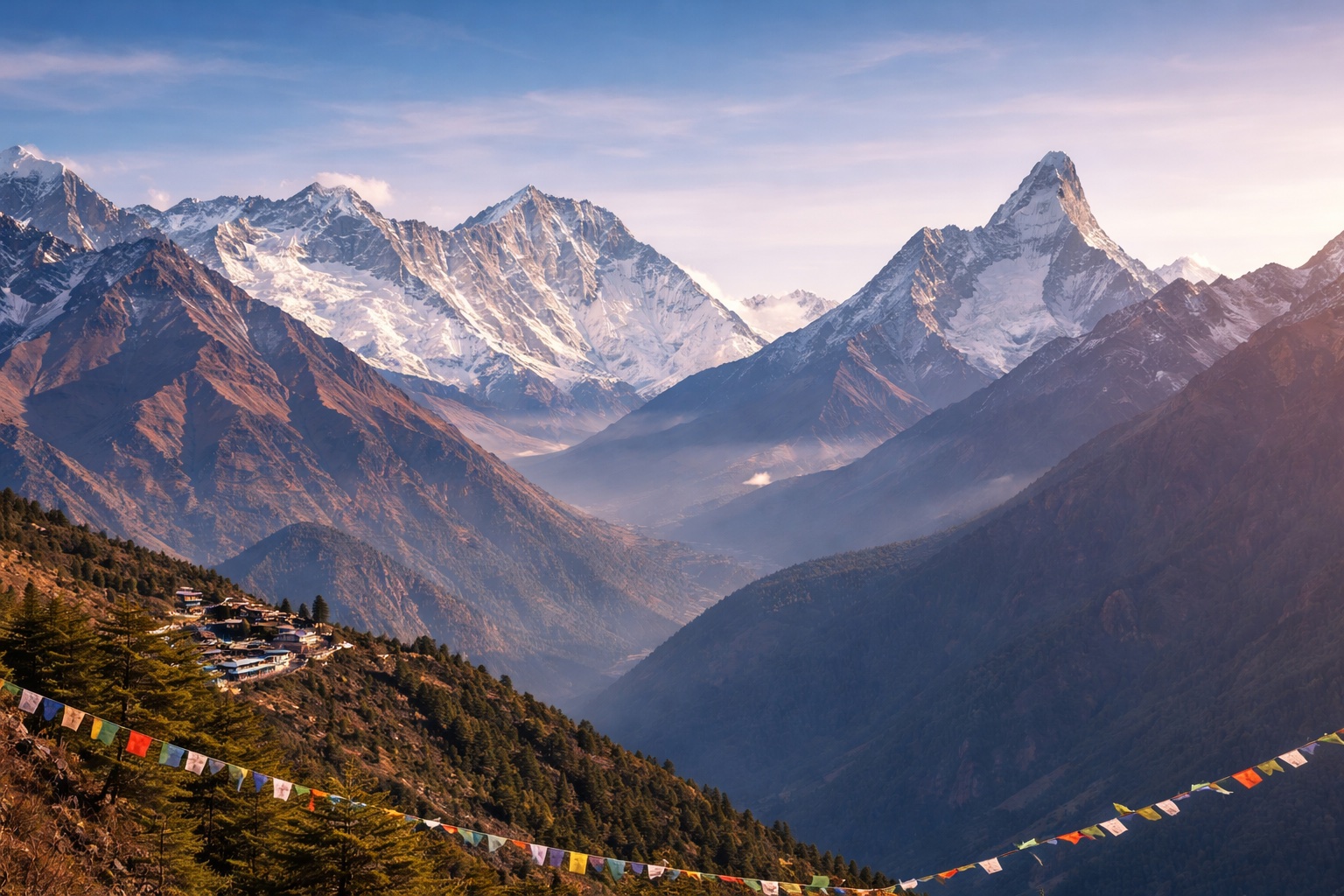
Hike to Sarangkot (1,592 m) before dawn from Pokhara Lakeside and watch the Annapurna range ignite at sunrise — Annapurna I, Annapurna South, Machapuchare, Hiunchuli, and Dhaulagiri turning gold, then amber, then blazing white in the first light above the sleeping valley and Phewa Lake below. Nepal's most celebrated morning hike. The 45-minute trail through the forest delivers one of the world's great sunrise spectacles.
The Sarangkot Sunrise Hike from Pokhara is, by sheer visitor numbers and international recognition, the most famous short hike in Nepal — a pre-dawn 45-minute walk from the Pokhara Lakeside district up through rhododendron and pine forest to the Sarangkot viewpoint (1,592 m), where the Annapurna Himalaya performs one of the world's great daily light displays as the sun rises behind the observer and illuminates the range to the north in a sequence of colours — deep rose, burning gold, pure white — that no photograph taken from a lower viewpoint or a later hour replicates. The hike is short enough to be completed before breakfast and long enough to feel genuinely earned; the view at the top is, by the consensus of travellers who have seen it, worth the early alarm.
Sarangkot is a ridge above the northwest edge of Pokhara, rising 750 metres above the valley floor. The viewpoint at 1,592 m looks north across the Pokhara valley to the full western Himalaya — Annapurna I (8,091 m), Annapurna II (7,937 m), Annapurna III (7,555 m), Annapurna IV (7,525 m), Annapurna South (7,219 m), Hiunchuli (6,441 m), and the incomparable Machapuchare (6,993 m) in the foreground — with Dhaulagiri (8,167 m) visible to the west on clear days. Below the viewpoint, Phewa Lake lies in the valley floor, its surface catching the first colours of the dawn sky and reflecting the mountains above. The combination — the greatest mountain range in the world in a single northward sweep, the lake below, the silence of the pre-dawn ridge, and the slow revelation of the peaks as the light builds from east to west — is an experience that visitors from every country and every background consistently describe as one of the most moving of their Nepal journey.
The most rewarding way to reach Sarangkot is on foot — not by road or vehicle, but on the traditional stone-stepped trail that climbs from the Khapaudi neighbourhood above Lakeside through a continuous corridor of mixed rhododendron, oak, and pine forest. The trail begins at approximately 850 m and gains 750 metres of elevation over 3–4 km, with the gradient steepest in the first section (where the stone steps climb sharply away from the village lanes) and easing progressively as the ridge approaches. In the dark before dawn, the trail is navigated by headtorch — our guide leads the way and knows every turn — and the pre-dawn forest has a quality of profound quiet that the midday crowds on the same path do not provide. The only sounds on the 5:00 am trail are the rustle of the forest canopy in the pre-dawn air, the distant dogs of Pokhara far below, and occasionally the wings of a nightjar or the call of an owl from the forest edge. Most hikers who make the pre-dawn ascent report that the walk itself — in the dark, in the quiet, building toward something unseen — is as memorable as the sunrise that crowns it.
The viewpoint at the top has a cluster of small tea houses and cafes that open before dawn to serve the sunrise crowd — hot sweet milk tea, instant coffee, and fresh roti with honey are the standard order while the mountains slowly materialise out of the darkness to the north. The first sign of dawn is not the sun but the colour change in the sky above the eastern ridge — a deepening of purple to indigo to the first faint flush of pink — before the light catches the highest summit snows and the peaks ignite. Machapuchare is typically the first peak to turn colour, as its summit protrudes furthest south and catches the oblique morning light before the peaks behind it, and the transition from dark silhouette to glowing golden pyramid happens in under two minutes — a moment that reliably produces an audible reaction from every group watching.
The descent from Sarangkot takes 35–40 minutes on the same trail and returns you to Lakeside by approximately 8:00–8:30 am — leaving the entire morning ahead for Pokhara activities. Many visitors combine the Sarangkot sunrise hike with a morning boat ride on Phewa Lake (15 minutes from the Lakeside trailhead), a visit to the Barahi Temple island in the middle of the lake, or a lakeside breakfast with the mountains still visible above the valley floor. The hike is frequently combined with the afternoon Pokhara paragliding (operating from the same Sarangkot ridge) as a full Sarangkot day — sunrise hike up, breakfast at the top, down by vehicle, paragliding from mid-morning.
Sunrise in Pokhara varies by season — from approximately 5:30 am in June to 6:45 am in December. We calculate the departure time based on the current sunrise time and allow the full 45–60 minutes of hiking time plus a 15-minute buffer to be at the viewpoint before first light. In October and November, hotel pickup is typically at 5:00–5:15 am. In December and January it can be as late as 5:45 am. In March and April, around 5:00 am. We confirm the exact pickup time for your date when your booking is finalised — the guide handles the pre-dawn logistics and there is no risk of missing the sunrise if you depart on the confirmed schedule.
Yes — the Sarangkot trail is classified as easy to moderate. The 3 km distance and 750 m elevation gain is completed in 45–60 minutes by most adults at a comfortable pace. The trail is consistently steep (many sections are stone steps rather than switchbacks) but there are no technical sections, loose terrain, or altitude concerns. Children from age 6–7 upward typically manage the trail without difficulty. The most challenging aspect for unfit participants is the sustained gradient in the first 15 minutes — after which the steps level out slightly. Carrying a small daypack (water, a light jacket) is the only equipment requirement. Walking shoes or lightweight trail runners are ideal; proper hiking boots are not necessary.
Yes — a vehicle road reaches Sarangkot from the western side of the ridge, and many tour operators drive visitors to the summit for sunrise rather than hiking. However, the hiking experience is qualitatively different from the drive: the pre-dawn forest trail, the gradual build of effort and anticipation, and the physical arrival at the viewpoint after genuine exertion are integral to what makes the Sarangkot sunrise memorable for most visitors. We strongly recommend the hiking route — it is not significantly more demanding than a sustained staircase climb, and the contrast between the dark forest trail and the sudden explosion of mountain light at the summit is one of the defining Nepal travel moments. If mobility limitations genuinely preclude the hike, we arrange the vehicle route.
October and November deliver the most consistently clear conditions — the post-monsoon atmosphere is exceptionally transparent, the Annapurna range is fully snowcapped, and the probability of a clear sunrise is very high (approximately 80–90% of days in October have clear mountain views at dawn). March and April are equally popular — the rhododendron forest is in bloom on the trail, the light is warmer and more golden than in October, and the spring haze has not yet built to obscure the mountains. December and January provide clear skies but the pre-dawn temperature at the viewpoint drops to 2–5°C (warm layers essential). February can have valley fog that obscures the lake below while the peaks remain visible. The monsoon (June–September) makes sunrise views unpredictable — cloud typically fills the valley by dawn.
Yes — this is the most popular Sarangkot combination. The sunrise hike finishes at the viewpoint by approximately 7:30–8:00 am. Paragliding operations from Sarangkot begin at approximately 9:30–10:00 am when thermal conditions develop. After the sunrise and breakfast at the top, you descend to the Lakeside area for a 1–2 hour rest (shower, light meal), then return to Sarangkot by vehicle for the paragliding flight. The combined Sarangkot sunrise hike + paragliding morning package can be booked together and includes a single vehicle for both the pre-dawn drive to the trailhead and the midmorning drive to the paragliding launch — enquire for the combined pricing.