
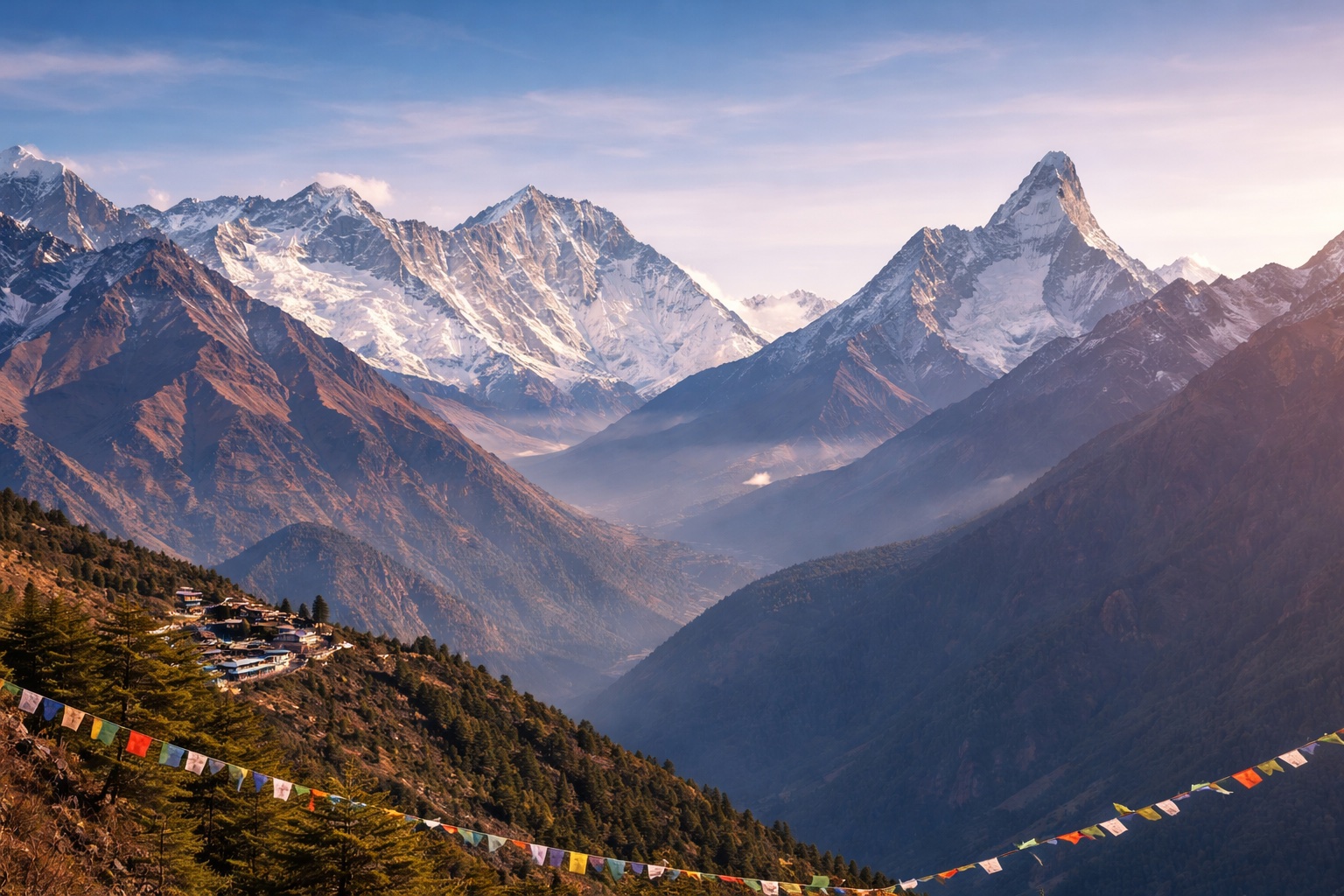
Fly from Pokhara over the Kali Gandaki gorge and the arid plateau of Mustang to Lo Manthang — the walled capital of the ancient Kingdom of Lo, closed to foreigners until 1992 and still one of the most complete surviving medieval cities in Asia. Two days in the last Forbidden Kingdom: ancient cave monasteries, the royal palace, the 15th-century Thubchen Gompa, and an overnight in a traditional Mustangi lodge.
Upper Mustang — the district north of Kagbeni in Nepal's far northwest — is one of the most extraordinary and least-changed landscapes in the Himalayan world. Geographically and culturally Tibetan rather than Nepali (the name "Mustang" derives from the Tibetan Mun Tang, meaning "fertile plain"), the district was an independent kingdom until 2008, when the last king (Raja Jigme Dorje Palbar Bista) formally relinquished his throne to Nepal's post-monarchist government. The Mustang plateau lies entirely north of the main Himalayan chain in the rain shadow — the monsoon's rain does not reach here — and the resulting landscape is a spectacular high-altitude desert of ochre, red, and grey rock formations that looks less like Nepal and more like the American Southwest transposed to 3,500–4,000 m altitude.
Lo Manthang (3,840 m) — the walled capital of the Kingdom of Lo — is the destination of the helicopter tour and one of the most extraordinary settlements in Asia. A compact medieval city of approximately 200 households enclosed within a perimeter wall of rammed earth and stone, Lo Manthang was built in the late 14th century and has changed so little in the intervening 600 years that walking its lanes — past whitewashed houses with carved wooden windows, past ancient chortens and prayer wheels, to the royal palace of the Lo Raja — creates a sensation of genuine historical displacement. Upper Mustang was closed to foreigners until 1992, and even now requires a restricted area permit that limits visitor numbers. The result is a destination that retains a genuine character of undiscovered remoteness — which the helicopter makes accessible without the 5-day jeep and walk approach required on the surface route.
The Thubchen Gompa in Lo Manthang is one of the most important repositories of Tibetan Buddhist art outside Tibet itself — and, given the destruction of comparable temples in Tibet during the Cultural Revolution, it is arguably the finest surviving example of 15th-century Tibetan Buddhist painting in existence. The Thubchen was built in 1447 by Ame Pal, the king who also constructed Lo Manthang's walls. Its interior murals — painted in the refined Tibetan artistic tradition of the Pala period — cover every surface of the temple's nave and ambulatory in extraordinary condition. The central Maitreya (Future Buddha) figure, flanked by the figures of 1,000 Buddhas rendered in individual panels across the side walls, is one of the most impressive Buddhist sculptural environments in Nepal.
The Jampa Lhakhang (Temple of Maitreya) adjacent to the Thubchen contains an enormous clay Maitreya figure that fills the temple's upper story — a work of Tibetan sculptural art from the same 15th-century period that has survived intact through centuries of earthquakes and political upheaval in a way that comparable monuments in Tibet did not. Access to both temples is managed by the Lo Manthang monastery trust — entry fees directly support ongoing conservation efforts.
The cliffs above and around Lo Manthang are riddled with sky caves — thousands of man-made cave dwellings and burial chambers carved into the vertical rockface at heights requiring rope access, now abandoned but originally inhabited as far back as the 3rd century BCE. The caves have been systematically studied since 2008 by an American archaeological team, which found human remains, manuscripts, and artefacts that pushed the date of Mustang's human habitation back nearly 2,000 years earlier than previously documented. From the helicopter, the sky caves are visible in the cliff faces above the town — their dark openings arranged in apparently random clusters across the orange rock that are, on closer examination, the remains of a sophisticated vertical city with internal corridors, storage rooms, and ceremonial chambers.
The Upper Mustang Helicopter Tour includes one overnight in Lo Manthang at a traditional Mustangi lodge — a flat-roofed stone building with carved wooden balconies, a central courtyard, and rooms furnished with Tibetan-style wooden beds and handwoven rugs. The Lo Manthang overnight allows the morning — the most important time for photography in the Mustang light — and the afternoon after the helicopter arrival, which together provide time for both the temple visits and a leisurely walk through the walled city. Breakfast is traditional Mustangi food: tsampa (roasted barley flour) with butter tea, local flat bread, and the potato dishes that are Mustang's agricultural staple at this altitude.
Upper Mustang is designated a restricted area by the Nepal government, requiring a special permit in addition to the standard TIMS card and ACAP permit. The restricted area permit costs USD 500 per person for 10 days. The permit was introduced in 1992 when Upper Mustang was first opened to foreigners — the cost is explicitly intended to limit visitor numbers and protect the cultural and ecological integrity of the Lo Manthang area. The permit is included in our tour price and is arranged by our agency before departure. Without a registered agency and the restricted area permit, foreigners cannot enter Upper Mustang by any means — including helicopter.
Upper Mustang is politically part of Nepal (Mustang District, Gandaki Province) but culturally and geographically Tibetan. The population speaks Tibetan, follows Tibetan Buddhism, practices the same agricultural and pastoral traditions as the Tibetan plateau, and the landscape north of Kagbeni is geologically part of the Tibetan plateau — arid, treeless, and receiving almost no monsoon precipitation. The district was an independent kingdom (the Kingdom of Lo) with its own monarchy until 2008, when the last king formally relinquished sovereignty. Nepal has governed the area since the early 19th century but the Tibetan cultural character is entirely intact and is the primary draw for visitors.
Yes — the standard surface route is a 5-day jeep drive from Jomsom (accessible by domestic flight from Pokhara) along the Kali Gandaki valley to Lo Manthang, or an 8–10 day trek on foot. The jeep route is rough and dusty — the Upper Mustang road is one of Nepal's most challenging and scenically rewarding drives, often requiring river crossings in the high monsoon. Our Upper Mustang Helicopter Tour is designed for visitors who want the Lo Manthang experience without the 5-day approach commitment — and for those for whom the helicopter flight itself (the aerial view of the Mustang plateau and the Kali Gandaki) is an integral part of the experience.
The Tiji Festival (Tempa Chirim) is the most important religious festival in Upper Mustang — a three-day masked-dance ceremony conducted annually by the monks of Lo Manthang's Chode Monastery to celebrate the victory of a divine protector over a demon threatening the kingdom. The festival is held in late April or early May according to the Tibetan lunar calendar and is one of the most visually extraordinary cultural events in Nepal — the costumes, the music, the monastery courtyard setting, and the backdrop of Lo Manthang's ochre walls produce images that are some of the most celebrated in travel photography. We strongly recommend timing a visit to coincide with Tiji if your schedule allows — enquire for the specific festival dates for the current year.
The Muktinath and Upper Mustang tours are complementary rather than competing. Muktinath (1-day, shorter, less expensive) focuses on the sacred pilgrimage temple and is the right choice for Hindu and Buddhist devotees and visitors who want a profound religious experience in a single day. Upper Mustang (2-day, overnight, more expensive) focuses on the medieval walled city of Lo Manthang, the Tibetan Buddhist art of the Thubchen and Jampa temples, and the extraordinary landscape of the restricted Mustang plateau. Both can be combined in a 3-day itinerary: fly to Muktinath on Day 1 (southward stop en route), continue to Lo Manthang (Day 1 overnight), explore Lo Manthang (Day 2), return via Muktinath (Day 2 afternoon). Enquire for the combined pricing.
Lo Manthang (3,840 m) is at a significant altitude — higher than the summit of the Matterhorn — and passengers arriving by helicopter from Pokhara (827 m) will feel the altitude change immediately upon landing. Mild symptoms (headache, shortness of breath, fatigue) are common for the first few hours and usually resolve with rest, hydration, and a slow pace. Our guide sets a relaxed tempo for all temple visits and walks. Serious altitude sickness (HACE or HAPE) is uncommon at 3,840 m for healthy adults who rest and hydrate appropriately, but anyone with a prior history of altitude illness above 3,000 m should consult their doctor before booking. We carry emergency oxygen and have evacuation protocols in place for the rare occasion it is needed.