
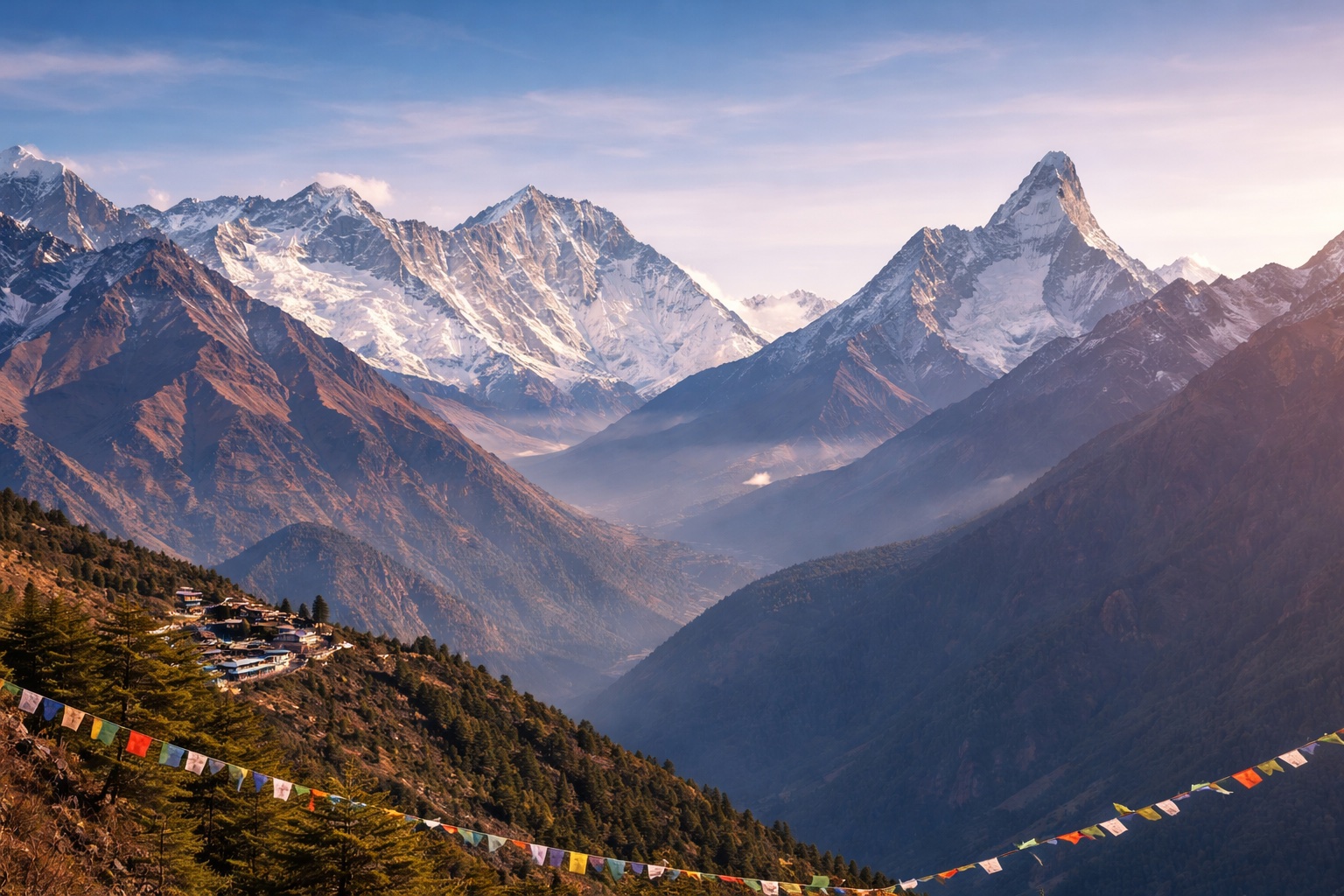
Watch the sunrise over the Himalayas from Nagarkot — the closest panoramic mountain viewpoint to Kathmandu, with views stretching from Dhaulagiri to Kanchenjunga across 200 km of Himalayan crest. Combine with the Chandragiri Hills cable car for a bird's-eye view of the Kathmandu Valley with Ganesh Himal and Langtang on the horizon.
Nagarkot, at 2,175 metres on the eastern rim of the Kathmandu Valley, is the most popular Himalayan sunrise viewpoint accessible from Nepal's capital — a ridge-top village that has drawn travellers since the 1970s for a single, reliable reason: on clear mornings, the panorama from Nagarkot's viewpoint tower stretches uninterrupted across the entire eastern Himalayan chain, from Dhaulagiri (8,167 m) in the west through Manaslu, Ganesh Himal, Langtang, Jugal Himal, Gauri Shankar, Cho Oyu, Everest, Lhotse, Makalu, and on clear winter days all the way to Kanchenjunga (8,586 m) — 200 kilometres of unbroken Himalayan skyline, 32 named peaks, and eight of the world's fourteen 8,000-metre mountains visible from a single viewpoint.
The experience of watching sunrise paint this horizon gold — starting with Everest's triangular summit pyramid catching the first light before any other peak, spreading westward over the ridge in a sequence that takes twenty minutes to complete — is one of the most reliable great-view moments available anywhere in Asia, requiring no trekking fitness, no special equipment, and no more than an overnight stay from Kathmandu.
The secret of Nagarkot's appeal is elevation combined with unobstructed eastern exposure. At 2,175 m, the ridge stands well above the valley haze that blurs Kathmandu's own mountain horizon. The eastern-facing viewpoint has no intervening ridges or forest between the viewer and the Himalayan chain — the mountains rise directly from the Indrawati valley floor 70 km to the north. On crisp autumn and winter mornings (October through February), the air clarity is exceptional and the views routinely extend to Kanchenjunga, 200 km to the east-southeast.
The village of Nagarkot itself is small and genuinely peaceful — a scatter of mountain resorts and viewpoint lodges spread along a 2 km ridge, with terraced fields below and a pine and rhododendron forest covering the upper slopes. The atmosphere in the evenings is unhurried: hot tea on a terrace, conversation with the resident mountain dogs, and the gradual appearance of the Kathmandu Valley lights far below as dusk falls. After a day of Kathmandu's controlled chaos, the contrast is restorative.
The Nagarkot sunrise requires getting up at 5:00–5:30 am and walking 10–15 minutes to the main viewpoint tower or your resort's roof terrace. Bring a warm jacket — at 2,175 m, the pre-dawn air is cold (5–10°C even in October), and the wait before first light can be 20–30 minutes. The moment the sun clears the ridge to the east and the Himalayan skyline ignites is worth the cold and the early start by a considerable margin. Most visitors who experience it once come back.
Our package includes overnight accommodation at a well-positioned Nagarkot resort — we select properties specifically for their sunrise viewing angle, choosing north or northeast-facing rooms that maximise the mountain panorama. A cup of hot milk tea delivered to your room at 5:00 am is standard at most Nagarkot resorts and is one of the small pleasures that make the sunrise experience particularly civilised.
Chandragiri Hills (2,551 m), on the southwestern rim of the Kathmandu Valley, offers a completely different mountain view and is one of Kathmandu's most underrated attractions. The Chandragiri Cable Car — opened in 2016 and Nepal's finest — rises 2.5 km from the valley floor to the hilltop in 15 minutes, with a gondola that passes over forested hillsides and emerges at a hilltop complex featuring a Balachumbre Temple, viewpoint tower, restaurant, and one of the finest unobstructed views of the Ganesh Himal, Langtang, and Jugal Himal ranges available from any Kathmandu Valley rim point.
The Chandragiri viewpoint faces northwest — complementing Nagarkot's eastern panorama perfectly. From Chandragiri, Ganesh Himal (7,422 m), Shisha Pangma (8,027 m), Langtang Lirung (7,234 m), Dorje Lakpa (6,966 m), and on the clearest winter days Manaslu (8,163 m) are all visible, with the Kathmandu Valley spread below in the opposite direction. The descent from the cable car station through the forested Chandragiri slopes is a pleasant 45-minute walk that can replace the return gondola ride for those who prefer to stay on foot.
The route between Kathmandu and Nagarkot passes through (or close to) Bhaktapur — the best-preserved medieval city in Nepal and a UNESCO World Heritage Site. Our itinerary includes a late-afternoon stop at Bhaktapur Durbar Square on the way to Nagarkot: the 55-Window Palace, the Golden Gate, the Nyatapola Pagoda, and the ancient pottery squares where Bhaktapur's signature black pottery has been made since the 15th century. Bhaktapur in the late afternoon, when the day-trip crowds have thinned and the stone squares fill with golden light, is one of Kathmandu Valley's most atmospheric experiences.
For travellers who want more than a sunrise-and-drive experience, Nagarkot is the starting point for two of the Kathmandu Valley's finest ridge walks. The Nagarkot to Dhulikhel trail (4–5 hours, moderate) follows the valley rim through terraced villages and rhododendron forest with near-continuous mountain views, ending in the historic town of Dhulikhel — another viewpoint with Himalayan panoramas. The Nagarkot to Changu Narayan trail (3–4 hours) descends to Nepal's oldest Hindu temple through farmland and forest — a walk that combines mountain views with archaeological heritage. Both trails are available as optional extensions to our 2-day itinerary.
October to February offers the clearest skies and sharpest mountain views from Nagarkot. October and November are post-monsoon — the air has been washed clean by months of rain and visibility is at its maximum: Kanchenjunga (200 km east) is visible on good mornings in late October and November. December to February is cold but extraordinarily clear — the full 32-peak panorama at its most crisp. March is good with warming temperatures. April and May have good visibility early in the season, deteriorating as the pre-monsoon haze builds. June to September (monsoon) is not recommended — heavy cloud typically obscures the mountains entirely. Even in the best seasons, cloud can cover the mountains on any given morning — this is weather-dependent. Most Nagarkot visitors stay two nights to maximise the chance of a clear sunrise.
Nagarkot is 32 km from Kathmandu city centre — approximately 1.5 to 2 hours by private vehicle via Bhaktapur (the route we use) or 1.5 hours via the direct Nagarkot highway. The road is fully paved and suitable for standard vehicles year-round. There is no domestic flight required. Our package includes all transfers by private vehicle with your guide.
Technically yes — you can drive to Nagarkot by 5:00 am for the sunrise (departing Kathmandu at 3:30 am) and return in time for breakfast. In practice, the overnight stay is strongly recommended: the pre-dawn drive on mountain roads is uncomfortable, you arrive without having slept, and there is no hotel breakfast after the sunrise. Staying overnight allows you to arrive relaxed, enjoy dinner and the sunset, wake up rested, and experience the sunrise without the stress of a 3:30 am car departure. The price difference between a day trip and an overnight stay is modest.
Warm jacket or down puffy — essential. At 2,175 m, pre-dawn temperatures at Nagarkot are 3–8°C in October–November and can drop to -5°C in January. Most visitors underestimate the cold and regret it. Gloves and a hat are worth carrying in December–February. Good walking shoes for the walk to the viewpoint (10–15 minutes on an unpaved path). Camera or phone with a good low-light capability — the pre-dawn mountain silhouette shots and the first-light gold on Everest are among the most photographed scenes in Nepal. Binoculars significantly enhance the experience — we can provide them on request.
Yes — the Chandragiri Cable Car is one of Nepal's most accessible tourist attractions and is fully suitable for families with children and elderly travellers. The gondolas are modern, enclosed, and stable. The hilltop complex has paved paths, a restaurant, and clean facilities. The only physical requirement is the ability to walk from the cable car station to the viewpoint tower — approximately 10 minutes on a gentle slope. The cable car operates daily from approximately 9:00 am to 5:00 pm. Our guide accompanies you throughout.
Yes — Nagarkot is the starting point for several popular valley-rim treks. The Nagarkot to Dhulikhel ridge walk (4–5 hours, moderate) is the most popular: it follows the valley rim with continuous mountain views through terraced farmland and rhododendron forest, ending in the Newari town of Dhulikhel where lunch is available before the drive back to Kathmandu. The Nagarkot to Changu Narayan trail (3–4 hours, easy-moderate) ends at Nepal's oldest Hindu temple. Both can be added to our 2-day itinerary as a morning extension on Day 2, with the Chandragiri cable car visited in the afternoon. Discuss your preferences when booking.