
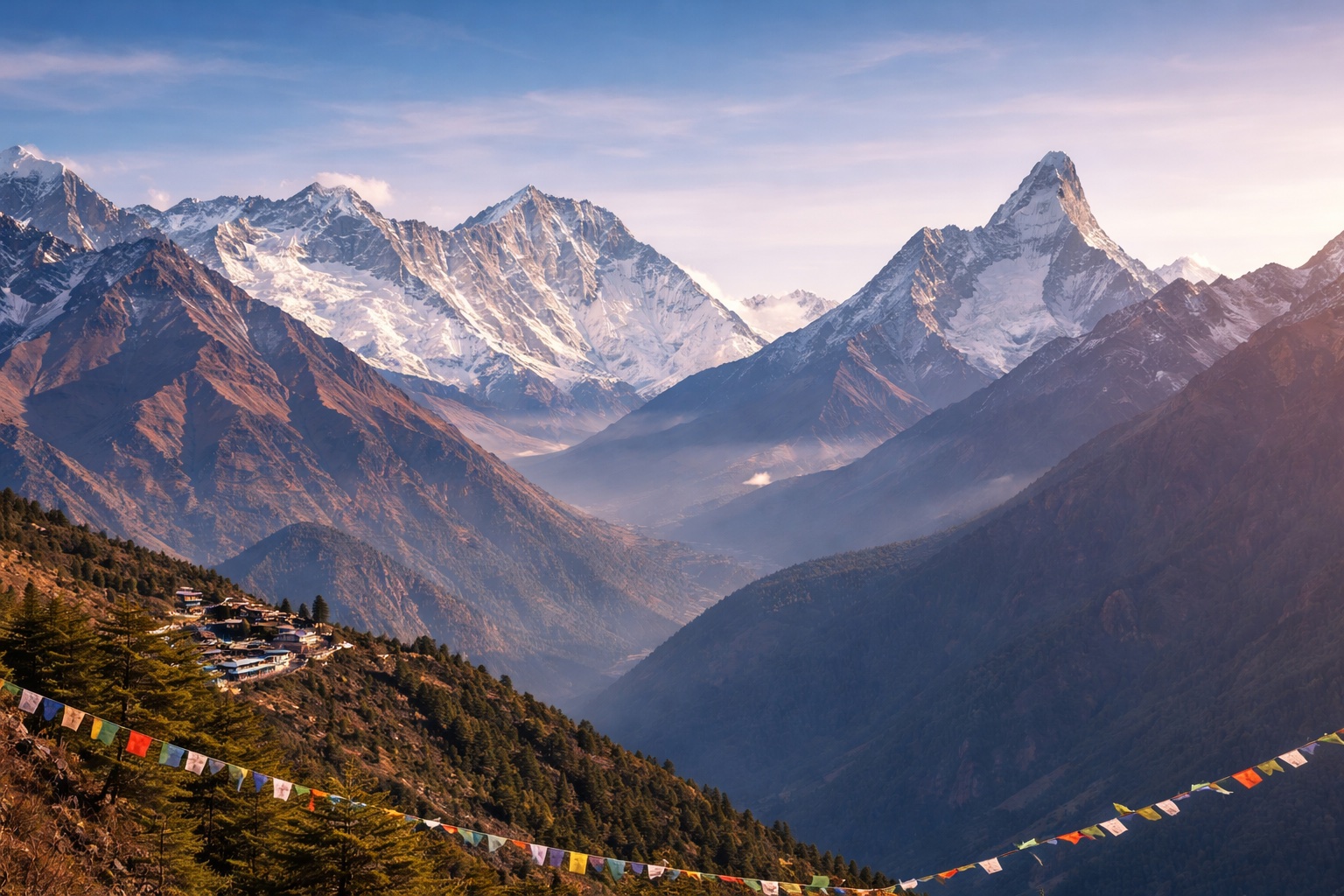
Trek into the Tsum Valley — Nepal's most remote and sacred Buddhist "hidden valley" (Beyul), accessible only since 2008. Ancient monasteries untouched by time, Tibetan-origin Tsumba people, snow leopard habitat, and the tranquillity of a place that has maintained complete cultural isolation for centuries.
The Tsum Valley is Nepal's most extraordinary trekking destination — a self-contained Buddhist cultural world in the northern Gorkha district that was closed to all foreign visitors until 2008 and remains, even today, one of the most challenging permits to obtain and one of the most rewarding destinations to reach. The valley was identified in ancient Buddhist texts as a beyul — a sacred "hidden valley" consecrated by Guru Rinpoche (Padmasambhava) as a place of spiritual refuge and preservation — and its remarkable cultural and religious integrity is the direct result of centuries of deliberate isolation maintained by both its natural barriers (deep gorges, high passes, difficult river crossings) and the conscious choices of its Tsumba people.
The Tsumba, the indigenous people of the Tsum Valley, are of Tibetan origin — their language is a distinct dialect of Tibetan, their religious practice follows the Milarepa lineage of the Kagyu school of Tibetan Buddhism, and their material culture — the architecture, the textile traditions, the agricultural practices, the ritual calendar — has remained largely unchanged since the valley's first settlement a millennium ago. The reason is simple: the Tsum Valley has had almost no economic relationship with the outside world until the 21st century. There were no roads, no schools, no government services, no commercial goods, and no tourists. What entered the valley was Buddhist teaching, pilgrims, and the occasional trader. What left it was nothing of significance. The result is a living Buddhist cultural landscape of extraordinary completeness — the most intact Tibetan cultural enclave in Nepal.
Rachen Gompa (3,800 m) is a nunnery — a monastery for Buddhist nuns — of approximately 70 resident nuns, practicing meditation and ritual in a complex of red-painted buildings perched on a cliff above the Sho valley. The nunnery was founded in the 17th century and maintains an unbroken tradition of female Buddhist practice that is rare even in Tibet. Mu Gompa (3,700 m), the senior monastery of the Tsum Valley, houses approximately 60 monks and is the religious authority for the entire valley. Both monasteries contain ancient thangka paintings, butter sculptures, and ritual objects that scholars of Himalayan art rate among the finest surviving examples of the Kagyu religious art tradition. Visitors are welcomed by the resident lamas who, accustomed to receiving only a few hundred foreign visitors per year, provide a quality of monastic hospitality and access that the overcrowded gompas of the Kathmandu Valley cannot match.
The physical landscape of the Tsum Valley is as extraordinary as its culture. The approach from the Buri Gandaki river involves days of walking through one of Nepal's deepest and most dramatic gorges — vertical walls rising hundreds of metres above the trail, waterfalls crashing directly onto the path, the river a continuous thunder below. The valley itself, once you pass the inner gorge, opens into a broad glacier-carved basin at 3,000–4,000 m, ringed by the Ganesh Himal (7,422 m), Sringi Himal (7,161 m), and the Tibetan border peaks. The sacred peak of Tsergo Ri dominates the upper valley — no Tsumba person has ever climbed it because the summit is the residence of the valley's protective deity. The optional extension to the Ngula Dhojhyang Pass (5,093 m) on the Tibetan border delivers a panorama of the Tibetan plateau that is available from very few points in Nepal.
The Tsum Valley and the Manaslu Conservation Area in which it lies are designated as priority snow leopard habitat by the Snow Leopard Trust and the Nepal Department of National Parks. Snow leopard sightings in the Tsum Valley are rare but documented — the combination of steep terrain, abundant blue sheep (bharal) prey, and low human disturbance creates conditions that support a significant population. Trekkers who spend time at dawn and dusk scanning the cliffs above the valley floor, particularly in the upper valley above Chhule, have the best chance of any Nepal trekker of seeing this most elusive of the great cats.
The Tsum Valley requires a Restricted Area Permit (USD 35 per person per week for the first 4 weeks, USD 70 per person per week thereafter) in addition to the Manaslu Conservation Area Permit and TIMS Card. Minimum two trekkers — solo trekking is not permitted. A licensed guide is legally required. All permits are included in our package price.
The Tsum Valley was designated a Restricted Area by the Nepal government — primarily to protect the cultural and ecological integrity of the valley from mass tourism impact. The restriction was partially lifted in 2008 with the introduction of the current permit system, which limits trekker numbers and requires a licensed guide. The closure was also partly motivated by the valley's proximity to the Tibetan border and the politically sensitive nature of the Gorkha district's northern zones.
Both Sherpa and Tsumba people are of Tibetan origin and practice Tibetan Buddhism. The difference is in the specific lineage, isolation, and preservation. Sherpas have been integrated into the global trekking economy since the 1950s and their culture has adapted significantly. The Tsumba people had no significant outside contact until 2008 and their culture remains markedly more archaic — the language, dress, agricultural practices, and religious calendar are all closer to medieval Tibetan practice than anything surviving in Tibet itself after the Cultural Revolution.
Three permits: (1) Restricted Area Permit — USD 35 per person per week; (2) Manaslu Conservation Area Permit — NPR 3,000; (3) TIMS Card. Minimum 2 trekkers, licensed guide mandatory. All permits are arranged and included in our package price.
Yes — the Tsum Valley Trek requires fitness and high-altitude experience but no technical climbing. The optional Ngula Dhojhyang Pass (5,093 m) requires good acclimatisation and physical reserves but no ropes or technical equipment. We recommend prior high-altitude trekking experience (above 4,000 m, ideally above 5,000 m) for the pass extension. The main valley circuit to the monasteries and back is achievable for anyone who has completed a route like Manaslu Circuit or Everest Base Camp.
March–May (spring) and October–November (autumn). Spring brings rhododendron blooms in the lower valley and clear mountain views. Autumn is the best season for visibility. Winter is very cold and the upper valley can be snowed in. Monsoon (June–September) is not recommended.