
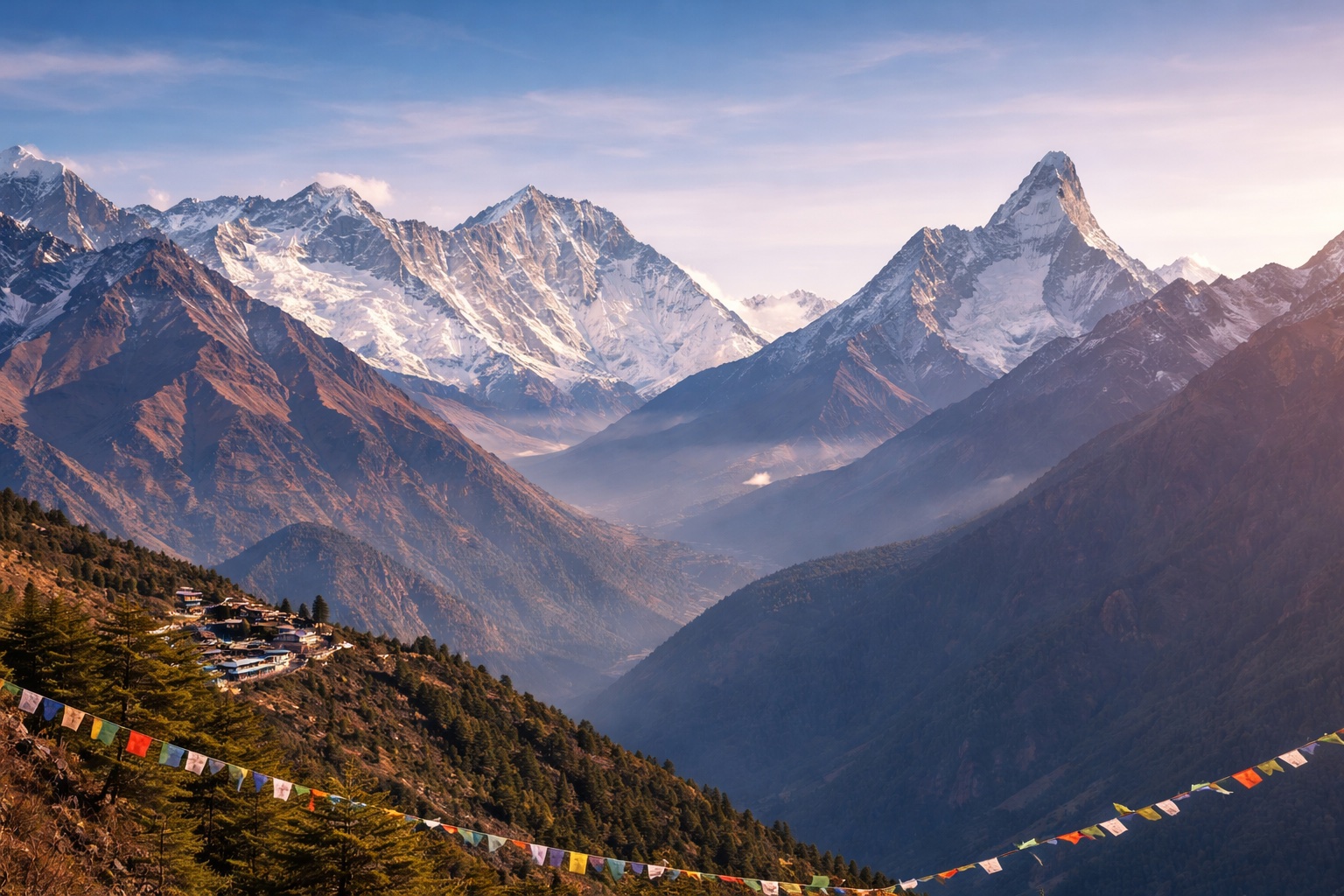
The Australian Camp and Dhampus day hike is Pokhara's most rewarding full-day Annapurna foothills walk — climbing from Phedi village (1,130 m) through rhododendron and oak forest to Australian Camp (2,060 m) with its famous open-air Annapurna close-up view, then descending through the ancient Gurung village of Dhampus (1,650 m). A first genuine taste of the Annapurna region without the commitment of a multi-day trek. Machapuchare fills the northern sky all day.
The Australian Camp and Dhampus day hike from Pokhara is the finest single-day introduction to the Annapurna hill country accessible from Nepal's second city — a 15 km circuit from Phedi village (1,130 m) to Australian Camp (2,060 m) and back through the ancient Gurung village of Dhampus (1,650 m), delivering the full character of the lower Annapurna foothills in the space of a long morning and a leisurely lunch. The hike is popular for one overriding reason: from the moment the forest opens above Phedi and throughout the entire day, Machapuchare (6,993 m) fills the northern sky like a natural clock tower above the valley — the mountain is closer here than from any other one-day hike in the Pokhara area, and the proximity of its twin-peaked summit gives the walk a feeling of genuine mountain engagement that purely valley-floor viewpoints cannot provide.
Australian Camp earned its name from Australian development volunteers who established a reforestation project in the area in the 1980s and used the site as their base — a characteristically un-romantic origin for one of Nepal's most romantically situated viewpoints. At 2,060 metres on the broad ridge above the Pardi Khola valley, the Australian Camp is a flat grassy shelf with an unobstructed 270-degree mountain panorama: Annapurna South (7,219 m) and Hiunchuli (6,441 m) directly north, Machapuchare filling the northeast with its impossible double summit, Annapurna I (8,091 m) visible over the shoulder of Annapurna South, and the long ridge of Annapurna II, III, and IV extending northeast. Below the camp, the Modi Khola valley descends toward the Annapurna Sanctuary — the same valley that trekkers follow on the 10-day Annapurna Base Camp trek — visible as a deep green groove in the mountains leading toward the glacial amphitheatre above. It is the closest you can get to the sanctuary entrance in a single day from Pokhara without committing to the multi-day ABC trek.
Dhampus is one of the finest surviving examples of a traditional Gurung village in the Pokhara region — the stone-and-slate houses, the elevated grain stores on timber stilts, the intricately carved wooden doorframes, and the community taps and washing areas arranged around the village lanes preserve a domestic architecture and social organisation that the rapid development of Pokhara Lakeside has largely erased at lower elevations. The Gurung people are one of Nepal's most celebrated hill communities — the primary source of Gurkha soldiers for the British and Indian armies since the early 19th century — and the village has maintained a strong community identity despite the close proximity to Pokhara. Elderly Gurkha veterans are frequently encountered on the village lanes, and the hospitality at the Dhampus lodges — where lunch is served at timber tables with the mountains visible through the open-sided dining area — is the genuine rural Nepali warmth that development researchers consistently cite as one of Nepal's most valuable cultural assets.
The hike from Phedi climbs through a continuous belt of rhododendron, oak, and magnolia forest — among the finest accessible forest walking in the Pokhara district — before breaking onto the open ridge at Australian Camp. The forest section (Phedi to Australian Camp, approximately 5 km, 900 m ascent) takes 2–2.5 hours at a comfortable pace and provides the full character of the middle-elevation Annapurna forest: dappled light, moss-covered stone walls, the occasional bright flash of a fire-tailed sunbird or the hammering of a Himalayan flameback woodpecker on a dead oak. The descent through Dhampus to Phedi or Pothana (3–4 km, 400 m descent, 1–1.5 hours) crosses open terraced farmland with mountain views throughout and passes through the Gurung village at a pace that allows the cultural stop — a tea or lunch at a village lodge — that most hikers on an organised day trip do not experience if they are rushed.
The Australian Camp and Dhampus are on the southern approach route to the Annapurna Base Camp trek — the first two stops on the classic ABC itinerary from Pokhara. The standard ABC trek (10–12 days) passes through Phedi, climbs to Australian Camp (or bypasses via Kande), continues through Ghandruk, Chhomrong, and up the Modi Khola gorge to the Annapurna Sanctuary. The Australian Camp day hike delivers the first section of this route — the forest climb to the ridge and the Dhampus village — as a standalone day experience for visitors who want the ABC atmosphere without the full multi-day commitment. For many visitors, the day hike serves as a preview that convinces them to return for the full trek.
Both are famous Annapurna viewpoints but at different elevations and with different access. Poon Hill (3,210 m) is higher and provides the famous panorama that includes Dhaulagiri alongside the Annapurna range — it requires 3–4 days of trekking from Pokhara as a minimum and is not accessible as a day trip from the city. Australian Camp (2,060 m) is lower and closer to Pokhara, accessible in a single day from the city. The view from Australian Camp focuses more directly on Machapuchare and the Annapurna South group — the close-up Machapuchare view from Australian Camp is actually more intimate than from Poon Hill, where the extra elevation and distance creates a slightly more panoramic but less close-up perspective. For a day trip from Pokhara, Australian Camp is the best option. For a longer, higher, and more comprehensive view, Poon Hill requires the 3-day minimum trek.
The rhododendron forest on the Phedi–Australian Camp ascent blooms from mid-February through April, with peak flowering typically in March. Nepal has the world's greatest diversity of rhododendron species (over 30 identified in the Annapurna Conservation Area alone) and the forest on this trail includes the crimson Rhododendron arboreum (Nepal's national flower), the pink R. barbatum, and the white R. campanulatum in the higher sections near Australian Camp. The trail during peak rhododendron season is one of the finest forest walks in Nepal — the canopy blazes with colour above the stone path, and the contrast between the deep red rhododendron and the white snow peaks above is one of the most photogenic landscape combinations available on a day hike in Nepal.
Yes — children from age 7–8 upward typically manage the Australian Camp trail comfortably. The ascent is sustained (900 m over 5 km) but follows a well-maintained stone trail without technical sections or exposed edges. Children who regularly walk in hilly terrain will find it straightforward; less active children may find the first section (the steepest) challenging and will need frequent breaks. We recommend departing early (by 7:00 am) to avoid hiking in the hottest part of the day, particularly in March–May. The Dhampus descent is easier and shorter than the ascent and is very manageable for children who are tired by the end of the day. The lunch stop at a Dhampus lodge — with the village dogs, the yaks, and the mountain backdrop through the dining area window — is typically a highlight for younger hikers.