
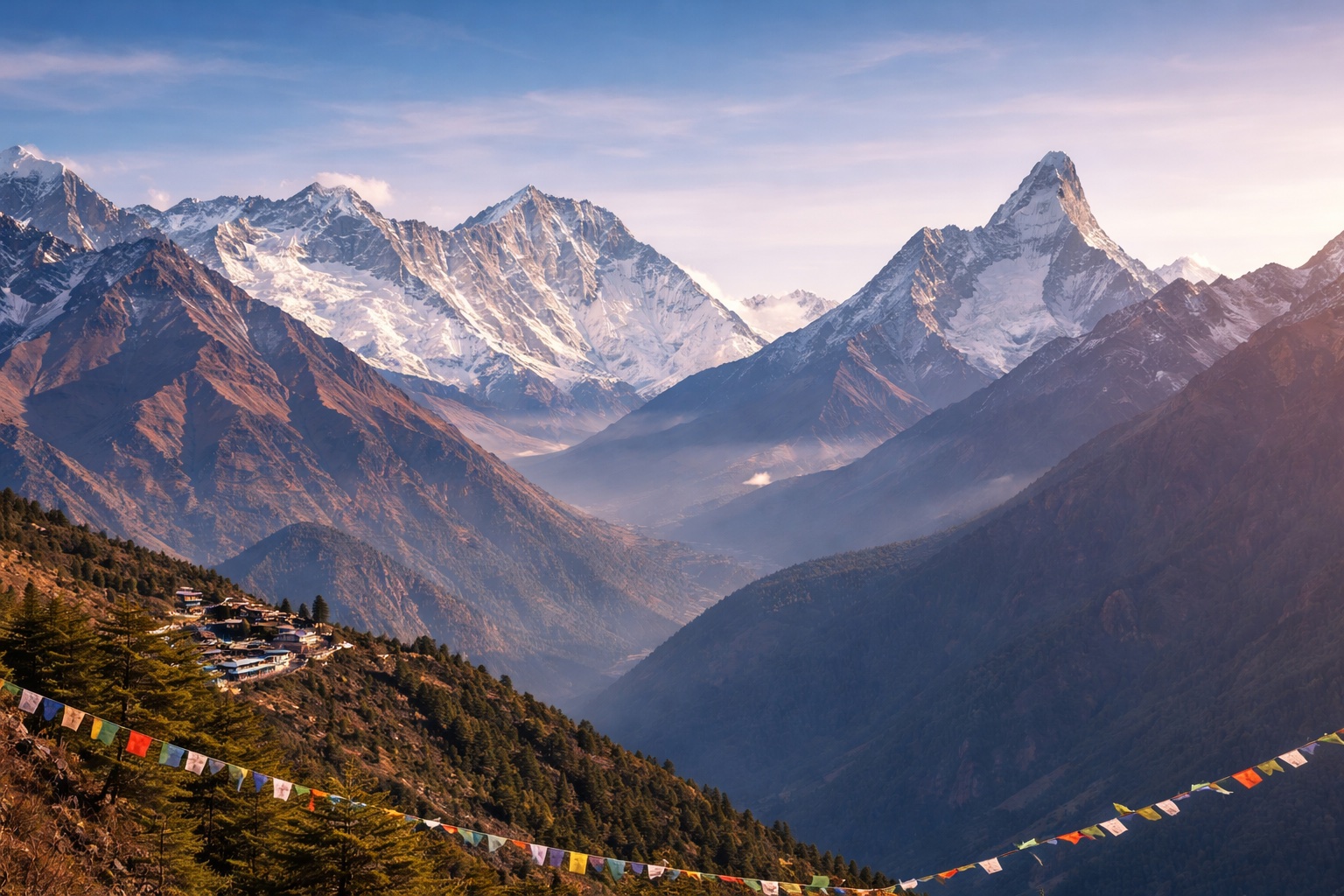
Nepal's most popular two-peak combination: Mera Peak (6,476 m) — the highest trekking peak in Nepal — followed by Island Peak (Imja Tse, 6,189 m) — the most technically demanding. A 22-day journey through the remote Hinku valley, over the Mera La, across the Amphu Labtsa Pass, and into the Khumbu — two Himalayan summits in one continuous alpine adventure with views of five 8,000-metre peaks from the top of Mera.
Nepal's most sought-after twin-peak climbing itinerary pairs Mera Peak (6,476 m) — the highest officially classified trekking peak in Nepal — with Island Peak (Imja Tse, 6,189 m) — the most technically challenging and most popular trekking peak in the Khumbu. The combination creates a 22-day adventure that traverses the remote Hinku valley, the high crossing of the Mera La (5,415 m), the wild Amphu Labtsa Pass (5,780 m), and the classic Khumbu terrain around Chhukung and Dingboche — delivering two genuine Himalayan summits, extraordinary mountain scenery, and the satisfying arc of a journey that begins in lowland forest and ends at the foot of Everest.
Mera Peak and Island Peak each have established reputations in their own right — Mera for its extraordinary summit panorama and Island Peak for its technical headwall section — but together they form an itinerary greater than the sum of its parts. The Amphu Labtsa crossing that connects the two peaks is one of Nepal's most serious high-altitude pass crossings: at 5,780 m, it requires crampons, ice axe, and fixed-rope management on a 50-degree snow and ice face — a genuine technical challenge between the two summits that elevates the combination from a straightforward twin-peak tick into an integrated alpine adventure.
Mera Peak is Nepal's highest classified trekking peak and, at 6,476 m, sits in the zone where acclimatisation begins to be a genuine physiological challenge rather than a management exercise. The standard ascent via the North Face from Mera La Base Camp is predominantly a long glacier walk with a final moderately angled snow slope — technically accessible for any climber with basic crampon competence and appropriate fitness. The summit is not technically extreme, but the altitude, the physical effort of the approach through the remote Hinku valley, and the need for genuine cold-weather camping preparation distinguish it clearly from lower trekking peaks.
The summit view from Mera is among the finest panoramas available from any Himalayan summit at this elevation. On clear mornings (most common in October–November), five 8,000-metre peaks are simultaneously visible: Everest (8,849 m), Lhotse (8,516 m), Makalu (8,485 m), Cho Oyu (8,188 m), and Kangchenjunga (8,586 m) — all within a 180-degree arc. The Hinku valley lies below to the south; the Khumbu peaks are arrayed to the north; and Mera's own glacier falls away beneath your feet. It is, without question, one of the greatest summit views available from a mountain of this elevation anywhere in the world.
The Amphu Labtsa is the high snow and ice pass that connects the Hinku valley (Mera side) with the Chhukung valley (Island Peak side). At 5,780 m, it is a genuine technical crossing — the Nepal-side approach from Mera is a moderate glacier walk to the base of the pass, but the descent into Chhukung involves a 50-degree snow and ice face of approximately 200 metres that requires crampons, ice axe, and confidence on steep terrain. Fixed ropes are typically placed by the Sherpa team, but the terrain demands respect. The pass takes 6–8 hours to cross and is the combination itinerary's most physically and technically demanding single day.
The view from the Amphu Labtsa is one of the most dramatic transition panoramas in the Himalaya: behind you, the wild Hinku drainage and Mera's glacier; before you, the Chhukung valley with Ama Dablam, Island Peak, and — rising above everything — the Lhotse south face and Everest's summit pyramid. The crossing marks the moment when the itinerary shifts from the remote Mera world to the Khumbu — from Nepal's wilderness to its most celebrated mountain landscape.
Island Peak — so named by Eric Shipton's 1952 Everest reconnaissance expedition because it appeared as an island of rock rising from the surrounding glaciers — is the Khumbu's most popular and most technically demanding trekking peak. The standard route ascends from Island Peak Base Camp (5,087 m) via the Southeast Ridge to a spectacular 6,189 m summit with Ama Dablam, Lhotse, and Makalu filling the horizon. The route involves a glacier approach, a steep snow gully on the headwall (50–55 degrees, fixed ropes), and a final exposed ridge to the summit. This headwall section requires genuine ice-climbing confidence — more technical than Mera's summit approach — and the combination of altitude and exposure makes it the fitting climax to a 22-day journey.
The combination makes both physical and logistical sense. Mera's approach through the Hinku valley naturally connects to Island Peak via the Amphu Labtsa Pass — a high-mountain crossing that is itself one of Nepal's great alpine experiences. Doing them in sequence means you acclimatise naturally for both peaks (Mera first provides ideal altitude preparation for Island Peak's headwall), you complete a genuine traverse rather than an out-and-back, and you experience two contrasting mountain environments: the remote Hinku wilderness and the classic Khumbu. Doing them as separate trips requires two Kathmandu flights, two permit applications, and twice the acclimatisation time.
The Amphu Labtsa is a serious high-mountain crossing, not a standard trekking pass. The 50-degree descent on the Chhukung side requires crampons, ice axe, and confidence on steep snow and ice — the same skills used on Island Peak's headwall. Our Sherpa team places fixed ropes on the steep descent section. The pass is safe with proper preparation, appropriate gear, and a competent guide. It is not appropriate for trekkers without prior crampon experience. Any participant who has not previously used crampons on steep terrain will have a skills session at Khare before the Mera summit and the Amphu Labtsa crossing.
The combination requires: TIMS card (NPR 2,000), Sagarmatha National Park entry permit (NPR 3,000), Mera Peak climbing permit (NPR 3,500 / approx. USD 26), and Island Peak climbing permit (NPR 3,500 / approx. USD 26). All permits are included in our package price and arranged before departure.
October–November is the optimal season for both peaks: post-monsoon clear skies, the five-8,000-metre-peak panorama from Mera at its sharpest, and stable conditions on the Amphu Labtsa and Island Peak headwall. The combination is also popular in the spring season (March–May) — rhododendron blooms on the Hinku approach and generally good conditions on both peaks, though the spring window can be shorter. The monsoon (June–September) is not suitable for either peak or the Amphu Labtsa crossing.
The Mera–Island Peak combination is appropriate for trekkers with solid high-altitude fitness who are comfortable with basic glacier travel, crampons on 35–50-degree snow, and the physical demands of consecutive high days above 5,500 m. Island Peak's headwall at 55 degrees is the single most technically demanding section — previous crampon experience on any slope above 40 degrees is important. We recommend that anyone who has not previously climbed Mera or Island Peak individually attends a basic mountaineering skills course before the combination trip. Our guide provides a comprehensive skills briefing and practice session before the first summit.