
Open Hours: Mon - Fri 6.00 am - 10.00 pm (Nepal Standard Time)
Annapurna Circuit Trek
14 Days Challenging 5,416 m - Thorong La Pass March-May, October-November
Country Annapurna, Manang, Mustang, Nepal
Difficulty Challenging
Max Elevation 5,416 m - Thorong La Pass
Duration 14
Best Time March-May, October-November
Meals Full board on trek
Accommodation Tea houses and lodges
Group Size 2-16
Circumnavigate the entire Annapurna massif crossing the legendary Thorong La Pass (5,416 m) - the world's most famous trekking pass - through subtropical forests, high-altitude desert, and the sacred Muktinath Temple.
Trip Highlights
  • Thorong La Pass (5,416 m) — highest pass on any trekking circuit
  • Sacred Muktinath Temple — pilgrimage site for Hindus and Buddhists
  • Manang village — acclimatisation with Annapurna III backdrop
  • Upper Pisang and Ngawal — spectacular Tibetan villages
  • Marpha — the apple capital of Nepal
  • Annapurna Conservation Area — Nepal's largest protected area
  • Supremely diverse landscape: jungle to desert in one trek

Annapurna Circuit Trek - The World's Greatest Trekking Loop

The Annapurna Circuit Trek encircles the entire Annapurna Himalayan range in one 14-day odyssey. From tropical lowlands and terraced rice paddies through alpine meadows and glacial valleys to the bone-dry rain-shadow of upper Mustang, this is the world's most diverse trek.

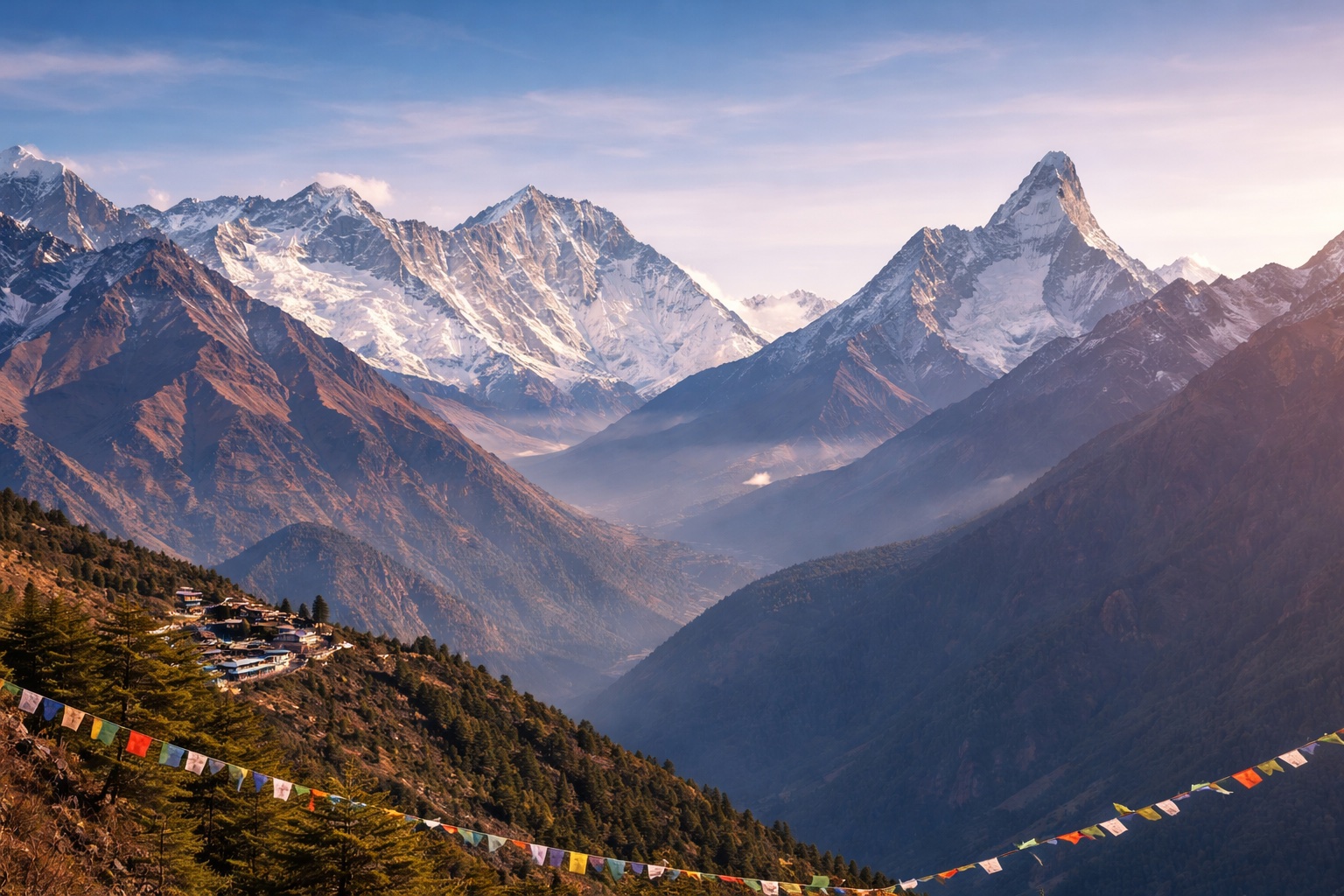
The crown jewel is crossing Thorong La Pass (5,416 m) - the highest pass on any major trekking circuit in the world. Views of Annapurna I (8,091 m), the Dhaulagiri range, and the vast Tibetan plateau are simply overwhelming. Descending to the sacred pilgrimage site of Muktinath - where Hindus and Buddhists worship side-by-side at an eternal flame fed by natural gas - adds deep spiritual resonance.

The Tibetan-influenced village of Manang (3,500 m) is a mid-circuit highlight. Apple brandy, yak cheese, and mountain cinema sessions at the Himalayan Rescue Association have become beloved trekker traditions here.

Day-by-Day Itinerary

Transfer from Kathmandu through the Prithvi Highway to Besisahar - gateway to the Annapurna Circuit. 7-hour drive through terraced hillsides and riverside towns. Trek briefing and permit check.
Besisahar Breakfast, Dinner Guest house, Besisahar
Trek begins through subtropical terraced farmland and riverside trails alongside the Marsyangdi River. Village life is warm - local children call "Namaste!" at every turn. The Marsyangdi, roaring with glacial meltwater, accompanies you throughout the circuit.
Bahundanda 5-6 hours Breakfast, Lunch, Dinner Tea house, Bahundanda
Descend to the Marsyangdi and climb through bamboo and oak forests. Cross multiple suspension bridges. The valley narrows dramatically with vertical cliffs rising hundreds of metres on both sides.
Chamje 5-6 hours Breakfast, Lunch, Dinner Tea house, Chamje
Enter the deepening gorge - waterfalls thunder directly onto the trail. Landscape transitions from subtropical to temperate. Dharapani is the official entry point into Manang District where the cultural shift toward Tibetan Buddhism begins.
Dharapani 5 hours Breakfast, Lunch, Dinner Tea house, Dharapani
The valley opens as culture unmistakably shifts Tibetan. Chortens, mani walls, and prayer flags mark every trail junction. First views of Annapurna II (7,937 m) appear through pine-scented forest. Chame is the Manang District headquarters with a proper market and medical post.
Chame 5-6 hours 2,710 m Breakfast, Lunch, Dinner Tea house, Chame
Spectacular day dominated by the great curved rock face of Paungda Danda. Enter the wide Manang valley. Upper Pisang perches photogenically on a cliff above the river with Annapurna IV perfectly framed - one of the most photographed villages in Nepal.
Upper Pisang 5 hours 3,300 m Breakfast, Lunch, Dinner Tea house, Upper Pisang
High route via Ghyaru and Ngawal - two spectacularly situated Tibetan villages with Annapurna II and Gangapurna perfectly framed. This route adds altitude for acclimatisation and the panoramas are incomparable. Arrive at Manang - the circuit's cultural and logistical hub.
Manang 5-6 hours 3,500 m Breakfast, Lunch, Dinner Tea house, Manang
Essential rest day. Morning hike to Ice Lake (4,600 m) for panoramic views of Annapurna III, Gangapurna Glacier, and Tilicho Peak. Visit Manang monastery. Afternoon: Himalayan Rescue Association altitude illness lecture - strongly recommended for all trekkers. Apple brandy in the evening - a Manang tradition.
Manang Breakfast, Lunch, Dinner Tea house, Manang Ice Lake hike (4,600 m), HRA altitude lecture
Short acclimatisation day. Trail climbs through sparse alpine meadows grazed by yaks and blue sheep. First clear views of Thorong La ahead. Yak Kharka sits in a wide open valley with views of Chulu East and West peaks.
Yak Kharka 3-4 hours 4,018 m Breakfast, Lunch, Dinner Tea house, Yak Kharka
Climb through Thorong Phedi (4,450 m) and push up to High Camp (4,850 m). The altitude is significant and the air noticeably thin. Sleep at High Camp to reduce the crossing time tomorrow and improve success chances at the pass.
High Camp 4-5 hours 4,850 m Breakfast, Lunch, Dinner Tea house, High Camp
The defining day. A 3 am start by headlamp climbs steep switchbacks in bitter cold to Thorong La at 5,416 m. Wind, cold, and altitude demand determination. Prayer flags snap in the icy wind. The descent of 1,600 m to sacred Muktinath Temple - where an eternal flame fed by natural gas burns beside water springs - creates a profoundly moving finish to the crossing.
Thorong La / Muktinath 7-8 hours 5,416 m Breakfast, Lunch, Dinner Tea house, Muktinath
Descend through the arid Kali Gandaki valley - the world's deepest gorge, flanked by Dhaulagiri (8,167 m) and Annapurna (8,091 m). Marpha is a perfectly preserved Thakali village with flat-roofed whitewashed houses, apple orchards, and the finest apple brandy in Nepal.
Marpha 5-6 hours Breakfast, Lunch, Dinner Tea house, Marpha
Continue to Jomsom and take a Jeep or flight to Pokhara. Celebrate the completion of the Annapurna Circuit with dinner at Phewa Lake.
Pokhara Breakfast, Dinner Hotel, Pokhara
Flight or bus from Pokhara to Kathmandu. Onward international departure. Congratulations on completing the world's greatest trekking loop.
Kathmandu Breakfast

What’s Included

Included

  • Airport transfers (Kathmandu)
  • Domestic flights as per itinerary
  • TIMS card and national park/area permits
  • Experienced English-speaking licensed trekking guide
  • Porter service (1 porter per 2 trekkers)
  • Full-board accommodation on trek (tea house)
  • Duffel bag and sleeping bag (returnable)
  • First-aid kit and emergency oxygen
  • All government taxes and service charges

Excluded

  • International flights
  • Nepal visa fees
  • Travel and medical insurance (mandatory)
  • Meals in Kathmandu unless specified
  • Personal trekking gear and equipment
  • Gratuities for guide and porter
  • Extra nights due to flight delays or weather
  • Personal expenses and bar bills

Useful Info

Best Time for the Annapurna Circuit Trek

The circuit passes through radically different climate zones — subtropical jungle in the lower Marsyangdi valley to the arid rain-shadow of upper Mustang. Season choice significantly affects the Thorong La crossing.

Spring

  • March – May
  • Rhododendron blooms on lower trail, stable weather for Thorong La, warm days.
  • Best Season

Summer / Monsoon

  • June – September
  • Heavy rain and frequent landslides on the lower gorge. Thorong La snow-risk. Avoid main trail.
  • Avoid

Autumn

  • October – November
  • Crystal-clear post-monsoon skies, sharpest mountain views, ideal Thorong La conditions.
  • Best Season

Winter

  • December – February
  • Thorong La may be closed by snow. Upper valley (Mustang section) is possible but very cold.
  • Possible

Crossing Thorong La Pass (5,416 m)

Thorong La is the highest trekking pass on any major circuit in the world. The crossing requires a 3 am start from High Camp (4,850 m) and 7–8 hours of sustained uphill on thin air. Key rules:

  • Never attempt the crossing if you have AMS symptoms — turn back and descend.
  • Carry a headlamp, warm layers, wind-proof jacket, and emergency snacks.
  • Cross in the morning — afternoon wind and cloud can be severe.
  • Do not rush the acclimatisation day in Manang (Day 8) — it is non-negotiable.

Signs of Altitude Sickness to Watch For

  • Persistent headache not relieved by paracetamol
  • Nausea, vomiting, or loss of appetite
  • Fatigue disproportionate to effort
  • Dizziness or loss of coordination
  • Dry cough that worsens at rest
  • Confusion or difficulty concentrating (serious — descend immediately)

Permits Required

  • Annapurna Conservation Area Permit (ACAP) – NPR 3,000 per person.
  • TIMS Card – NPR 2,000 (group) or NPR 4,000 (independent).

Accommodation on the Annapurna Circuit

Tea houses on the circuit are well developed, especially in Chame, Manang, and Muktinath. The Thakali people of the Manang region are legendary hosts — their dal bhat, apple pie, and apple brandy are circuit highlights. Expect comfortable private rooms in larger villages and more basic facilities in smaller stops. Full-board is included in our package.

Annapurna Circuit Trek Packing List – What to Bring

Keep your pack light (8–10 kg max in your day bag; porters carry heavier duffel bags). Layers are the key strategy for managing wide temperature swings.

Clothing & Insulation

  • Moisture-wicking base layers (top & bottom)
  • Mid-layer fleece jacket
  • Down jacket (600+ fill, critical above 4,000 m)
  • Waterproof hardshell jacket and pants
  • Trekking trousers (2 pairs)
  • Warm hat and sun hat
  • Gloves (liner + waterproof outer)
  • Merino wool or thermal socks (4–6 pairs)
  • Gaiters (light, for snow/mud)

Footwear

  • Waterproof trekking boots (ankle support, broken in before trek)
  • Camp sandals / lightweight shoes
  • Trekking poles (collapsible, highly recommended)

Health & Safety

  • Diamox (acetazolamide) – consult doctor before taking
  • Paracetamol, ibuprofen, rehydration salts
  • Blister kit, bandages, antiseptic
  • Water purification tablets / filter
  • High-SPF sunscreen (SPF 50+) and lip balm
  • UV-protection sunglasses (essential above 4,000 m)
  • Pulse oximeter (monitors blood oxygen saturation)

Essentials

  • Sleeping bag (−10°C comfort rating)
  • Headlamp + spare batteries
  • Daypack (25–30 L with rain cover)
  • Duffel bag (provided by agency, 80–100 L)
  • Power bank (charging scarce at higher altitudes)
  • Offline map (Maps.me, Gaia GPS)
  • Cash in NPR (very few card machines on trail)

Circuit-Specific Items

  • Wind-proof shell (Thorong La winds can be extreme)
  • Balaclava or neck gaiter (for 3 am Thorong La start)
  • Hand and foot warmers (optional but useful at pass)
  • Electrolyte sachets (for the long Thorong La crossing day)
  • Small lock for tea house room (standard precaution)

Frequently Asked Questions

The Annapurna Circuit is rated Challenging. The main challenge is the crossing of Thorong La Pass (5,416 m), which requires an early start (3 am), 7–8 hours of sustained uphill walking in thin air, and potentially severe cold and wind. The remainder of the circuit is moderate to strenuous, with daily walks of 5–8 hours through varied terrain.
The highest point is Thorong La Pass at 5,416 m (17,769 ft). This is the world's highest trekking pass on a major circuit route and the most challenging section of the trek. High Camp (4,850 m) the night before the crossing helps reduce the ascent on pass day.
Our standard itinerary is 14 days. This includes an essential acclimatisation day in Manang (Day 8) and careful altitude gain throughout. Some trekkers do it in 10–12 days by skipping some villages or taking jeeps on the lower sections, but we strongly recommend the full itinerary for safety and cultural immersion.
Two permits are required: (1) Annapurna Conservation Area Permit (ACAP) — NPR 3,000 and (2) TIMS Card — NPR 2,000. Both are included in our package and arranged by us before you start trekking from Besisahar.
The prime seasons are Spring (March–May) and Autumn (October–November). Autumn offers the clearest mountain panoramas and most stable weather for Thorong La. Spring brings rhododendron blooms on the lower reaches. The Annapurna Circuit is NOT recommended during monsoon (June–September) as landslides frequently block the trail and visibility is poor.
Muktinath (3,800 m) is one of Nepal's most sacred pilgrimage sites, revered by both Hindus and Buddhists. A natural flame fed by underground natural gas burns beside a stream of water at the Muktinath Temple — symbolising the five elements. For Hindus it is a Vishnu shrine; for Buddhists it represents liberation (mukti). Visiting after crossing Thorong La gives the descent a deeply spiritual dimension.
We strongly advise against it. The monsoon (June–mid September) brings heavy rainfall, frequent landslides on the lower section, flooded rivers, and trail closures. Thorong La can be dangerous due to snow. However, the rain-shadow area from Manang northward (including Muktinath, Jomsom, and Marpha) receives very little rain even during monsoon — some trekkers do the upper section only.
Manang (3,500 m) is the largest village on the circuit and the last significant settlement before the high passes. The acclimatisation day here is medically essential — you have gained 2,700 m in just 7 days, and your body needs time to produce more red blood cells. The optional Ice Lake hike (4,600 m) follows the "climb high, sleep low" principle. The Himalayan Rescue Association (HRA) runs a free altitude illness lecture in Manang every afternoon.
The Kali Gandaki is the world's deepest gorge — deeper than the Grand Canyon when measured between the summits of Dhaulagiri (8,167 m) and Annapurna I (8,091 m) which flank it. You walk through the gorge on the lower section of the circuit near Jomsom and Marpha. The afternoon wind in the gorge (often 60+ km/h) is legendary — always plan to pass Jomsom in the morning.
Yes — absolutely. While jeep roads have replaced some of the classic trail on the lower sections and around Manang-Jomsom, the core trekking experience remains superb. We use the high alternative trails (via Upper Pisang, Ghyaru, Ngawal) that avoid roads entirely. Thorong La and the upper circuit are as wild and rewarding as ever. The fewer trekkers compared to the 1990s actually makes it more peaceful.
Tea houses on the Annapurna Circuit are generally excellent value and well-established. In larger villages (Chame, Manang, Muktinath, Marpha) you'll find comfortable private rooms, hot showers, good food menus, and Wi-Fi. In smaller villages the facilities are more basic. Our package includes full-board (breakfast, lunch, dinner) in all tea houses.
Temperatures vary dramatically. At lower elevations (Besisahar, Bhulbhule) daytime is warm at 20–25°C. At Manang (3,500 m) nights drop to 0°C or below even in October. On Thorong La Pass in the pre-dawn hours, temperatures can reach -10°C to -20°C with wind chill. A down jacket, thermal layers, and warm gloves are essential regardless of season.
Marpha (2,670 m) is a perfectly preserved Thakali village in the Kali Gandaki valley, famous for its extensive apple orchards. The Thakali people produce outstanding apple products — fresh apples, dried apples, apple juice, and most famously apple brandy (locally called tongba-style apple raksi). Every second house in Marpha seems to distill it. It's one of the most charming villages on the circuit.
Yes. Jeep roads exist from Besisahar to Chame and from Jomsom onwards to Pokhara. Many trekkers take a jeep from Jomsom to Beni or Pokhara on the final day to save time. We recommend walking the entire upper section (Chame to Jomsom via Thorong La) for the full experience, but the lower jeep sections are a reasonable time-saving option.
Top viewpoints: (1) Upper Pisang ridge looking back at Annapurna IV and Pisang Peak. (2) Ghyaru and Ngawal with Annapurna II filling the valley. (3) Thorong La Pass — the complete Annapurna, Dhaulagiri, and Tibetan plateau panorama. (4) Ice Lake (4,600 m) above Manang. (5) Poon Hill (3,210 m) for the post-circuit Annapurna-Dhaulagiri sunrise.
No. If weather, altitude sickness, or exhaustion prevents you from crossing, you can descend from High Camp back to Manang and exit via Besisahar. The pass attempt should always be abandoned if you have AMS symptoms, severe weather, or deep snow. Our guides make this judgment call conservatively and your safety always comes first.
The Circuit (14 days) is a full circumnavigation of the Annapurna massif — diverse landscapes from jungle to desert, maximum elevation 5,416 m, cultural highlights at Manang and Muktinath. The Base Camp trek (11 days) goes into the Annapurna Sanctuary — a glacial amphitheatre at 4,130 m surrounded by 10 peaks over 7,000 m. ABC is shorter, lower, more accessible, and focused on mountain scenery. The Circuit is the greater cultural and geographical adventure.
ATMs exist in Besisahar, Chame, and Manang. Beyond Manang there are no ATMs until Jomsom. Carry sufficient Nepali rupees from Pokhara or Kathmandu. Most tea houses accept only cash. Credit cards are accepted at a few lodges in Manang and Jomsom but with 3–5% surcharge.
We run groups of 2–16 trekkers. Smaller groups (2–6) move faster, find accommodation more easily, and have a more personalised experience. Larger groups (8–16) work well with advance bookings. We maintain a maximum guide-to-trekker ratio of 1:8 for safety.
Surprisingly good. The Thakali people of the Manang-Mustang region are renowned as some of the finest cooks in Nepal. Thakali dal bhat — served with unlimited refills — is the legendary energy food of the circuit. Manang has excellent bakeries (apple pie, cinnamon rolls, espresso). Marpha apple products are unmissable. Beer and apple brandy are widely available above Thorong La.
Yes — this is one of the most popular combinations. After completing the circuit and arriving in Pokhara, you can arrange a 5-day Poon Hill trek to cap your Nepal experience with the famous Annapurna sunrise. Alternatively, start with Poon Hill before the circuit to ease into altitude. We can arrange the combined itinerary seamlessly.

Reviews

From USD 1200 1400 per person
Book Now
  • Secure Booking
  • No Hidden Costs
  • Instant Confirmation