
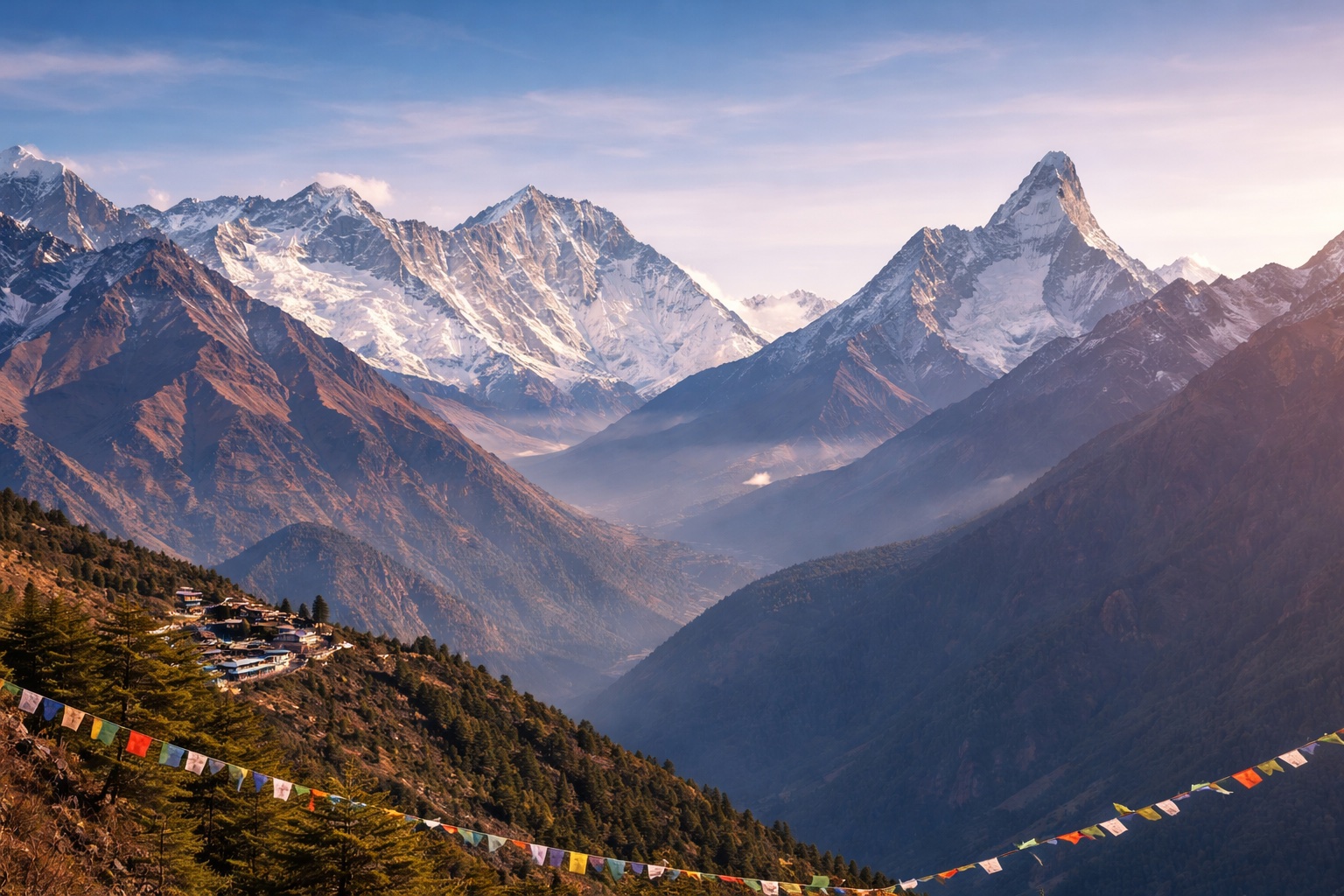
The Annapurna region's most rewarding off-track route — a circuit that combines the famous Ghorepani rhododendron forests with the dramatic Khopra Ridge (3,660 m), the sacred Khayer Lake (4,870 m), and close-up views of Dhaulagiri and Annapurna South that rival anything on the main circuit.
The Khopra Ridge & Khayer Lake Trek is the single most frequently requested "hidden gem" among experienced Annapurna region trekkers — a route that branches off the busy Ghorepani–Poon Hill trail and climbs into a completely different landscape: the high ridges and alpine lakes above the Kali Gandaki gorge that give the closest views of Dhaulagiri (8,167 m) and Annapurna South (7,219 m) available from any trekking route in the Annapurna Conservation Area.
The route was developed by community lodges from the Magar villages of Dobato, Khopra, and Swanta in the early 2010s, deliberately designed as an alternative to the crowded Ghorepani–Annapurna Base Camp corridor. The lodges on the Khopra extension are community-owned and operated — every rupee spent on accommodation directly funds the villages that built the trail. The result is a trekking experience that feels genuinely off the beaten track — you will meet perhaps 15–20 trekkers per day on the upper Khopra Ridge sections, compared to 200–300 on the Poon Hill and ABC approaches — while maintaining the comfortable tea-house infrastructure and licensed guide quality that Nepal's best routes provide.
Khopra Ridge (3,660 m) sits directly below the north face of Annapurna South (7,219 m) and faces directly toward Dhaulagiri (8,167 m) across the Kali Gandaki gorge — the world's deepest river gorge, dropping over 6,000 vertical metres from the summit of Dhaulagiri to the river below. The view from Khopra Ridge is, in the assessment of many experienced Himalayan trekkers, the finest valley-and-peak combination in Nepal: Dhaulagiri's enormous west face filling the western horizon, Annapurna South and Hiunchuli rising directly overhead, and the Nilgiri (7,061 m) north wall visible to the north above the Kali Gandaki gorge. This view is more dramatic than the Poon Hill panorama precisely because you are closer to the mountains — the distance from Khopra Ridge to Dhaulagiri's summit is under 20 kilometres.
Khayer Lake (4,870 m), a 5-hour round trip from the Khopra camp, is a glacially formed alpine lake at the foot of Annapurna South's glacier. Sacred to the Magar people as the home of the mountain deity and visited by Hindu pilgrims from the Kali Gandaki valley during festival seasons, the lake sits in a cirque of ice and rock that makes it feel genuinely remote even though the approach from Khopra is well-maintained. Above 4,500 m the trail enters permanent snow in winter and early spring — crampons are useful for the lake approach in March. The lake reflection of Annapurna South on a still morning is one of the Annapurna region's finest photographs.
Our itinerary begins at Nayapul (the standard Annapurna trekking trailhead) and follows the classic Ghorepani route as far as Poon Hill before branching south along the ridge to Dobato and Khopra — avoiding the ABC-bound crowds entirely. The return from Khopra descends to the Modi Khola valley through Swanta and the beautiful Magar villages above Ghandruk, completing a circuit that visits every significant landscape type in the Annapurna Conservation Area: subtropical gorge, high-altitude rhododendron forest, alpine ridge, glacial lake, and the traditional Gurung–Magar cultural villages of the lower Annapurna.
The Magar people of the Khopra Ridge area are one of Nepal's oldest and most historically significant indigenous groups — the communities from which the British and Indian armies have recruited Gurkha soldiers for over 200 years. The villages of Swanta, Naurikot, and Kimrong on the descent route from Khopra retain a traditional architecture and cultural vitality that the more-visited Gurung villages of the standard Annapurna circuit have partially lost to tourism modernisation. The Magar women's traditional dress, the stone-paved village lanes, and the community-managed forest above the villages collectively constitute a cultural landscape that the Annapurna Conservation Area's community forestry programme has actively protected.
The Khopra Ridge Trek lies entirely within the Annapurna Conservation Area (ACAP). Required permits: ACAP Entry Permit (USD 30 per person) and TIMS Card (USD 20 per person). Both are included in our package price. The Khopra community lodge fee (NPR 1,500–2,000 per night) is included in the accommodation charge.
The Poon Hill Trek reaches Ghorepani (2,860 m) and Poon Hill (3,210 m) before returning via Ghandruk. The Khopra extension continues south along the ridge from Ghorepani to Khopra Ridge (3,660 m) and Khayer Lake (4,870 m) — significantly higher, more remote, and with closer views of Dhaulagiri. Our 10-day Khopra itinerary includes the Poon Hill sunrise as well, so you get both experiences. Khopra sees a fraction of the Poon Hill crowd — the higher sections feel genuinely off-track.
The main trail to Khopra Ridge is suitable for fit beginners. The Khayer Lake day trip (reaching 4,870 m) is more demanding and requires altitude awareness — AMS precautions apply above 4,000 m. If you have not previously trekked at altitude, the Khopra community lodge provides a safe overnight at 3,660 m before the lake excursion. Our guides make the assessment of individual readiness for the lake trip on site.
The Dobato, Khopra, and upper ridge community lodges are purpose-built wooden structures managed by local cooperatives. Rooms are simple but clean — twin beds, foam mattresses, blanket and pillow. The kitchen serves dal bhat, pasta, noodles, and the local apple cider and rakshi that the Magar villages produce. The lodge income goes directly to the village cooperative fund. These are among the most sustainably run accommodation options in Nepal trekking.
Annapurna Conservation Area Permit (ACAP) — USD 30 per person, and TIMS Card — USD 20 per person. Both are included in our package price. No restricted area permit is required.
Yes — this is exactly our 10-day itinerary design. The Poon Hill sunrise is on Day 3, then the route branches to Khopra rather than retracing to Ghandruk. If you have already done the Poon Hill Trek, Khopra Ridge can be done as a standalone 6-day trip from Pokhara without the Ghorepani section.