
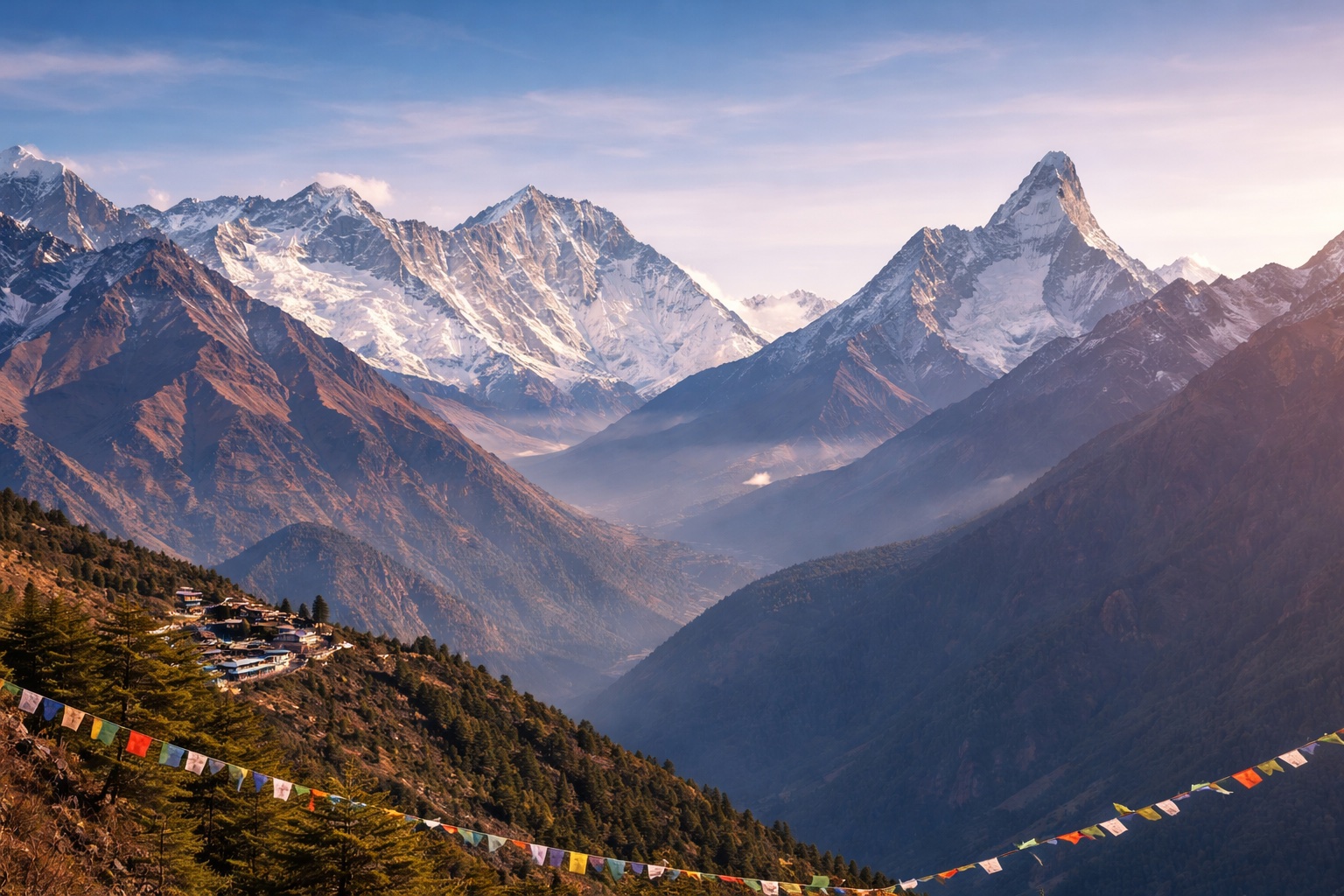
Muktinath Temple (3,800 m) — one of the most sacred pilgrimage sites in both Hinduism and Buddhism — in a single day by private helicopter from Pokhara. Fly over the dramatic Kali Gandaki gorge and the arid high-plateau landscape of Mustang, land at the world's highest Vishnu temple, complete the sacred circumambulation, and return via the ancient Thakali town of Jomsom. Nepal's most spiritually significant helicopter tour.
Muktinath (3,800 m) is one of the holiest sites in both Hinduism and Tibetan Buddhism — a combination that is uniquely Nepali and uniquely sacred. For Hindus, Muktinath is the 106th Divya Desam — the holiest Vishnu temples as enumerated in the Tamil Vaishnava scripture — and one of only eight Swayam Vyakta Kshetras (self-manifested shrines of Vishnu) in the world. For Tibetan Buddhists, Muktinath is a Chos 'Khor — a sacred dharma-circle site — associated with Guru Rinpoche (Padmasambhava) and mentioned in the Tibetan Buddhist canonical texts as a place of liberation. The convergence of these two major religious traditions at a single site at 3,800 m in the high Mustang valley is a phenomenon found nowhere else on Earth.
The Muktinath helicopter tour from Pokhara makes this sacred site accessible to pilgrims and travellers who cannot undertake the 8–10 day Annapurna Circuit walk required to reach it on foot — including elderly pilgrims (a significant portion of Muktinath visitors are Hindu devotees over 60), travellers with mobility limitations, and those with limited time. The tour completes the pilgrimage — temple circumambulation, 108 sacred water spouts, and the eternal flame — and returns the same day, providing a complete religious and cultural experience that can genuinely be called life-changing for Hindu pilgrims for whom Muktinath is a lifelong aspiration.
The Muktinath temple complex sits in a high-altitude grove of poplar trees above the treeless Mustang plateau — a startling patch of green at 3,800 m that is itself evidence of the site's sacred status, maintained by continuous human devotion in an environment where natural tree growth at this altitude is extraordinary. The complex comprises several elements of deep religious significance:
The Vishnu Temple is the central shrine — a pagoda-style structure housing a golden image of Vishnu that is attended by Buddhist nuns rather than Hindu priests, reflecting the site's syncretic character. The temple is one of the few in Nepal that is genuinely co-worshipped by both Hindu and Buddhist devotees simultaneously, each tradition conducting its own rituals in the same space without conflict.
The 108 Sacred Water Spouts (Muktidhara) — carved in the form of cow heads (Muktidhara means "stream of liberation") — emerge from a stone wall and pour continuously from a glacial spring source above the complex. Hindu pilgrims traditionally bathe in all 108 spouts, a practice that requires considerable fortitude given the near-freezing water temperature. The physical act of completing the 108 spouts is considered to wash away past sins and advance the pilgrim toward liberation (mukti).
The Eternal Flame — the Jwala Mai fire that burns from the earth at the base of the complex — is a natural gas seep that has burned continuously for centuries, considered a manifestation of both fire (agni) and water (a nearby spring) at a single location, which is specifically mentioned in the Hindu scriptures as a marker of the site's cosmic significance.
Gomba (Buddhist monastery) at the site is attended by Tibetan Buddhist nuns who conduct daily puja ceremonies and are the primary custodians of the site's Buddhist identity — a remarkable arrangement in a Hindu pilgrimage destination that reflects the practical accommodation of religious coexistence that characterises so much of Nepal's sacred geography.
The helicopter flight from Pokhara to Muktinath crosses the Kali Gandaki gorge — the world's deepest valley by the measure of vertical relief between the valley floor and the flanking summits (Dhaulagiri to the west at 8,167 m and Annapurna I to the east at 8,091 m). From the helicopter at the appropriate altitude, both summits are visible simultaneously above the valley walls — a perspective on the gorge's scale that no ground position can provide. The ancient Thakali trading town of Jomsom (2,720 m) — the Mustang district headquarters and the standard approach airport for the Annapurna Circuit's final stage — is visible below the aircraft before the flight continues north to Muktinath.
Above Jomsom, the landscape transitions from the green gorge walls of the lower Kali Gandaki to the extraordinary arid plateau of Upper Mustang — a rain-shadow desert of ochre, red, and grey rock formations, wind-carved cliffs, and the most spectacular badlands terrain in Nepal. The Mustang plateau is part of the Tibetan plateau geologically, culturally, and climatically — the monsoon's rain does not reach here, the architecture is Tibetan flat-roof, and the people speak a Tibetan dialect. Flying over the Mustang approach to Muktinath provides one of the most dramatic landscape transitions available in Himalayan air travel: the lush subtropical-to-temperate gorge giving way to the austere Tibetan plateau within the space of a 20-minute flight.
Muktinath is the 106th of the 108 Divya Desams — the holiest Vishnu temples according to the Tamil Vaishnava tradition — and one of only eight Swayam Vyakta Kshetras (self-manifested Vishnu shrines) in the world. Its elevation at 3,800 m in the high Himalaya, the presence of the 108 sacred water spouts, the eternal flame, and the combination of natural (water, fire) and sacred (Vishnu image) elements at a single site make it one of the most complete manifestations of the Vaishnava tradition available to pilgrims. For many Hindu devotees — particularly from South India and Maharashtra — completing the Muktinath darshan is a lifetime aspiration equivalent in significance to visiting Varanasi, Tirupati, or Puri.
Yes — this is one of the most important practical benefits of the helicopter tour. The traditional approach to Muktinath requires the Annapurna Circuit trek (8–10 days, with the Thorong La pass at 5,416 m), which is physically demanding and altitude-intensive. The helicopter eliminates this challenge entirely: the flight from Pokhara takes 30–45 minutes and lands directly at Muktinath. At 3,800 m, the site is high enough to feel the altitude but well below the threshold of serious risk for most healthy elderly visitors. We do recommend a medical consultation before booking for anyone over 70 or with existing heart or respiratory conditions. Our guides pace the temple visit to allow rest and ensure the experience is comfortable for all fitness levels.
Our standard itinerary allows 1.5–2 hours at Muktinath — sufficient time to complete the full temple circuit including the Vishnu shrine, all 108 water spouts, the eternal flame, and the Buddhist gomba with guided explanation of each. The 108 spouts circumambulation takes 20–30 minutes at a walking pace. The helicopter pilot waits at the helipad throughout the ground stop. If you wish to spend longer at the temple (for personal prayer or meditation), this can be arranged with advance notice — the pilot schedules accordingly.
The Muktinath helicopter tour operates year-round with some seasonal caveats. April–November is the most reliable window: stable weather, clear flights, and comfortable temperatures at 3,800 m. December–February is possible but cold (temperatures at Muktinath can drop to -10°C in winter) and the Mustang valley can receive snowfall that occasionally delays flights. The monsoon season (June–September) affects the lower Kali Gandaki valley but Muktinath itself lies partly in the rain shadow — July and August are often flyable, though morning cloud can delay departures.
Yes — Muktinath and the walled city of Lo Manthang (the capital of Upper Mustang) are in the same valley system and can be combined in a longer helicopter itinerary that also stops at Lo Manthang. This combination requires an Upper Mustang restricted area permit (USD 500 per person for 10 days) and a longer ground time. We offer the Upper Mustang Helicopter Tour separately (also in our portfolio) — Muktinath can be added as an intermediate stop. Enquire for the combined pricing.