
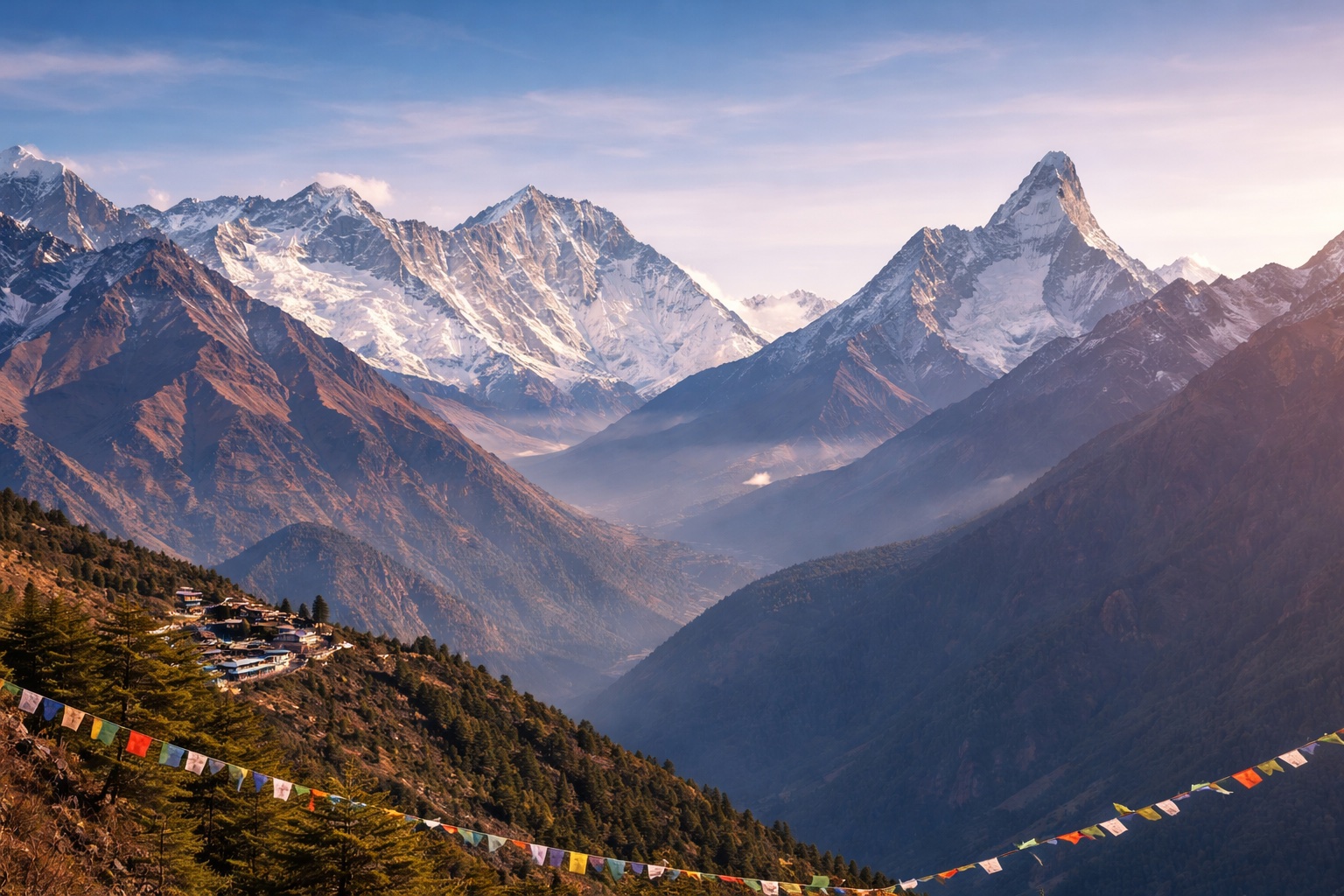
Pisang Peak (6,091 m) is the finest trekking-peak climb in the Annapurna region — a technically engaging ascent via the North Ridge that combines with the classic Annapurna Circuit approach for a complete 18-day package. Summit views of Annapurna II, Annapurna IV, Gangapurna, Tilicho Peak, and the entire Manang valley, with the circuit's famous Thorong La crossing as the return route.
Pisang Peak (6,091 m) stands above the village of Pisang in the upper Marsyangdi valley — the most dramatic section of the Annapurna Circuit — and is the most popular trekking peak in the Annapurna region for three interrelated reasons: its elevation is achievable with proper acclimatisation for any trekker with basic technical skills, its summit view is exceptional, and its location on the Annapurna Circuit means it can be integrated into a circuit itinerary without requiring a dedicated approach from Kathmandu. You are already walking past Pisang Peak on the Annapurna Circuit — the question is simply whether you turn left at the Base Camp junction and climb it.
Pisang Peak occupies a strategic position at the eastern entrance to the Manang valley — the transition point between the subtropical lower Marsyangdi gorge and the high Tibetan plateau landscape of upper Manang that makes the Annapurna Circuit the most scenically diverse high-altitude walk in the world. The village of Pisang itself is one of the Circuit's most atmospheric stops: a medieval-looking settlement of flat-roofed stone houses and a prominent monastery on the cliff above, with yaks grazing the fields below and Pisang Peak's north face rising directly overhead.
The standard route follows the North Ridge from Base Camp (approximately 4,900 m) to the summit. From the road-accessible Pisang village, a 3–4 hour walk on moraine and glacier reaches Base Camp, where the expedition tent camp is established the night before the summit attempt. The North Ridge ascent involves:
Lower section (4,900–5,400 m): mixed moraine and glacier terrain requiring crampons and careful navigation. The gradient is moderate and the terrain is technically straightforward for climbers with basic glacier experience.
Mid-ridge (5,400–5,800 m): steeper snow and ice at 40–50 degrees. Fixed ropes are placed on the steeper sections. The exposure increases significantly — the Manang valley is 2,000+ metres below on the left, and the Marsyangdi gorge on the right.
Summit (6,091 m): a broad snow summit with the full Annapurna massif filling the southern and western horizon. Annapurna II (7,937 m), Annapurna IV (7,525 m), Gangapurna (7,455 m), Tilicho Peak (7,134 m) are all visible from the summit, along with the entire length of the Manang valley below and — on clear days — the summit of Dhaulagiri (8,167 m) 80 km to the west.
Our 18-day itinerary integrates the Pisang Peak climb with a complete Annapurna Circuit experience — including the Thorong La Pass (5,416 m), the highest trekking pass on the standard circuit. The sequence: trek the lower circuit from Besisahar to Pisang (7 days), acclimatise and summit Pisang Peak (3 days), continue the circuit through Manang to the Thorong La and down to Muktinath and the upper Mustang valley, then complete the descent to Pokhara.
This combination delivers two altitude achievements in one itinerary — a technical summit to 6,091 m and the 5,416 m Thorong La crossing — in a single 18-day package that covers the full scenic and cultural range of the Annapurna Circuit from subtropical gorge to Tibetan plateau to the apple orchards of Marpha and the Kali Gandaki valley.
The Annapurna Circuit approach provides ideal natural acclimatisation for Pisang Peak. By the time you reach Pisang (3,200 m) after seven days of trekking from Besisahar (820 m), your body has been gradually exposed to increasing altitude and has undergone the initial red blood cell production increase that forms the foundation of high-altitude adaptation. The two acclimatisation days at Manang (3,500 m) before the summit attempt — standard on the Annapurna Circuit regardless of the peak climb — provide the additional adaptation that makes a 6,091 m summit achievable for properly acclimatised trekkers without prior high-altitude experience.
Pisang Peak is the ideal first technical Himalayan climb for trekkers who have completed one or two high-altitude treks (Everest Base Camp, Annapurna Circuit, or similar) and want to take the next step from trekking to actual mountaineering. The technical demands are real — you need to be comfortable on crampons on 45-degree snow and confident on fixed ropes — but they are not beyond any motivated trekker who prepares properly. Pre-climb preparation should include some technical mountaineering course work (crampons-on-glacier practice, ice axe arrest techniques) and solid cardiovascular fitness. We provide a pre-climb technical briefing and glacier skills session at Base Camp.
Pisang Peak is one of the most accessible technical Himalayan climbs, but "accessible" is not the same as "easy." You need to be comfortable on crampons (including on steep 40–45 degree snow), know how to use a jumar/ascender on a fixed rope, and have basic ice axe self-arrest skills before attempting the North Ridge. If you have never used crampons or an ice axe, we provide a 2–3 hour glacier skills session at Base Camp before the summit attempt — this covers the fundamentals but is not a substitute for prior training. We strongly recommend attending a beginner alpinism course (3–5 days) before the expedition.
Yes — a shorter 12-day itinerary is possible by driving to Besisahar and taking the road to Chame (skipping the lower circuit walking days), then walking only from Chame to Pisang. This reduces the total walking time but also reduces the acclimatisation benefit of the gradual altitude gain on the circuit approach. We recommend the full 18-day version for first-time high-altitude climbers, as the circuit acclimatisation directly contributes to summit safety. The shortened version is appropriate for climbers who have recent high-altitude experience (above 4,000 m in the past 6 months).
The Nepal Mountaineering Association permit for Pisang Peak is USD 250 per person for any season — making it one of the most affordable technical climbing permits in Nepal. The ACAP conservation area fee (NPR 3,000) and TIMS card are additional but included in our package price.
Both Pisang Peak (6,091 m) and Chulu Far East (6,059 m) are Annapurna Circuit trekking peaks of similar elevation, but they differ in character and approach. Pisang Peak is climbed via the North Ridge — a snow/mixed route with clear fixed-rope sections. Chulu Far East is technically more demanding, involving a longer glacier approach and steeper summit snow. Pisang Peak is generally considered more manageable for first-time technical climbers and integrates more naturally into the standard circuit itinerary. Both offer exceptional Annapurna panorama views from the summit.
Weather in the Annapurna region is generally more stable than the Everest region in both spring and autumn, but summit-day weather cannot be guaranteed. Our 18-day itinerary includes one contingency summit-day window — if the first summit attempt is turned back by weather or conditions, there is typically one additional attempt possible before the Thorong La crossing day. If both attempts are unsuccessful, the full Annapurna Circuit continues as planned. The climbing permit is non-refundable, but our expedition fee includes a partial refund of Sherpa climbing days not used if the attempt is abandoned due to conditions outside our control.
Yes — Tilicho Lake (4,919 m), the world's highest lake, is a 2-day side trip from Manang that can be inserted between the Manang acclimatisation days and the return to Pisang Base Camp. Adding Tilicho Lake to the itinerary requires 2 extra days and significantly enhances the acclimatisation profile before the summit attempt (sleeping at 4,800 m at the Tilicho Base Camp is excellent altitude preparation for 6,091 m). We can customise the itinerary to include Tilicho Lake on request — discuss when booking.