
Open Hours: Mon - Fri 6.00 am - 10.00 pm (Nepal Standard Time)
Annapurna Base Camp Trek
11 Days Moderate 4,130 m - Annapurna Base Camp March-May, October-November
Country Annapurna Sanctuary, Kaski, Nepal
Difficulty Moderate
Max Elevation 4,130 m - Annapurna Base Camp
Duration 11
Best Time March-May, October-November
Meals Full board on trek
Accommodation Tea houses
Group Size 2-16
Trek into the Annapurna Sanctuary - a glacial amphitheatre ringed by ten peaks over 7,000 m - to stand at the base of Annapurna I (8,091 m), the world's tenth highest mountain, in just 11 days.
Trip Highlights
  • Annapurna Base Camp (4,130 m) — perfect 360° amphitheatre of 7,000m+ giants
  • Sunrise on Annapurna I south face (8,091 m)
  • Machhapuchhare (Fish Tail) — Nepal's sacred unclimbed mountain
  • Natural hot springs at Jhinu Danda
  • Rhododendron forests in full bloom (March–April)
  • Gurung and Magar village culture and hospitality
  • Poon Hill (3,210 m) sunrise over Annapurna and Dhaulagiri

Annapurna Base Camp Trek - Inside the Annapurna Sanctuary

The Annapurna Base Camp Trek leads into one of the most spectacular mountain sanctuaries on Earth. From the lakeside city of Pokhara the trail climbs through terraced farmland, rhododendron forests, and the deep Modi Khola gorge before opening into the vast glacial bowl of the Annapurna Sanctuary.

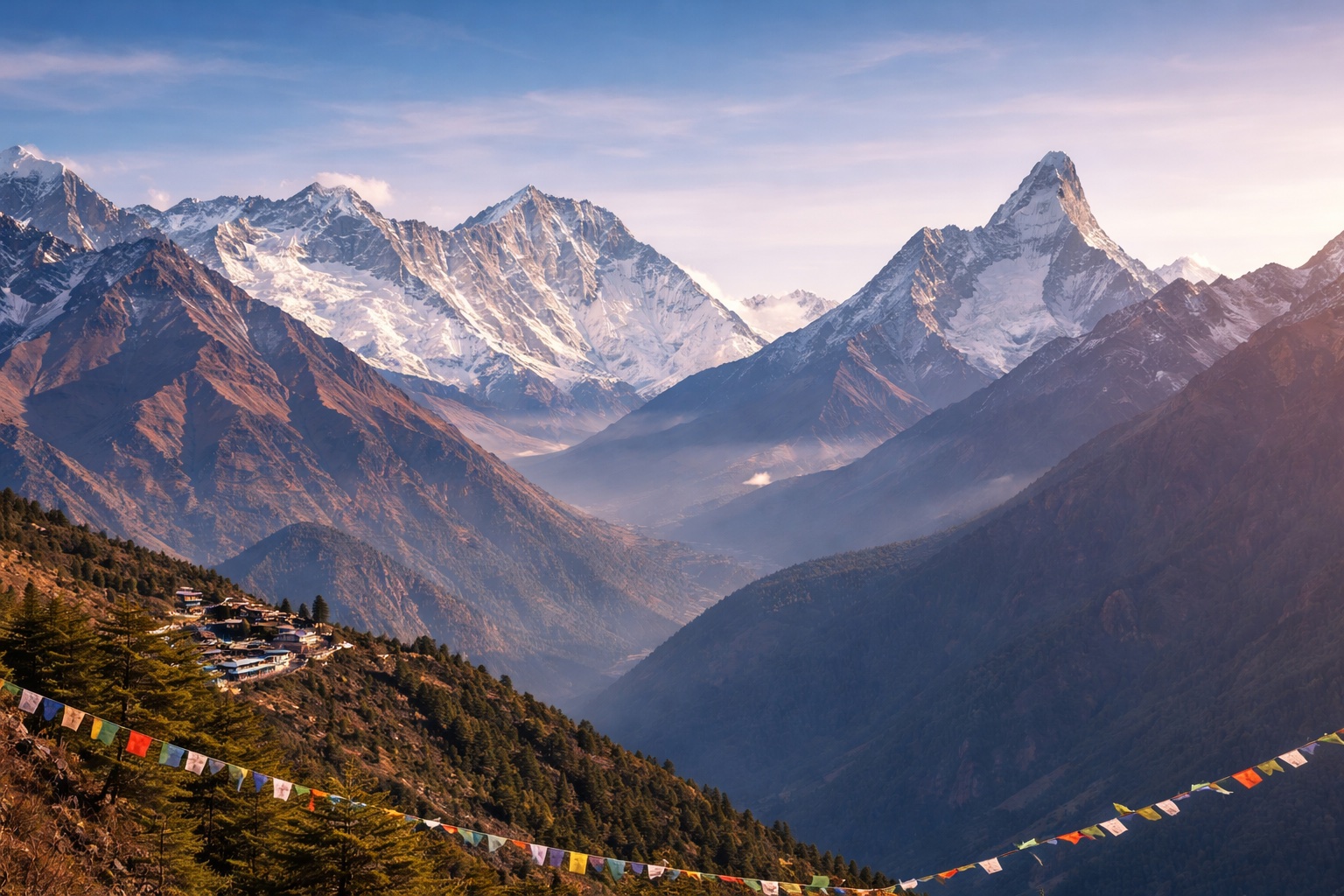
At Annapurna Base Camp (4,130 m) you are encircled by a complete 360-degree amphitheatre of Himalayan giants: Annapurna I (8,091 m), Annapurna South, Hiunchuli, the sacred unclimbed Machhapuchhare (Fish Tail, 6,993 m), Gangapurna, and Tent Peak. The scale is overwhelming.

The sunrise at ABC - the first rays igniting the south face of Annapurna I in brilliant orange - is among the most photogenic moments in all of Himalayan trekking. The natural hot springs at Jhinu Danda provide the perfect post-trek muscle soak, and the Gurung village culture throughout the valley adds rich human dimension to this outstanding trek.

Day-by-Day Itinerary

Drive from Pokhara to Nayapul (1.5 hrs). Begin trekking through Birethanti along the Modi Khola. Pass local markets and Gurung villages. Trail is wide and well-marked.
Tikhedhunga 4 hours Breakfast, Lunch, Dinner Tea house, Tikhedhunga
Climb 3,200 stone steps through magnificent rhododendron and oak forest - a riot of scarlet blooms in season. Ghorepani sits above the treeline. Sunset view over Dhaulagiri and the Annapurna range is spectacular.
Ghorepani 5-6 hours 2,860 m Breakfast, Lunch, Dinner Tea house, Ghorepani
Pre-dawn hike to Poon Hill for the world-famous Annapurna and Dhaulagiri sunrise. Descend through old-growth rhododendron to Tadapani, then continue to the large Gurung village of Chhomrong - the last major village before the Sanctuary.
Chhomrong 6-7 hours 3,210 m Breakfast, Lunch, Dinner Tea house, Chhomrong
Steep descent into the Modi Khola gorge, cross the river and climb into the narrow valley. Dense subtropical forest surrounds Bamboo lodge - the valley walls rise vertically on both sides.
Bamboo 4-5 hours Breakfast, Lunch, Dinner Tea house, Bamboo
Enter the Annapurna Sanctuary proper. Pass Dovan and Himalaya Hotel. The vegetation gives way to alpine scrub. Avalanche debris fields cross the trail seasonally. Machhapuchhare looms majestically above.
Deurali 5 hours 3,230 m Breakfast, Lunch, Dinner Tea house, Deurali
The final push into the inner Sanctuary. The trail climbs through moraine and glacial debris as the valley opens into the great amphitheatre. Annapurna Base Camp (4,130 m) is encircled by Annapurna I, South, Hiunchuli, Machhapuchhare, Gangapurna, and Tent Peak in a complete ring. Simply overwhelming.
Annapurna Base Camp 4-5 hours 4,130 m Breakfast, Lunch, Dinner Tea house, ABC
Rise at 5 am for the most dramatic sunrise in Nepal - Annapurna I's south face glows tangerine, then gold. After breakfast descend the full length of the Sanctuary to Bamboo.
Bamboo 6-7 hours Breakfast, Lunch, Dinner Tea house, Bamboo
Descend through Chhomrong to Jhinu Danda, famous for natural hot springs on the Modi Khola riverbank. Soak tired muscles in the steaming mineral pools - one of the best rewards in Himalayan trekking.
Jhinu Danda 5 hours Breakfast, Lunch, Dinner Tea house, Jhinu Danda
Final morning on the trail through Siwai to Nayapul. Drive back to Pokhara. Lakeside evening at Phewa Lake.
Pokhara 3 hours Breakfast, Lunch Hotel, Pokhara
Morning boat ride on Phewa Lake. Visit World Peace Pagoda. Flight or drive to Kathmandu. Farewell dinner in Thamel.
Kathmandu Breakfast, Dinner Hotel, Kathmandu
Transfer to Tribhuvan International Airport. Thank you for trekking with us in the Annapurna Sanctuary.
Kathmandu Breakfast

What’s Included

Included

  • Airport transfers (Kathmandu)
  • Domestic flights as per itinerary
  • TIMS card and national park/area permits
  • Experienced English-speaking licensed trekking guide
  • Porter service (1 porter per 2 trekkers)
  • Full-board accommodation on trek (tea house)
  • Duffel bag and sleeping bag (returnable)
  • First-aid kit and emergency oxygen
  • All government taxes and service charges

Excluded

  • International flights
  • Nepal visa fees
  • Travel and medical insurance (mandatory)
  • Meals in Kathmandu unless specified
  • Personal trekking gear and equipment
  • Gratuities for guide and porter
  • Extra nights due to flight delays or weather
  • Personal expenses and bar bills

Useful Info

Best Time for the Annapurna Base Camp Trek

The Annapurna Sanctuary is enclosed by high ridges that funnel weather — the gorge entry between Hiunchuli and Machhapuchhare can accumulate snow rapidly. Timing matters for safe access.

Spring

  • March – May
  • Peak rhododendron blooms (March–April) make the forest between Tikhedhunga and Ghorepani spectacular. Warm and settled.
  • Best Season

Summer / Monsoon

  • June – August
  • Heavy rain, leeches on lower trail, and avalanche risk in the Sanctuary gorge. Not recommended.
  • Avoid

Autumn

  • September – November
  • Post-monsoon clarity with outstanding Annapurna views. October and November are peak months.
  • Best Season

Winter

  • December – February
  • Cold and quiet. Avalanche risk in the Sanctuary (gorge approach) is highest Jan–Mar. Use caution.
  • Possible

How Difficult Is the Annapurna Base Camp Trek?

The ABC trek is rated Moderate — Nepal’s best-suited high-altitude trek for beginners and intermediate trekkers alike. The maximum altitude of 4,130 m is achievable without dedicated acclimatisation days for most healthy adults. Daily walks are 4–7 hours on well-maintained stone and dirt trails.

The steepest section is the descent into and climb out of the Modi Khola gorge between Chhomrong and Bamboo. The approach to the Sanctuary narrows and can be icy in winter.

Signs of Altitude Sickness to Watch For

  • Persistent headache not relieved by paracetamol
  • Nausea, vomiting, or loss of appetite
  • Fatigue disproportionate to effort
  • Dizziness or loss of coordination
  • Dry cough that worsens at rest
  • Confusion or difficulty concentrating (serious — descend immediately)

Permits Required

  • Annapurna Conservation Area Permit (ACAP) – NPR 3,000 per person.
  • TIMS Card – NPR 2,000 (group) or NPR 4,000 (independent).

Accommodation on the ABC Trek

The Annapurna region has the best tea house infrastructure in Nepal. Lodges in Ghorepani, Chhomrong, and Ghandruk offer comfortable private rooms, hot showers, excellent food menus, and Wi-Fi. Higher up (Bamboo, Deurali, ABC) the facilities are more basic but clean and safe. Full-board accommodation is included in our package.

The famous natural hot springs at Jhinu Danda are a 20-minute walk from the lodge — a perfect muscle soak after descending from Base Camp.

Annapurna Base Camp Trek Packing List – What to Bring

Keep your pack light (8–10 kg max in your day bag; porters carry heavier duffel bags). Layers are the key strategy for managing wide temperature swings.

Clothing & Insulation

  • Moisture-wicking base layers (top & bottom)
  • Mid-layer fleece jacket
  • Down jacket (600+ fill, critical above 4,000 m)
  • Waterproof hardshell jacket and pants
  • Trekking trousers (2 pairs)
  • Warm hat and sun hat
  • Gloves (liner + waterproof outer)
  • Merino wool or thermal socks (4–6 pairs)
  • Gaiters (light, for snow/mud)

Footwear

  • Waterproof trekking boots (ankle support, broken in before trek)
  • Camp sandals / lightweight shoes
  • Trekking poles (collapsible, highly recommended)

Health & Safety

  • Diamox (acetazolamide) – consult doctor before taking
  • Paracetamol, ibuprofen, rehydration salts
  • Blister kit, bandages, antiseptic
  • Water purification tablets / filter
  • High-SPF sunscreen (SPF 50+) and lip balm
  • UV-protection sunglasses (essential above 4,000 m)
  • Pulse oximeter (monitors blood oxygen saturation)

Essentials

  • Sleeping bag (−10°C comfort rating)
  • Headlamp + spare batteries
  • Daypack (25–30 L with rain cover)
  • Duffel bag (provided by agency, 80–100 L)
  • Power bank (charging scarce at higher altitudes)
  • Offline map (Maps.me, Gaia GPS)
  • Cash in NPR (very few card machines on trail)

ABC-Specific Items

  • Light gaiters (Modi Khola gorge can be muddy)
  • Leech socks or insect repellent (for lower trail in wet season)
  • Swimwear (for Jhinu Danda hot springs)
  • Quick-dry towel
  • Electrolyte tablets (humid lower gorge drains energy fast)

Frequently Asked Questions

The ABC trek is rated Moderate. It is one of the most accessible high-altitude treks in Nepal, suitable for fit beginners with no prior Himalayan experience. Daily walking times are 4–7 hours. The maximum altitude is 4,130 m — well below the threshold where serious altitude sickness typically occurs. The steep descent into and climb out of the Modi Khola gorge is the most physically demanding section.
Annapurna Base Camp sits at 4,130 m (13,549 ft). This is comfortably within the range where most healthy trekkers acclimatise well without special medication. The approach through the Annapurna Sanctuary is gradual enough that most trekkers experience only mild headaches at most.
Our itinerary is 11 days from Pokhara to Pokhara (or Kathmandu). There are no dedicated acclimatisation days as the altitude gain is gradual, but the day at ABC is a rest/exploration day before descending.
You need: (1) Annapurna Conservation Area Permit (ACAP) and (2) TIMS Card. Both are included in our package price and obtained in Pokhara or Kathmandu before the trek starts.
Yes — our itinerary includes the famous Poon Hill (3,210 m) sunrise on Day 3. You leave Ghorepani at 4:30 am for the 45-minute hike to the viewpoint, where you are rewarded with one of the most photographed mountain panoramas in the world: Annapurna I, Dhaulagiri, Machhapuchhare, and the entire Annapurna range at sunrise.
The Annapurna Sanctuary is a glacial amphitheatre — a natural bowl encircled by twelve mountains including Annapurna I (8,091 m), Annapurna South (7,219 m), Hiunchuli (6,441 m), Machhapuchhare (6,993 m), Gangapurna (7,455 m), and Tent Peak (5,663 m). You enter through a narrow gorge between Machhapuchhare and Hiunchuli — one of the most dramatic entrances in mountain trekking. The sanctuary is considered sacred and hunting is forbidden within it.
Machhapuchhare ("Fish Tail Peak", 6,993 m) is Nepal's most iconic and recognisable mountain — its twin summits are visible from Pokhara and dominate the Annapurna Sanctuary skyline. It is sacred to Hindus as a manifestation of Shiva and has never been officially climbed to the summit. The Nepal government has banned all climbing on Machhapuchhare. You can admire it from virtually every angle on the ABC trek.
Jhinu Danda's natural hot springs are located directly on the Modi Khola riverbank, about a 20-minute walk below the village. The springs are rich in minerals and maintained as a community facility. After 8 days of trekking, soaking in the hot pools with Annapurna South visible above is one of the most relaxing experiences in Nepal. Entry is free (small tip to the caretaker appreciated).
Yes — ABC is genuinely suitable for fit beginners. No technical skills or prior Himalayan experience are required. You should be able to walk uphill for 4–6 hours with a daypack. We recommend 4–6 weeks of fitness preparation before the trek. Many of our clients complete ABC as their first trekking experience and find it deeply rewarding.
The rhododendron forests between Tikhedhunga and Ghorepani are among the largest in the world. They bloom from late February through April, with peak colour in March–April when the forests become a blaze of scarlet, pink, and white. Walking through the rhododendron forest in full bloom is one of the most visually spectacular experiences on any Himalayan trek.
The Annapurna region has the best-developed tea house infrastructure in Nepal. Lodges in Ghorepani, Chhomrong, and Ghandruk have comfortable private rooms, hot showers, excellent food, and Wi-Fi. Higher up (Bamboo, Himalaya Hotel, Deurali, ABC) the facilities are more basic — shared rooms, bucket showers, and limited menus. Our package includes full-board in all tea houses.
Yes, the ABC route is one of Nepal's safest and best-maintained trekking routes. It is well-marked, heavily trekked, and has emergency communication throughout. Potential hazards include avalanche risk in the Sanctuary gorge (January–March, mitigated by timing and guide judgment), altitude sickness above 3,500 m, and common trail injuries. Our guides are trained in wilderness first aid.
We book all accommodation in advance for you, especially important during peak season (October–November, March–April) when lodges fill quickly. Independent trekkers without bookings regularly struggle to find rooms in Chhomrong and ABC during these periods. Our advance bookings guarantee you a room and the quality we have inspected.
Avalanche risk in the Annapurna Sanctuary is real during winter and early spring (December–March) when heavy snowfall loads the slopes. Our guides monitor conditions and communicate with local authorities and other operators daily. If there is credible avalanche risk in the gorge between Dovan and ABC, we will delay entry, choose alternative timing (typically early morning when temperatures are lowest), or adjust the itinerary. Safety of guests always supersedes the itinerary.
November is one of the best months. Post-monsoon clarity means outstanding mountain views, trails are dry and stable, and daytime temperatures are pleasant at lower elevations (15–22°C) and cool at ABC (around 0–5°C day, -5°C night). It is peak season so book well in advance.
Pokhara is 200 km west of Kathmandu. You can travel by tourist bus (5–6 hrs, USD 10–15), public bus (7–8 hrs), or domestic flight (25 min, USD 80–120). Most of our ABC packages start from Pokhara. If you fly into Kathmandu we include transport to Pokhara in the package.
The Annapurna Conservation Area is rich in wildlife. Common sightings: Himalayan tahr (mountain goat), langur monkeys, colourful Danphe pheasants (Nepal's national bird), assorted eagles and raptors, and red pandas (lucky sighting at lower elevations). Rarer: snow leopards (extremely rare, usually glimpsed at high altitude in winter). The forests between Ghorepani and Chhomrong are particularly rich in bird life.
The sunrise at Annapurna Base Camp itself is the highlight — standing in the centre of the Sanctuary at dawn as the south face of Annapurna I turns from grey to orange to gold is unforgettable. Poon Hill (Day 3) offers the widest panorama including Dhaulagiri. The ridge walk between Ghorepani and Tadapani through old-growth rhododendron is the most beautiful forest section.
Yes — unlike some restricted areas, the Annapurna region does not require a guide by law. However, we strongly recommend hiring a guide and porter. Your guide handles emergencies, communicates with local lodges, navigates in bad weather, and enriches your cultural experience enormously. A porter removes the physical burden of a heavy pack, letting you enjoy the walk. Both are available through us at very reasonable rates.
The Poon Hill trek (5 days) goes only as far as Ghorepani (2,860 m) — it is a shorter, easier trek focused on the famous sunrise panorama and rhododendron forests. It does not enter the Annapurna Sanctuary or reach Base Camp. The ABC trek (11 days) includes Poon Hill AND continues all the way to the Sanctuary at 4,130 m. If you have 11 days, ABC gives you Poon Hill plus the full Base Camp experience.
Ghandruk (1,940 m) is the largest Gurung village in Nepal and a designated Conservation Village. Its traditional stone houses with slate roofs, narrow cobblestone lanes, and panoramic views of Annapurna South and Machhapuchhare make it one of Nepal's most photogenic villages. The Gurung Museum here documents Gurung culture, history, and military traditions (Gurkha soldiers). We spend a night here on the descent.
Yes — a combined ABC + Circuit itinerary (22–25 days) is one of Nepal's ultimate trekking experiences. You would complete the Circuit (crossing Thorong La), descend to Pokhara, and then do the ABC trek. Alternatively, some trekkers insert the ABC as a side trip from the Sanctuary junction and continue on the Circuit. We can build this custom itinerary for you.

Reviews

From USD 950 1100 per person
Book Now
  • Secure Booking
  • No Hidden Costs
  • Instant Confirmation