
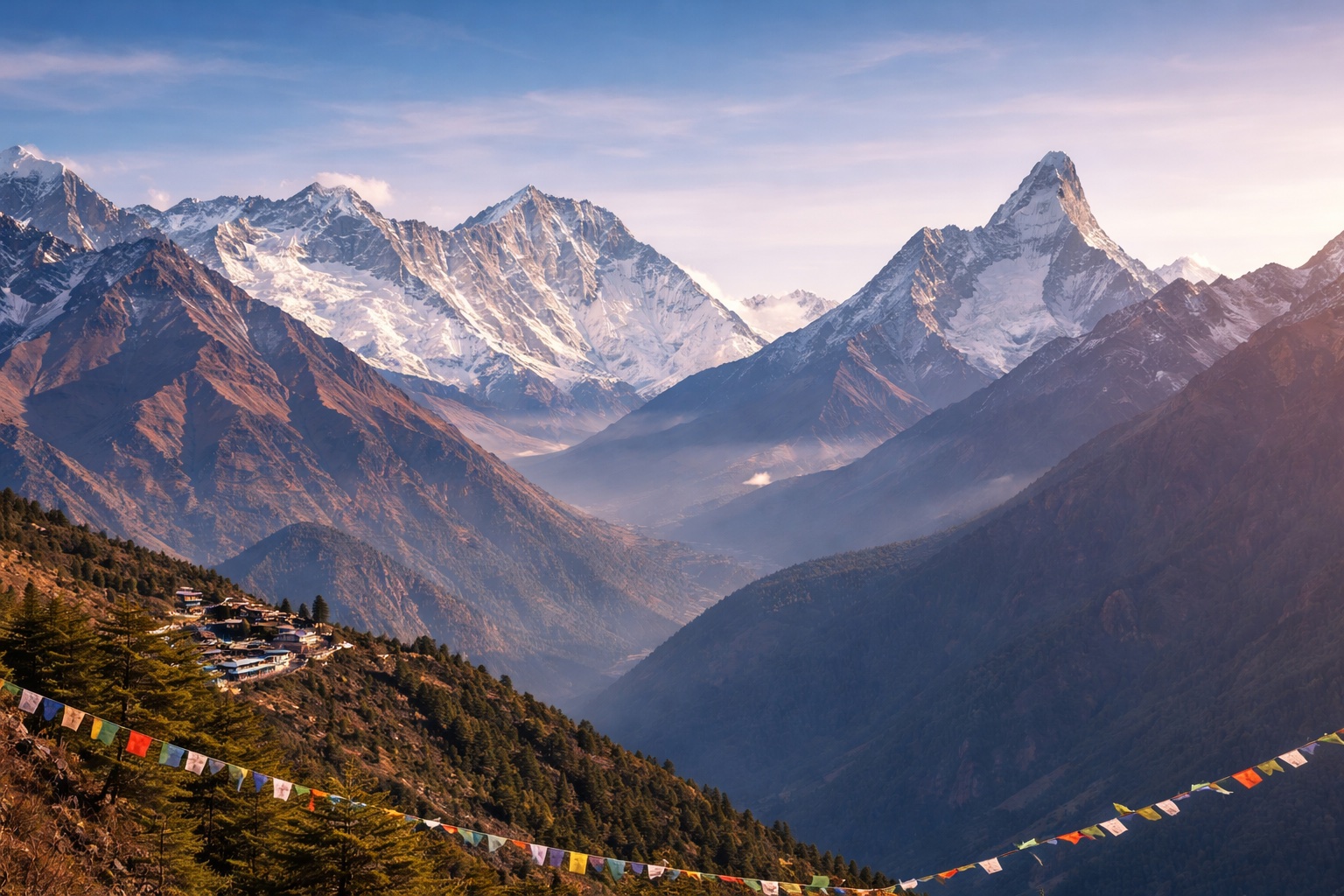
Tour in Nepal - Cultural, Heritage & Wilderness Experiences
Nepal is far more than its mountains — though the mountains alone would make it one of the world's great travel destinations. The Kathmandu Valley contains seven UNESCO World Heritage Sites within a few kilometres of each other: Pashupatinath Temple, Boudhanath Stupa, Swayambhunath (Monkey Temple), Changu Narayan, and the three ancient royal palace squares of Kathmandu, Patan, and Bhaktapur. The Terai lowlands in Nepal's south protect Chitwan National Park, one of Asia's finest wildlife habitats, where one-horned rhinos, Bengal tigers, and gharial crocodiles live in the sal forest and grassland of the sub-Himalayan belt. Lumbini, the birthplace of Siddhartha Gautama — the historical Buddha — is one of the world's most significant pilgrimage destinations, visited by Buddhists from across Asia. And Pokhara, Nepal's most beautiful city, sits at the foot of the Annapurna range where the Machhapuchhare (Fish Tail) peak is reflected in the mirror surface of Phewa Lake on calm mornings. A tour of Nepal that combines even a selection of these destinations delivers a cultural and natural richness that few countries can match.
Kathmandu Valley: Seven UNESCO World Heritage Sites
The Kathmandu Valley was the seat of the medieval Malla kingdoms for five centuries, and the artistic and architectural legacy of that period is preserved in a concentration of temples, palaces, and sacred spaces found nowhere else in South Asia. Pashupatinath Temple, on the banks of the Bagmati River, is the most sacred Hindu temple in Nepal and one of the holiest Shiva shrines in the world. The cremation ghats along the river bank, where Hindu funerary rites are conducted in public view, provide one of travel's most profound cultural encounters — a reminder that for Hindus, death is a transition to be marked with ceremony rather than concealed.
Boudhanath Stupa is one of the largest Buddhist stupas in the world and the spiritual centre of Nepal's Tibetan Buddhist community. The mandala-shaped base, the all-seeing eyes of the Buddha painted on the tower, and the constant circumambulation of monks, pilgrims, and devotees spinning prayer wheels create an atmosphere of living religious practice that the stupa's age and size make genuinely awe-inspiring. Swayambhunath, the Monkey Temple, crowns a hill above the valley with a stupa visible from across the city — its hilltop location delivers panoramic views of Kathmandu and the Himalayan horizon beyond.
The three Durbar Squares — Kathmandu Durbar Square, Patan Durbar Square, and Bhaktapur Durbar Square — are the civic and religious centres of the three medieval kingdoms that divided the valley between them before Prithvi Narayan Shah's unification of Nepal in 1768. The carved wood of the palace windows, the stone-paved courtyards, the golden-roofed temples, and the Kumari (living goddess) tradition maintained in the royal palace buildings are living expressions of a court culture that continued largely unchanged from the 12th to the 18th century.
Chitwan National Park: Wildlife Safari in Royal Bengal Tiger Country
Chitwan National Park in Nepal's Terai lowlands is one of Asia's premier wildlife destinations — a UNESCO World Heritage Site protecting 932 square kilometres of sal forest, grassland, and riverine habitat at the base of the Himalayan foothills. The park is one of the last remaining habitats of the greater one-horned rhinoceros (Rhinoceros unicornis), which was reduced to fewer than 100 individuals in the early 20th century by hunting and habitat loss before conservation efforts rebuilt the population to over 700 animals in Chitwan alone. Bengal tigers (Panthera tigris tigris) are present in significant numbers — Chitwan has one of the highest tiger densities of any protected area in Asia — and gharial crocodiles (Gavialis gangeticus), one of the world's most critically endangered reptiles, bask on the Rapti and Narayani riverbanks.
A Chitwan safari typically combines jeep safaris through the forest and grassland, dugout canoe trips along the rivers for crocodile and waterbird viewing, elephant breeding centre visits, and cultural programmes with the Tharu people — Nepal's indigenous Terai community whose traditional architecture, dances, and fishing culture are as distinctive and interesting as the park's wildlife. Three nights in Chitwan allows adequate time for multiple safari approaches at different times of day, giving the best possible chances of tiger and rhinoceros sightings.
Pokhara: Nepal's Lake District
Pokhara is Nepal's second city and the country's most scenically situated urban destination. The city sits in a valley at 822 metres above sea level, its western edge bordered by Phewa Lake and its northern horizon defined by the Annapurna Himal — Machhapuchhare (6,993 m) rising directly behind the city to a height that makes it appear far closer than its twenty-kilometre distance. The combination of lake, city, and mountain backdrop creates a setting of quite extraordinary beauty that photographs consistently underrepresent.
Pokhara offers cultural sightseeing (the Gurkha Museum, the International Mountain Museum, the Bindyabasini Temple), adventure activities (paragliding from Sarangkot with the Annapurna range as backdrop, white-water rafting on the Seti Gandaki, ziplining above the valley), and the kind of relaxed lakeside atmosphere that makes it a natural rest stop between the intensity of Kathmandu and the physical demands of any trekking route in the Annapurna region.
Lumbini: The Birthplace of the Buddha
Lumbini in Nepal's western Terai is one of the four most sacred sites in Buddhism — the location where Queen Maya Devi gave birth to Siddhartha Gautama, who became the Gautama Buddha, approximately 563 BCE. The sacred garden marks the exact birthplace with a stone marker and the Maya Devi Temple, which has been a pilgrimage destination for two and a half millennia. The Emperor Ashoka's pillar, erected in 249 BCE and one of the oldest archaeological monuments in Nepal, confirms the site's ancient significance. The surrounding Lumbini Development Zone contains monasteries from over twenty countries — Japanese, Chinese, Korean, Thai, Burmese, Sri Lankan, German, and others — each expressing Buddhist architecture in their own national idiom within a planned sacred landscape. For Buddhist pilgrims and cultural travellers alike, Lumbini is one of the world's genuinely moving sacred sites.
Nepal Mountain Flights
For travellers who want to experience the Himalayas without the physical demands of trekking, Nepal's scheduled mountain flights offer an extraordinary alternative. Daily morning flights departing from Kathmandu's Tribhuvan Airport circle close enough to Everest, Lhotse, Makalu, and the full Himalayan arc for close-range photography and the visceral experience of the range's scale. The sixty-minute flights are operated by Buddha Air and Yeti Airlines on comfortable aircraft with window seats assigned to every passenger. On clear mornings — most common in autumn and spring — the views are genuinely spectacular. Mountain helicopter tours, which fly closer to the peaks and include landings at high-altitude viewpoints, offer an even more immersive aerial Himalayan experience.
Customising Your Nepal Tour
Nepal's tour destinations can be combined in almost any configuration depending on available time and interests. A classic seven-day Nepal cultural tour combines three days in the Kathmandu Valley (UNESCO heritage sites, Pashupatinath, Boudhanath), two days in Chitwan (wildlife safari), and two days in Pokhara (lake, viewpoints, Annapurna panorama). A ten-day tour adds Lumbini for the complete Nepal cultural circuit. Mountain treks of any duration can be appended to either end of a cultural tour — many visitors combine a Kathmandu heritage tour with a Poon Hill or Langtang trek to experience both dimensions of Nepal within a single trip. Our team designs itineraries that balance cultural exploration, wildlife experience, and mountain adventure in whatever proportion fits your interests and time.