
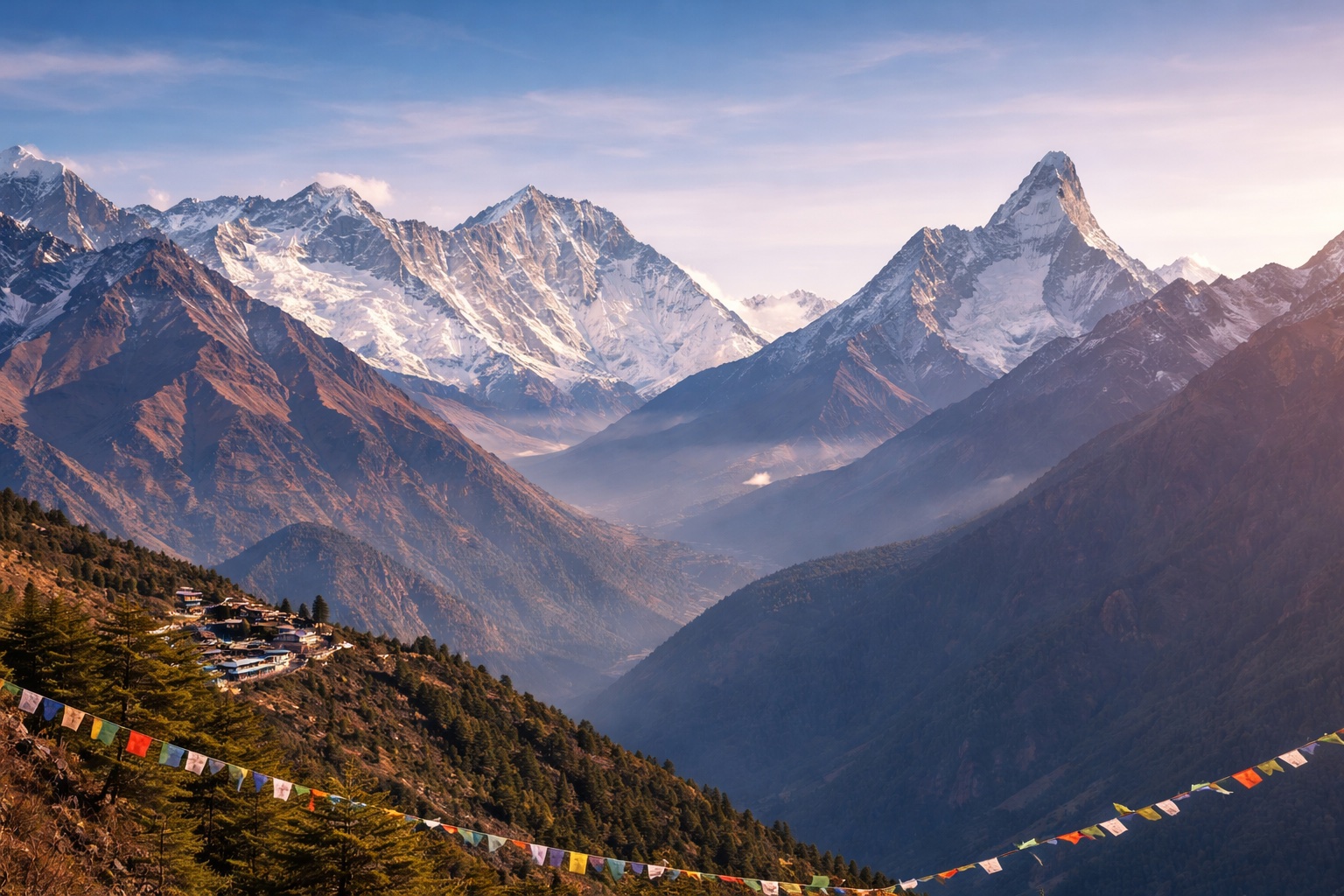
The Ganja La Pass Trek is the finest high-route traverse between Nepal's two most popular short-trek regions — Langtang and Helambu — combining the full Langtang Valley experience with a challenging 5,122-metre pass crossing and a descent through the Hyolmo Sherpa villages of Helambu. A 15-day journey for experienced trekkers who want the Langtang panorama, a technical high pass, and a complete point-to-point traverse without retracing their steps.
The Ganja La Pass (5,122 m) is the high mountain crossing that connects the Langtang valley — Nepal's most celebrated short-trek destination north of Kathmandu — with the Helambu highlands to the south, creating a point-to-point traverse that eliminates the out-and-back return of the standard Langtang valley trek and replaces it with an alpine crossing of genuine difficulty and extraordinary visual reward. The pass is not technical in the mountaineering sense — crampons may or may not be required depending on snow conditions — but at 5,122 m with a steep approach from both sides and significant exposure to weather, it demands respect, preparation, and the right conditions.
The trek divides naturally into three distinct phases, each with its own character. The first phase is the Langtang valley approach — the classic route from Syabrubesi up the Langtang Khola valley through the forest corridor to Kyanjin Gompa (3,870 m), with its yak-cheese factory, ancient gompa, and the astonishing presence of Langtang Lirung (7,227 m) directly overhead. The second phase is the high-route traverse — the ascent from Kyanjin to the high camp below the Ganja La, the pass crossing itself at 5,122 m, and the challenging descent into the upper Helambu on the south side. The third phase is the Helambu descent — through the ancient Hyolmo Sherpa villages of Tarkeghyang and Sermathang to Melamchi Pul Bazaar, from where a 2-hour drive returns to Kathmandu.
The Ganja La is the highest standard trekking pass in the Langtang-Helambu region and one of Nepal's most rewarding for the combination of physical achievement and visual payoff. The approach from Kyanjin involves a full day of altitude gain across open moraine and glacier debris to the high camp at approximately 4,700–4,900 m. The pass crossing itself departs pre-dawn — the snow-covered col at 5,122 m requires careful movement in the cold and the descent on the Helambu side is steep enough that crampons are prudent after fresh snowfall. The view from the pass is one of the finest available in the Langtang region: northward, the entire Langtang massif — Langtang Lirung, Langtang II, Dorje Lakpa, and the Tibetan plateau beyond; southward, the Helambu ridges and the distant Kathmandu Valley. It is a view that rewards the effort completely.
The first half of the trek follows the full Langtang Valley Trek itinerary — one of Nepal's finest and most accessible mountain experiences. The valley's ecological transition from subtropical forest at 1,500 m to alpine tundra at 4,000 m over five days of walking; the warm hospitality of the Tamang and Sherpa communities along the way; the post-earthquake rebuild of Langtang village (most dramatically represented by the memorial site of the destroyed old village, preserved alongside the rebuilt new one); and the arrival at Kyanjin Gompa beneath the overwhelming north face of Langtang Lirung — all of this is the foundation on which the Ganja La experience is built.
The descent from the Ganja La into Helambu passes through the Hyolmo Sherpa heartland — a landscape of apple orchards, ancient monasteries, and stone-walled villages that feels entirely distinct from the Langtang valley above and from the Khumbu to the east. The Hyolmo are a distinct Sherpa sub-group with their own dialect, their own monastery tradition rooted in the Nyingma Bon-Buddhist synthesis, and a way of life shaped by the apple and buckwheat agriculture of the mid-altitude ridges between the high valleys and the Kathmandu basin. Tarkeghyang (2,590 m) — the largest Hyolmo village on the descent — is one of Nepal's finest cultural experiences: a functioning monastic community, working orchards, and households whose hospitality has been extended to travellers for centuries.
The genius of the Ganja La Trek as an itinerary is that it makes the Langtang valley visit and the Helambu visit greater than they would be as separate undertakings. Coming over the Ganja La into Helambu, you arrive in the Hyolmo villages with a physical and psychological context — the high pass crossed behind you, the altitude experience accumulated above — that gives the cultural descent a depth it lacks if you simply drive from Kathmandu to Melamchi. And the Langtang valley, approached from Kathmandu and exited over a high alpine pass rather than retraced to the road, becomes a journey rather than an out-and-back — with the mountain experience completed rather than reversed.
The Ganja La (5,122 m) and Thorong La (5,416 m) are both high trekking passes, but the Ganja La is considered more challenging for most trekkers. The Thorong La has well-maintained trails on both sides, reliable waymarking, and numerous tea houses at Thorong Phedi and Muktinath that make the crossing a supported experience. The Ganja La has no tea houses near the pass, requires camping at the high camp, the south-side descent is steeper and requires more careful footwork, and the approach from Kyanjin through boulder fields and moraine is less defined. Crampons are prudent to carry regardless of season. That said, the Ganja La is well within reach of any trekker who has completed the Langtang valley and is physically and mentally prepared for an exposed high crossing.
Crampons are prudent to carry in all seasons — the south-side descent after fresh snowfall can be icy and steep enough to make them necessary. In dry conditions (October–November with no recent snowfall), many trekkers cross without crampons. An ice axe is not required under standard conditions but our guides carry one as emergency equipment. We include crampons in our group gear kit. The key variable is recent snowfall — our guides check conditions with the Kyanjin tea house community before departure and advise accordingly.
The Ganja La Trek requires a Langtang National Park entry permit (NPR 3,000 per person), a TIMS card (NPR 2,000 for organised groups), and for the Helambu section, a Langtang National Park extension — the same permit covers both valleys. No restricted area permit is required. All permits are included in our package price.
If you completed the Langtang valley trek comfortably and reached Kyanjin (3,870 m) without significant altitude difficulties, you have the basic altitude experience for the Ganja La. The additional demands are the two extra acclimatisation days at Kyanjin (which our itinerary includes), the physical fitness for the high-camp approach and the pre-dawn crossing, and the mental preparation for exposed terrain at 5,000 m. First-time trekkers are not recommended for the Ganja La — a prior Langtang or Helambu trek is the ideal preparation.
Different trekkers identify different highlights. The Kyanjin Ri sunrise (4,773 m), with the full Langtang range in alpenglow, is consistently described as the most spectacular single moment of the early portion. The Ganja La summit view — particularly the perspective of the Langtang Lirung massif from above, which no lower viewpoint provides — is the crossing's defining moment. And the descent into Tarkeghyang through apple orchards, with the transition from glacial wilderness to warm Hyolmo village completing the arc of the trek, is described by many returnees as the emotional peak — the moment when the whole journey makes sense as a single coherent story.