
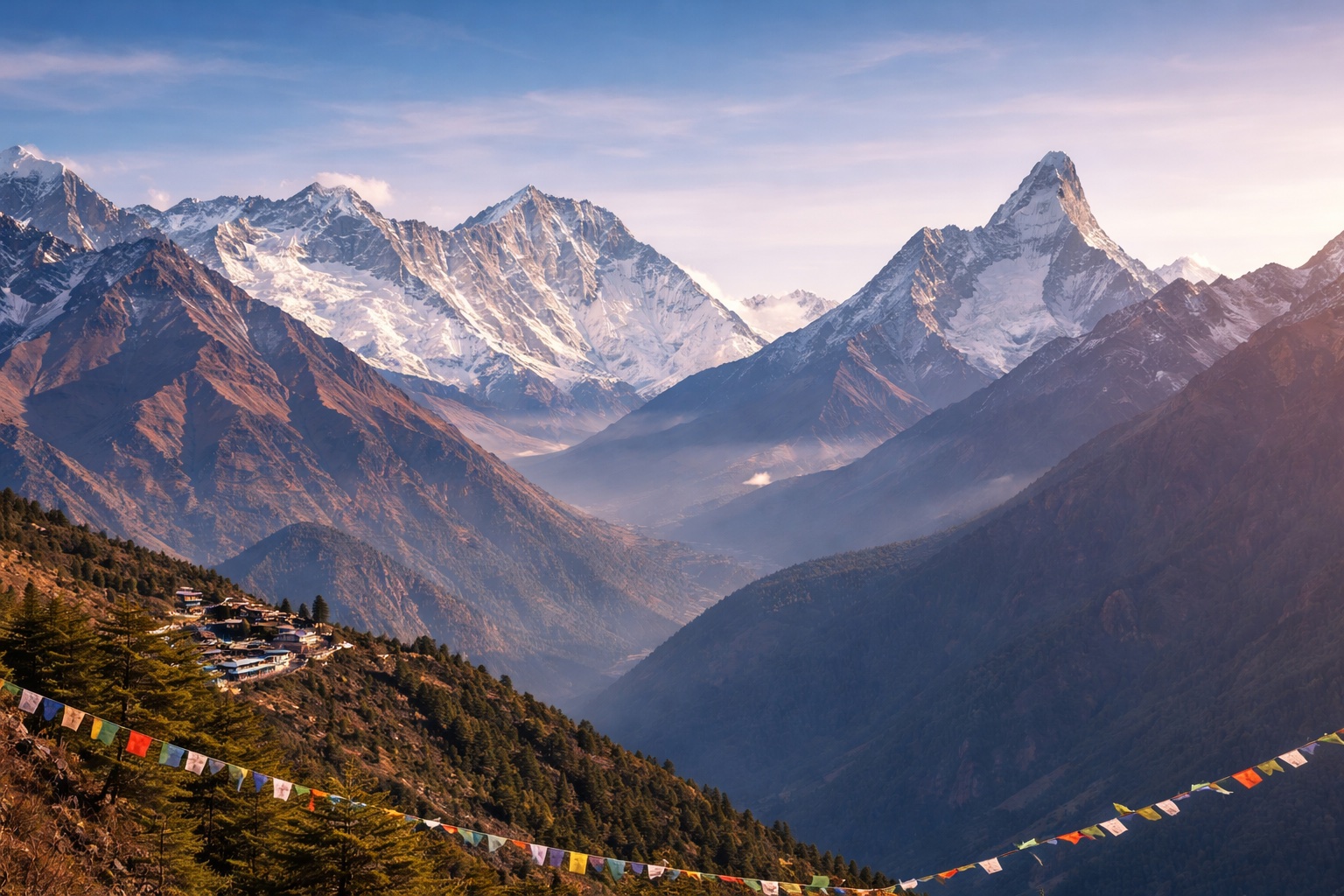
Explore all seven UNESCO World Heritage Sites of the Kathmandu Valley in three days — Pashupatinath, Boudhanath, Swayambhunath, and the three ancient palace squares of Kathmandu, Patan, and Bhaktapur. Expert local guide, all entrance fees included.
The Kathmandu Valley Cultural Tour is the essential Nepal experience for travellers who want to understand the civilisation that built one of the world's most concentrated collections of sacred and historical sites. Within a valley that measures just 25 kilometres across, the seven UNESCO World Heritage Sites of Kathmandu represent twelve centuries of unbroken artistic and religious creativity — Hindu temples, Buddhist stupas, medieval palace squares, and living religious traditions that continue today exactly as they have for a thousand years.
Nepal is not simply a gateway to the Himalayas. It is one of Asia's great civilisational crossroads — the meeting point of Hindu and Buddhist traditions from the Indian subcontinent and Tibetan plateau, expressed through a Newari artistic culture that produced architecture, bronze casting, and stone sculpture of such quality that scholars rank it among the finest in the world. The Kathmandu Valley tour gives you the context and the access to understand this — with an expert guide who has spent years studying these sites rather than simply pointing at them.
Pashupatinath Temple on the banks of the Bagmati River is the most sacred Shaivite temple in the world outside of Varanasi. The main temple complex — a pagoda of gilded copper roofs and carved wooden struts that dates in its present form to the 17th century, though the site's sanctity goes back at least to the 5th century CE — is restricted to Hindus. But the ghats along the Bagmati riverbank, where Hindu cremation rites are conducted daily in public view, are accessible and constitute one of travel's most profound cultural encounters. Seeing life and death held in equal dignity at the river's edge — the burning ghats, the sadhus smeared with ash meditating in the temple courtyard, the pujaris performing morning rituals — changes the way most Western travellers think about mortality and ceremony.
Boudhanath Stupa, one of the largest Buddhist stupas in the world, is the spiritual centre of Nepal's Tibetan Buddhist community. The stupa's mandala-shaped base measures 100 metres in diameter; the tower above carries the all-seeing eyes of the Buddha in each of the four cardinal directions. Surrounding the stupa is a ring of monastery buildings housing communities of Tibetan monks who fled to Nepal after 1959 — Boudhanath is the most important centre of Tibetan Buddhist learning outside Tibet itself. The experience of circumambulating the stupa at dusk, carried along by the flow of saffron-robed monks, Tamang pilgrims, and Tibetan grandmothers spinning hand-held prayer wheels, is one that most visitors describe as the single most memorable moment of their Nepal trip.
Swayambhunath Stupa crowns a forested hill above the western edge of the Kathmandu Valley. The hill has been a Buddhist sacred site for at least 2,000 years — one of the oldest religious sites in Nepal. The stupa's white dome and golden spire are visible from across the valley, and the 365-step staircase to the hilltop — flanked by stone Buddhas and monitored by the resident rhesus macaques that give the site its English name — delivers a panoramic view of Kathmandu and the Himalayan horizon that is particularly spectacular at dawn. The complex includes Hindu temples alongside Buddhist shrines — a visual expression of the syncretic religious culture that is uniquely Nepali.
Kathmandu Durbar Square, Patan Durbar Square, and Bhaktapur Durbar Square are the royal palace squares of the three kingdoms that divided the Kathmandu Valley between them during the Malla dynasty (10th–18th centuries). Each is distinct in character. Patan's is the finest for architecture — the Krishna Mandir, the Vishwanath Temple, and the Patan Museum (the best museum in Nepal) surround a square of such artistic concentration that art historians routinely describe it as the most beautiful courtyard in Asia. Bhaktapur preserves medieval Nepal most completely — the car-free city centre, the Nyatapola Temple (Nepal's tallest pagoda), and the ancient pottery squares where artisans still make clay pots using 15th-century techniques create an atmosphere of extraordinary historical continuity. Kathmandu's Durbar Square, though damaged in the 2015 earthquake, remains a living cultural site where the Kumari — Nepal's living goddess, a pre-pubescent girl selected through an ancient ritual process — resides in the Kumari Ghar and occasionally appears at her window to bless visitors.
Changu Narayan (1,541 m), perched on a forested ridge above the valley's eastern rim, contains the oldest inscribed stone pillar in Nepal (464 CE) and sculptures from the 4th to 12th centuries that are among the finest Licchavi-period artworks in existence. The temple to Vishnu is Nepal's oldest continuously active Hindu temple. The UNESCO designation here is perhaps the most deserved of all the Kathmandu sites — it is less visited than Pashupatinath or Boudhanath and retains the character of genuine pilgrimage rather than cultural tourism.
The Kathmandu Valley's sites require cultural and historical context to be fully understood. Without knowing that the erotic carvings on temple struts are believed to protect against lightning (Indra, the thunder god, is considered too pure to look upon such scenes), or that the black-faced Kali outside Pashupatinath temple is propitiated with blood sacrifice because she is held to be the goddess who protects the city, or that the courtyard tank in front of Patan's Vishwanath temple dates to the Licchavi period and was built by a king whose name is recorded in the Sanskrit inscription on the dhvajasthambha (victory pillar) beside it — without this knowledge, the sites are beautiful but opaque. Our guides have degrees in art history or archaeology and speak the sites rather than narrating them.
Three days is the ideal minimum to cover all seven UNESCO sites without rushing. Our itinerary is designed to let you spend meaningful time at each location — not a 15-minute photo stop but an hour or more with a guide who can explain what you are seeing. If you have four or five days, we add Nagarkot sunrise, Pashupatinath at dawn (different from daytime), and optional Newari cooking class or thanka painting workshop.
The main inner sanctum of Pashupatinath is restricted to Hindus. However, the ghats (riverside cremation and ritual bathing areas), the extensive surrounding temple complex, and the sadhu ashrams on the opposite bank of the Bagmati are fully accessible to all visitors. Your guide will ensure you can see and understand the full significance of the site.
Kathmandu is a safe destination for international tourists. Standard urban precautions apply — keep valuables secure in crowds, use authorised taxis or your guide's arranged transport, and drink bottled or purified water. The heritage sites are all well-policed and tourist-friendly. Our guide accompanies you throughout Days 1–3 so you are never navigating unfamiliar areas alone.
October–November is the best time — post-monsoon air is crystal clear, mountain views from Swayambhunath and Nagarkot are exceptional, and weather is warm and stable. March–April is the second-best window with spring blooms. December–February is cool but clear and uncrowded. Monsoon (June–September) is warm but hazy and rainy — the sites are still beautiful but mountain views are limited.
All entrance fees for listed sites are included in our package price. For reference, the standard tourist entrance fees are: Pashupatinath NPR 1,000 (approx. USD 7.50), Boudhanath NPR 400, Swayambhunath NPR 200, Kathmandu Durbar Square NPR 1,000, Patan Durbar Square NPR 1,000, Bhaktapur NPR 1,800 (includes the entire medieval city), Changu Narayan NPR 300. A combined visit to all seven would cost approximately USD 40 per person in entrance fees alone.
All seven UNESCO sites are within 15 kilometres of central Kathmandu. Our private vehicle ensures you move between sites efficiently without dealing with public transport. Bhaktapur is 14 km east of the city (30 minutes), Changu Narayan is 22 km (45 minutes). Pashupatinath, Boudhanath, Swayambhunath, and the Durbar Squares are all within 10 km of each other and reachable in 15–20 minutes by private vehicle.