
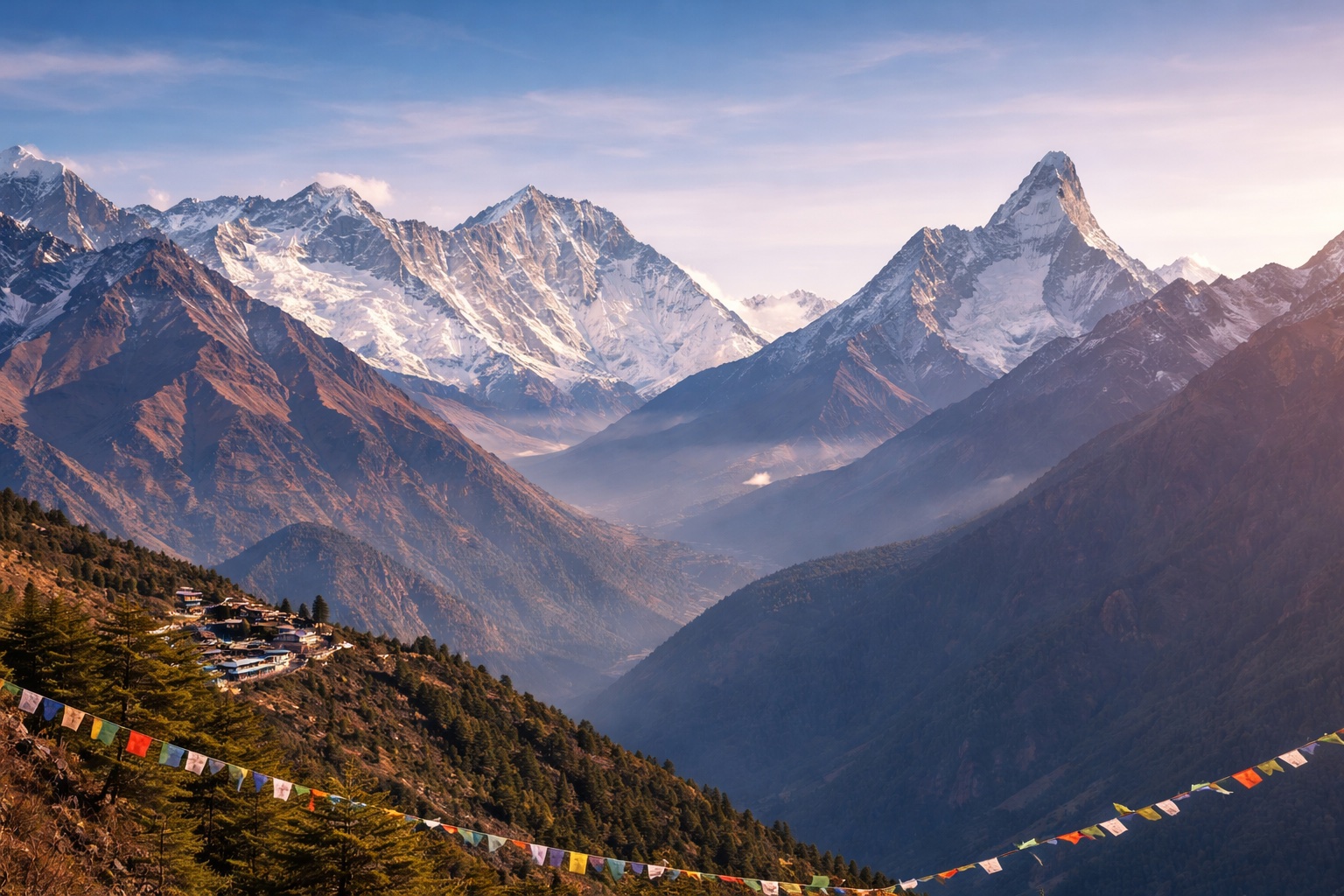
Dhulikhel (1,550 m) — 30 km east of Kathmandu, a preserved Newari market town on the Arniko Highway — for sunrise over the eastern Himalaya, then a 3-hour hike through pastoral ridges to Namobuddha (1,750 m), one of the most sacred Buddhist pilgrimage sites in Nepal. The Namobuddha hilltop monastery overlooks the site where the historical Buddha, in a previous life, offered his body to a starving tigress and her cubs. One of the most spiritually resonant day trips from Kathmandu.
The Dhulikhel sunrise and Namobuddha day trip combines two of the most rewarding experiences accessible in a single day from Kathmandu — a sunrise view of the eastern Himalaya from the hilltop above the medieval Newari town of Dhulikhel (1,550 m), followed by a 3-hour hike through terraced farmland and forest ridges to Namobuddha (1,750 m), one of the three most sacred Buddhist pilgrimage sites in Nepal's Kathmandu Valley area and the site of one of the most beloved stories in the Jataka tradition of Buddhist scripture. The day combines the finest Himalayan sunrise viewpoint east of Kathmandu with a walking meditation through Nepal's living rural heartland and an arrival at a hilltop monastery complex of genuine spiritual power and architectural beauty.
Dhulikhel is the finest surviving medieval Newari town in the Kavrepalanchok district — its central square (Naag Dhoka) ringed by 15th–19th century brick-and-timber merchant houses with intricately carved wooden windows and lattice screens, its stone-paved lanes connecting a dozen small temples, and its community life (the vegetable market, the early-morning water taps, the pigeons on the temple roofs) maintaining the rhythms of a market town that has not been significantly altered by modernity. The sunrise viewpoint above Dhulikhel — a short 15-minute walk from the town centre to the ridge crest north of the Bhagawati Temple — provides the finest panorama of the eastern Himalaya accessible as a day trip from Kathmandu: Ganesh Himal (7,422 m), Langtang Lirung (7,227 m), Dorje Lakpa (6,966 m), Gauri Shankar (7,134 m), Melungtse (7,181 m), Numbur (6,957 m), and on exceptionally clear days the distant white dome of Makalu (8,481 m) in the far east — arranged in a continuous east-to-west arc that turns pink, gold, and then blazing white in the first hour of light.
After the sunrise and breakfast in Dhulikhel, the hiking trail to Namobuddha departs from the eastern side of town and follows a series of open ridges through an agricultural landscape that is among the most characteristic of Nepal's Middle Hills: terraced barley and wheat fields in October–November (harvest season), mustard flowers in January–February (the fields turn gold), and transplanted rice in July–August. The 3-hour walk (approximately 10 km, 300 m ascent and descent, rolling ridge terrain) passes through several Tamang and Chhetri villages and provides continuous views of the Himalayan horizon to the north. The trail is easy to moderate — no technical sections, well-maintained paths — and is one of the finest introductions to Nepal's agricultural Middle Hills landscape for visitors who have been confined to Kathmandu's urban environment.
Namobuddha (1,750 m) is one of the three great sacred sites of the Kathmandu Valley's Buddhist landscape (alongside Swayambhunath and Boudhanath) and is considered by Tibetan Buddhist practitioners to be one of the most powerful sites for Buddhist practice in Nepal. The hill is sacred to the story of the Bodhisattva Mahasattva — the historical Buddha in a previous incarnation as a prince — who encountered a tigress dying of starvation with her cubs on this hillside and offered his own body to feed her. The story is narrated in the Jataka tales (the canonical accounts of the Buddha's previous lives) and is one of the most celebrated parables of compassion in Buddhist literature. A large stone slab inscription in Tibetan and Sanskrit at the site commemorates the event, and the Thrangu Tashi Yangtse Monastery — built by the Thrangu Rinpoche lineage in the 20th century and now one of the largest and most architecturally impressive Tibetan Buddhist monasteries in the Kathmandu Valley — has grown around the original sacred site over the past three decades.
Namobuddha's sanctity derives from the Jataka tale of the Bodhisattva Mahasattva, who encountered a starving tigress and her seven cubs on this hillside in a previous existence. Unable to kill an animal for food, the prince offered his own body, allowing the tigress to consume it and survive. This act of supreme compassion is regarded in Tibetan Buddhist tradition as a defining moment in the historical Buddha's karmic development toward full enlightenment, and the site where the event occurred is therefore a place of profound spiritual significance — a location where one of history's greatest acts of self-sacrifice happened in the physical world. The original stone slab inscription at the site commemorates the story in both Sanskrit and Tibetan. For Tibetan Buddhist practitioners, walking to Namobuddha and circumambulating the stupa is regarded as an act of genuine merit accumulation.
October and November are the clearest months — the post-monsoon atmosphere is transparent and the full range of eastern Himalayan peaks is typically visible from Dhulikhel's viewpoint on 85–90% of clear mornings. March and April are also excellent, with the spring barley fields in the valley below adding gold and green to the landscape composition. December and January provide clear skies but the pre-dawn temperature at Dhulikhel can drop to 2–5°C. The monsoon (June–September) makes the sunrise view unreliable — cloud typically fills the eastern horizon by dawn. February can produce valley haze in the lower sections while the peaks remain clear.
Yes — the Dhulikhel–Namobuddha hiking day can be done without the pre-dawn sunrise element, departing Kathmandu at a normal 7:30–8:00 am time and arriving in Dhulikhel for the cultural town walk and breakfast before the hiking trail begins. Without the sunrise, the day loses the specific early-morning Himalayan panorama but retains the medieval town visit, the ridge walk, and the Namobuddha monastery. Many visitors who are not early risers take this approach and find it fully satisfying. The trail between Dhulikhel and Namobuddha is equally beautiful in the mid-morning light — the mustard-field views (October–February) and the mountain horizon are visible throughout the day, not only at sunrise.
Yes — this is one of the most family-friendly day trips from Kathmandu. The ridge trail (10 km, rolling terrain) is moderate and has no technical sections or exposed drops. The cultural content (Newari town, Buddhist monastery) engages older children and teenagers. The monastery lunch (dal bhat at the Namobuddha kitchen) is an authentic and affordable meal that children typically enjoy. The main physical consideration is the pre-dawn start for the sunrise component — if doing the full sunrise format, a 5:00 am hotel pickup means waking at 4:30 am, which some children find challenging. For families with young children, we recommend the later (non-sunrise) departure and focusing the day on the town walk, ridge trail, and monastery.