
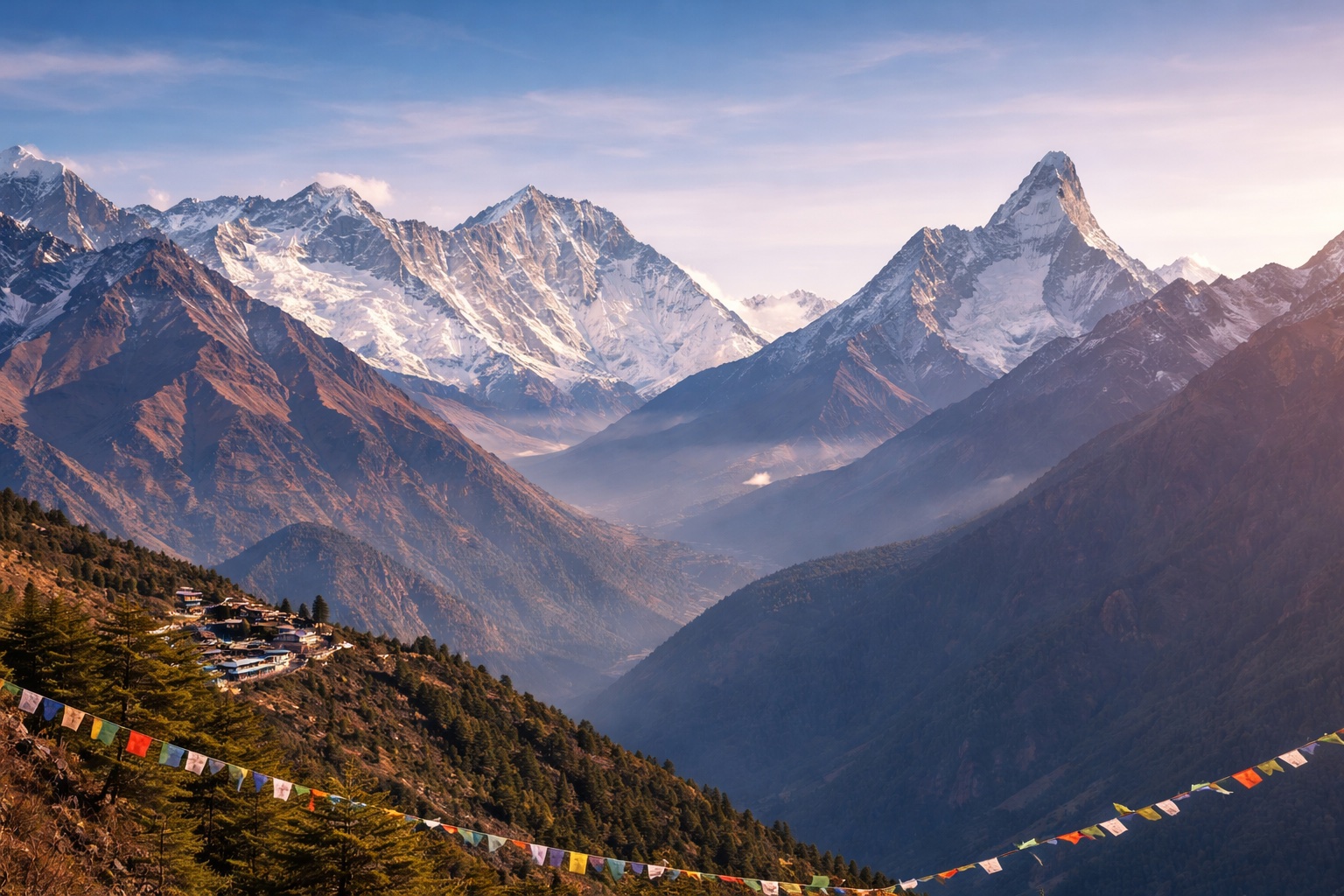
Champadevi Hill (2,278 m) — rising from the ancient town of Kirtipur on the Kathmandu Valley's southwestern rim — is the only day hike from Kathmandu that combines a Himalayan panorama including distant Everest and the Langtang range with a cultural trail passing active Hindu and Buddhist shrines, the cave hermitages of Pharping, and Dakshinkali — Nepal's most visited goddess temple. A circuit of the valley's southwestern sacred landscape in a single rewarding day.
Champadevi Hill (2,278 m) is the principal summit on the Kathmandu Valley's southwestern rim — a forested ridge rising above the ancient hilltop city of Kirtipur and the valley's most sacred Buddhist pilgrimage quarter around Pharping and Dakshinkali. The hill provides the only accessible day-hike viewpoint on the valley's southern side that delivers a genuine Himalayan panorama — including, in clear conditions, the distant white pyramid of Mount Everest (8,849 m) visible above the eastern ridgeline, alongside Ganesh Himal to the northwest, the Langtang range to the north, and the Annapurna massif to the west. This 360-degree mountain view — seen from the valley's southern rim rather than its familiar northern edge — provides a geographical perspective on the Kathmandu Valley that the more popular northern viewpoints (Nagarkot, Shivapuri, Sarangkot) do not offer.
The cultural density of the Champadevi circuit is exceptional. The approach trail from Kirtipur (one of the Kathmandu Valley's seven medieval cities, historically the last to resist the Prithvi Narayan Shah unification campaign and retaining the most complete medieval urban fabric of any valley town) passes the Uma Maheshwar Temple, the Chilanchu Stupa (an ancient Newari stupa at the hill's entry point), and the Champadevi Temple at the summit — a small but intensely active Hindu goddess shrine attended by local devotees year-round. The descent through Pharping delivers the Kathmandu Valley's most concentrated sacred Buddhist landscape: the Dakshinkali-Pharping area contains the cave hermitage of Asura Cave (where Guru Rinpoche is said to have meditated and left a body impression in the rock), the Yangleshö Cave (where Guru Rinpoche is said to have attained the Vajrakilaya realization), the Pharping Monastery, and the Shesh Narayan Temple complex — making the descent route one of the richest 2-km sacred geography walks in Nepal.
Kirtipur is the most historically significant of the Kathmandu Valley's seven medieval cities from a political perspective: the hilltop fortified town — built on a natural defensive ridge overlooking the valley floor — was the last city to hold out against Prithvi Narayan Shah's unification campaign that ended the Valley's independent era in 1768. The town resisted two sieges before falling in 1768, and the penalty was severe — the king ordered the noses and lips of all men in the city cut off as punishment. Despite this brutal history (or perhaps because of it), Kirtipur has maintained a distinct civic identity and an exceptional quality of medieval architecture in its central lanes: the Bagh Bhairab Temple, the weapons and armour collection mounted on its exterior walls, and the winding stone streets of the old hilltop town are among the finest medieval urban environments in Nepal.
The descent from Champadevi through Pharping brings you to Nepal's most celebrated goddess temple — Dakshinkali, a shrine to the goddess Kali set in a natural rock cleft at the confluence of two streams in a wooded gorge. The temple is the destination of Nepal's largest regular animal sacrifice — conducted every Tuesday and Saturday, when hundreds of devotees bring chickens, goats, and ducks for ritual sacrifice to Kali. The spectacle is confronting and authentic in equal measure: the drumming, the flower offerings, the smoke of the sacred fire, and the scale of devotion in Nepal's most actively visited goddess temple create an experience of Hindu religious life at full intensity that few visitors to Kathmandu encounter elsewhere. Dakshinkali is approximately 22 km from Kathmandu and is the natural finish point for the Champadevi circuit day.
Yes — on clear days in October, November, and March, the distant summit of Mount Everest is visible from the Champadevi ridge as a tiny white pyramid above the eastern ridgeline of the Kathmandu Valley, approximately 145 km away. The view requires exceptional clarity (low atmospheric haze) and some experience in identifying peaks at distance — our guide will point out the Everest position and help you confirm the identification. The view is not dramatic at this distance (Everest appears as a modest white point, not the enormous mountain visible from the Khumbu), but the experience of identifying the world's highest peak from a city-edge day hike is genuinely satisfying. The Langtang range, Ganesh Himal, and (on clear days) the Annapurna massif provide more visually dominant mountain content from Champadevi.
Asura Cave at Pharping is one of the most sacred sites in Tibetan Buddhism accessible in the Kathmandu Valley. According to the tradition maintained by the Nyingma lineage, the Indian master Guru Rinpoche (Padmasambhava) — the 8th-century teacher credited with bringing Buddhism to Tibet — meditated in this cave and achieved a specific realisation (the Vajrakilaya tantric transmission) while in retreat here. The evidence cited for this claim by the tradition is a body-sized impression in the cave's rock wall that is identified as the physical trace of Guru Rinpoche's meditation posture — a phenomenon similar to the hand and footprints attributed to Guru Rinpoche at other sacred sites across the Himalayan world. The adjacent Yangleshö cave is identified as the site of the actual realisation. For practitioners of Nyingma and Vajrayana Buddhism, these caves are sites of profound pilgrimage significance comparable to the Mahabodhi Temple at Bodh Gaya in India.
Dakshinkali is Nepal's most actively practised animal sacrifice site and the scenes of ritual slaughter — particularly on Tuesday and Saturday, when sacrifices are most frequent — are not appropriate for young children (under 10) or for adults who are sensitive to blood. On other days (Monday, Wednesday, Thursday, Friday, Sunday), the temple is active but much less intense — fewer animals, more flower and fruit offerings, and a quieter devotional atmosphere. Our guide briefs all visitors about what to expect before entering the temple area and adjusts the visit timing accordingly. If you are visiting with young children or have concerns about the sacrifice context, we recommend scheduling the Champadevi circuit on a non-Tuesday/Saturday, or skipping Dakshinkali itself and ending the day at Pharping.
The two hikes are very different in character and cultural content. The World Peace Pagoda hike (Pokhara, 1,100 m) is a short, relaxed half-day combining Japanese Buddhist architecture, a lake boat crossing, and a forest trail with a clear mountain panorama — a meditative, visually beautiful experience. The Champadevi circuit (Kathmandu, 2,278 m) is a full-day journey through layers of Nepali cultural and religious history — medieval city, Hindu summit temple, Buddhist cave hermitages, and the full intensity of the Dakshinkali goddess tradition — with a longer and more demanding trail. Champadevi is the right choice for visitors who want to engage deeply with the Kathmandu Valley's sacred geography and cultural complexity. The Peace Pagoda is the right choice for a shorter, more contemplative experience in Pokhara.