
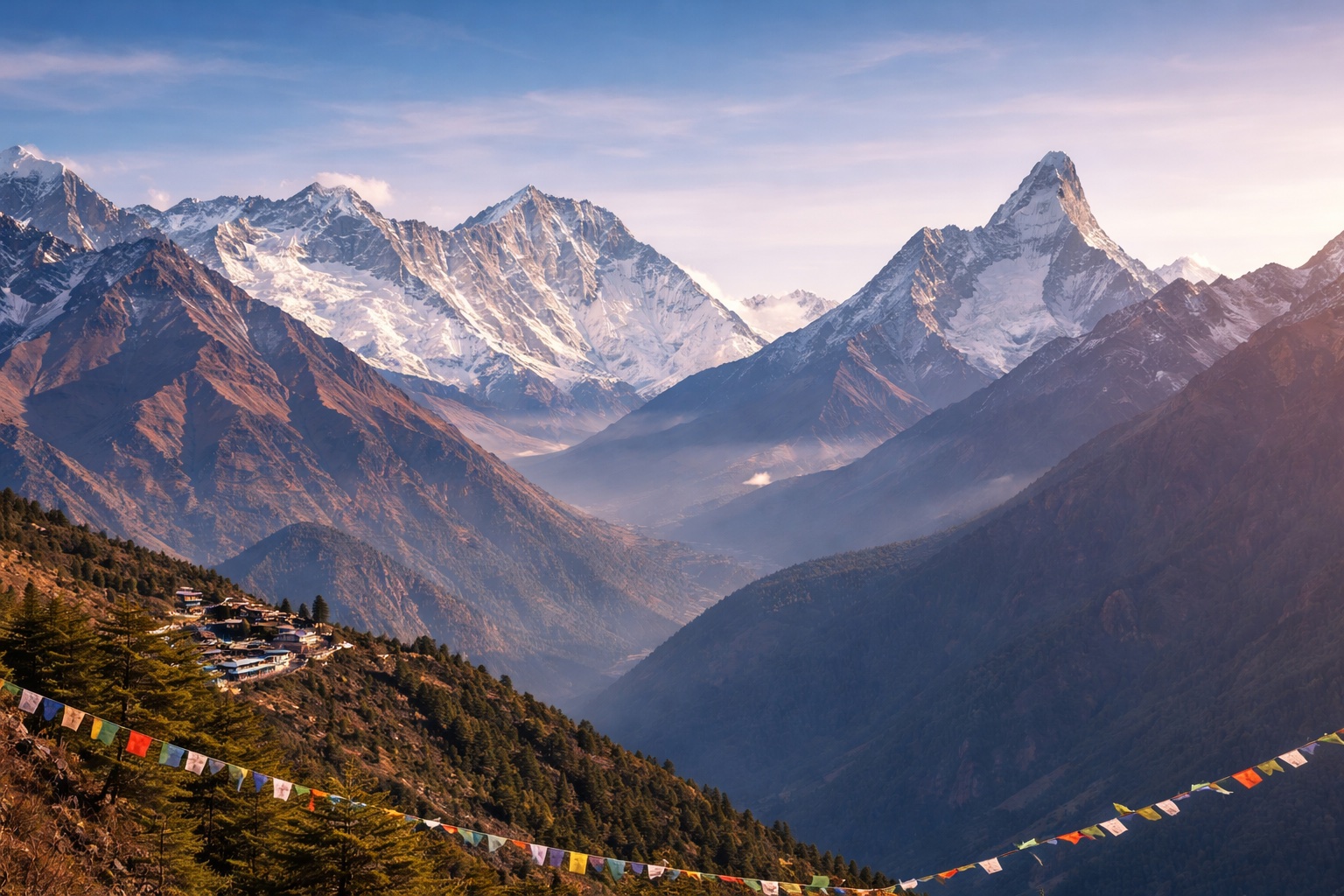
Trek through the authentic Tamang villages of the Langtang foothills — a route unchanged by mass tourism. Ancient Buddhist monasteries, traditional stone houses, spectacular Langtang and Ganesh Himal views, and the warmth of one of Nepal's most welcoming mountain peoples.
The Tamang Heritage Trail is one of Nepal's best-kept trekking secrets — a seven-day circuit through the Tamang villages of the Langtang foothills that offers everything the famous Everest and Annapurna routes deliver — Himalayan scenery, Buddhist cultural immersion, traditional mountain life — without the crowds, the cost, or the altitude demands that make those routes inaccessible for many travellers. At a maximum elevation of 3,165 m, the Tamang Heritage Trail is Nepal's most rewarding moderate trek, and among trekkers who have done it, it is consistently described as the single most culturally rich short walk in the Himalayas.
The Tamang people are one of Nepal's largest indigenous ethnic groups — a Tibetan-origin people who have lived in the hills north of Kathmandu for centuries, maintaining a language, material culture, and Buddhist religious tradition that is distinct from both the Sherpa culture of the Khumbu and the Gurung culture of the Annapurna region. The Tamang Heritage Trail was developed in the early 2000s specifically to route trekking through villages where Tamang culture remains strong and visible — where home-stay hospitality connects visitors directly with family life, where the gompas (monasteries) are centuries old and still actively used, and where the agricultural terraces, the style of dress, and the weaving traditions are the same ones that Tamang communities have maintained since their ancestors migrated from Tibet.
The trail begins at Syabrubesi (1,503 m) in the Rasuwa district — the same valley that serves as the gateway to Langtang National Park — and circuits through five of the region's most significant Tamang settlements. Briddim (2,250 m) is perhaps the finest traditional Tamang village surviving in Nepal — a compact cluster of stone houses with carved wooden windows and prayer flags, surrounded by terraced barley fields, with a 17th-century monastery at its centre. Tatopani offers natural hot springs on the banks of the Bhote Koshi, used by villagers and trekkers alike for bathing and relaxation. Gatlang (2,238 m) is the largest and most architecturally complete Tamang village on the trail — the slate-roofed houses, the water mills, and the Parvati Kund sacred lake above the village combine to create a cultural landscape of extraordinary integrity. Nagthali Ghyang (3,165 m), the high point of the trail, offers a 360° panorama of the Langtang, Ganesh Himal, Jugal Himal, and on clear days the distant Annapurna and Manaslu massifs — from a vantage point that fewer than a few thousand trekkers per year ever see.
Buddhism in the Tamang communities predates the formal introduction of Tibetan Buddhism into Nepal by centuries, and the religious practice of the trail's villages retains archaic elements — shamanic ritual practices blended with Vajrayana Buddhist ceremony — that scholars of Himalayan religion find uniquely significant. The gompas at Briddim and Gatlang both contain thangka paintings and bronze ritual objects that are estimated to be between two and four centuries old. The Nagthali Ghyang monastery sits at the hill's summit beside the trekker viewpoint, its prayer flags strung against the backdrop of the Langtang Himal in a composition that photographers describe as one of the most dramatic in Nepal trekking. Village lamas continue to perform daily puja (prayer) rituals and seasonal festival ceremonies — trekkers who time their visit to coincide with Losar (Tibetan New Year, February–March) or Dashain (autumn) encounter religious celebrations of a depth and authenticity that the heavily touristed circuits of Khumbu and Annapurna rarely offer.
A defining feature of the Tamang Heritage Trail is the availability of community home-stay accommodation in Briddim, Gatlang, and other villages — an arrangement managed by the Tamang Heritage Trail community homestay programme. Staying in a Tamang family home rather than a standard tea house means sleeping in the family's guest room, eating meals cooked on the family's hearth, and spending evenings in conversation with your hosts — often facilitated by your guide — about village life, traditional farming, Buddhist festivals, and the changes that have reached the Tamang communities over the past generation. The home-stay income goes directly to the host family rather than an outside investor. This is culturally responsible tourism at its most direct.
The trail's relatively low profile in international trekking marketing is almost entirely a product of its moderate altitude — international trekkers conditioned by the narrative of "Himalayan trekking means high altitude and challenge" often overlook a route whose maximum elevation is 3,165 m. This is the Tamang Heritage Trail's greatest underappreciated advantage. You can walk it in better physical condition, with less altitude-related stress, and with more energy for cultural observation and photography than any high-altitude route allows. The villages are warmer, the food is more varied, the gompas are accessible without a 4 am start, and the human connections are deeper. Among experienced Nepal trekkers who have done both the Tamang Heritage Trail and the EBC route, the Heritage Trail is frequently described as the more memorable cultural experience.
The Tamang Heritage Trail lies within the Langtang National Park buffer zone and requires a TIMS card and a Langtang National Park entry permit (NPR 3,000). The trailhead at Syabrubesi is a 4–5 hour drive from Kathmandu via the Trishuli valley — a road journey through the gorges of the Trishuli River that is itself scenic enough to constitute an attraction. All permits are arranged and included in our package price.
Yes — it is one of Nepal's best options for first-time trekkers. The maximum altitude of 3,165 m means no acclimatisation is required. Daily walks of 4–6 hours on well-maintained trails are achievable for anyone with reasonable fitness. The home-stay accommodation and the cultural richness of the route make it particularly rewarding for travellers who want more than a physical challenge from their Nepal experience.
The Langtang Valley Trek goes deeper into the national park and reaches higher altitude (Kyanjin Gompa at 3,870 m). The Tamang Heritage Trail stays in the buffer zone villages and focuses on cultural immersion rather than altitude gain. The Heritage Trail has better home-stay accommodation, more authentic village life, and significantly fewer trekkers. Many experienced Nepal travellers rate the Heritage Trail as the more culturally meaningful experience of the two routes.
Two permits: (1) TIMS Card (USD 20 per person) and (2) Langtang National Park Entry Permit (NPR 3,000 / approx. USD 22). Both are included in our package price. The Heritage Trail does not require a restricted area permit — it is fully accessible without the special permits needed for routes like Manaslu or Upper Mustang.
March–April and October–November are ideal. Spring brings rhododendron blooms throughout the forest sections and clear mountain views. Autumn (October–November) has the best mountain visibility and the most stable weather. December–February is cold but possible — the villages are quiet and beautiful in snow. Monsoon (June–September) brings rain and leeches — not recommended.
The community home-stays at Briddim and Gatlang are managed by village-level cooperatives. Rooms are simple — foam mattress, woollen blankets, shared squat toilet in most cases — but the meals are home-cooked Tamang food (dal bhat, gundruk soup, maize bread) and the experience of eating with the family, watching the host prepare the meal on the hearth, and talking through your guide about village life is genuinely one of the most memorable things you can do in Nepal trekking.