
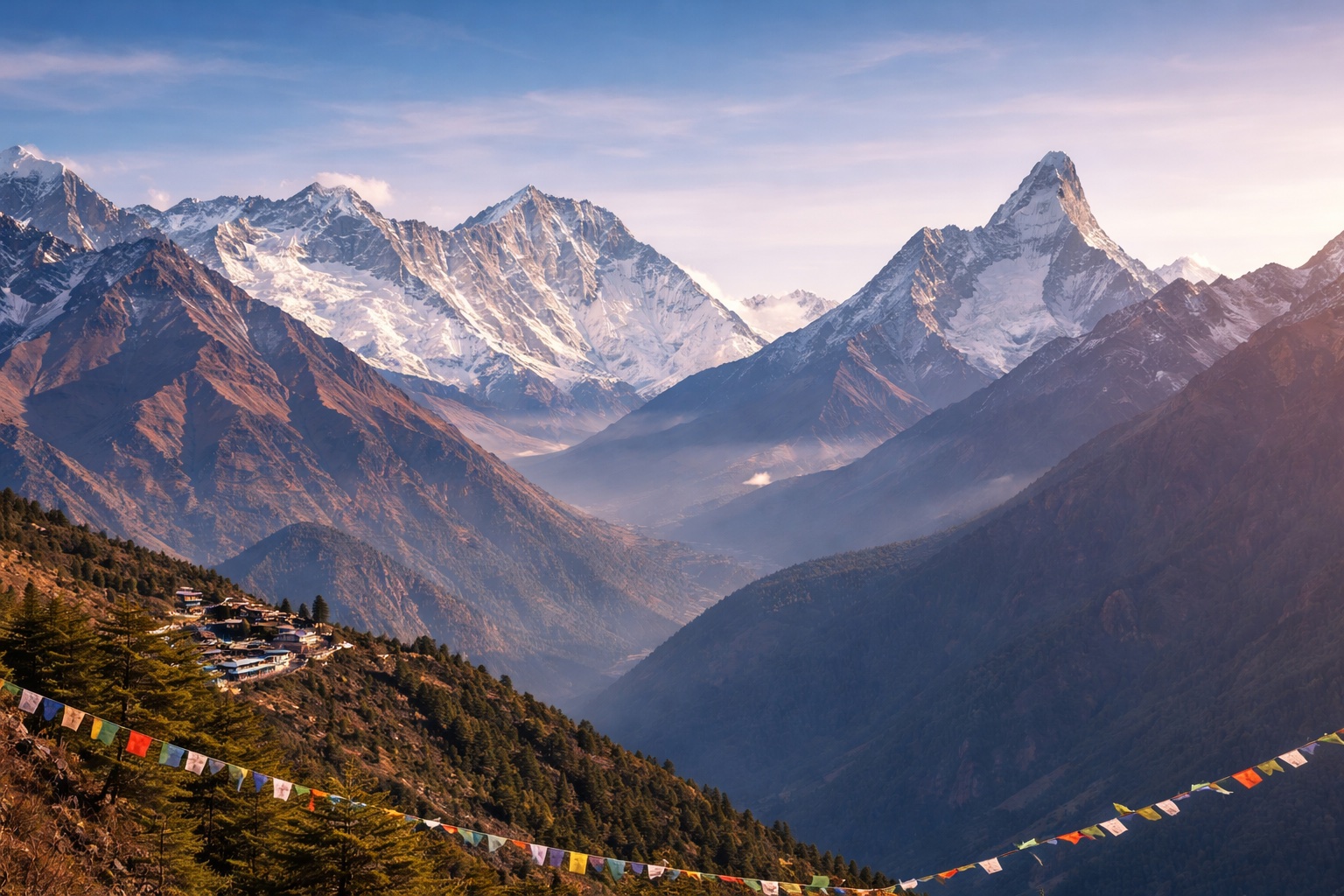
Trek to the base of Makalu (8,485 m) — the world's 5th highest mountain and Nepal's most remote 8,000 m peak. A 14-day wilderness journey through Makalu-Barun National Park — Nepal's most biodiverse protected area — with almost no other trekkers on the trail.
Makalu (8,485 m) is the fifth-highest mountain on Earth and the most isolated of Nepal's eight 8,000-metre peaks — its northeast buttress and southeast ridge rising from the floor of the Arun River valley in eastern Nepal, visible from Kala Patthar and the EBC approach as a distant but unmistakable four-sided pyramid east of the main Khumbu massif. The mountain is technically one of the world's most demanding 8,000-metre climbs — no technical route on Makalu is straightforward, and the French Northeast Ridge route (the most frequently attempted) involves sustained difficult climbing above 7,000 m. But the approach to Makalu Base Camp — the walk through the Makalu-Barun National Park and the Barun Valley to the high camp at Shershon (5,000 m) — is a trekking objective of extraordinary quality that very few trekkers discover because the route requires its own flight, permit, and significant logistical planning that most agencies don't offer.
The Makalu-Barun National Park, established in 1992, protects one of the most biodiverse areas in Asia — a vertical range from tropical forest at 435 m to permanent ice above 8,000 m within the same protected area. 25 types of forest, over 3,000 flowering plant species, 440 bird species (the highest count of any area that size in South Asia), snow leopard, red panda, Himalayan tahr, clouded leopard, and the four-horned antelope are all documented in the park. For naturalists and serious birdwatchers, the Makalu-Barun approach through the Arun valley is one of the finest natural history transects available to a trekker anywhere in Asia.
The upper Barun Valley — the glaciated valley that leads directly to Makalu Base Camp from the south — is one of Nepal's genuine wilderness routes. The trail from Tashigaon follows the Barun River for two days before entering the Barun glacier system, passing through forest that grades from subtropical in the lower valley to subalpine at 4,000 m to permanent ice and moraine at 5,000 m. This ecological gradient — which scientists use as a model for studying climate change impacts on Himalayan biodiversity — is also a trekker's progression through every vegetation zone in the eastern Himalaya, each with its own bird community, flowering plants, and mammal species. The trail through the upper Barun is one of the most likely places in Nepal to sight red panda, which uses the bamboo zones between 2,000 and 4,000 m. Snow leopard tracks are seen seasonally above 4,000 m on the approach to the glacier.
Shershon (5,000 m) is the advanced Base Camp used by Makalu expeditions and the trekking community's high point on the standard approach — a broad glacial moraine platform with Makalu's southeast ridge rising directly above and the full south face of the mountain filling the entire northern horizon. The experience of arriving at Shershon after twelve days of walking from the Tumlingtar airstrip — having passed through tropical forest, temperate oak and rhododendron woodland, subalpine meadows, and the permanent ice of the glacier approach — and seeing Makalu's enormous 3,000-metre south face above you is one of the most dramatically earned mountain encounters available in Nepal trekking. There is no shortcut to this view: it requires the walk, the altitude, and the total disconnection from the world below.
Three factors keep Makalu Base Camp among Nepal's least visited major trekking destinations. First, the access flight to Tumlingtar Airport requires planning — it operates on a limited schedule and weather dependency is higher than Lukla. Second, the route requires camping for most of the upper section — there are no tea houses above Tashigaon. Third, the route lacks the brand recognition of the EBC and Annapurna circuits — it is never mentioned in first-time Nepal trekking planning and requires a trekker who has specifically sought it out. The reward for doing so is a mountain base camp experience that, in terms of raw scale and solitude, is arguably superior to Everest Base Camp — Makalu's 3,000-metre south face is larger than the view of Everest from EBC — without the 40,000 annual visitors, the helicopter noise, or the city of coloured tents that makes Everest Base Camp during peak season feel less like wilderness and more like a mountain festival.
Three main reasons: access requires a domestic flight to Tumlingtar (less frequent than Lukla flights); the upper section requires camping rather than tea houses; and the route has never received the media and marketing attention of EBC and Annapurna. The result is a base camp experience that is objectively comparable in scale to EBC — Makalu's 3,000 m south face is enormous — but without the crowds, the helicopter noise, and the commercial infrastructure. Under 500 trekkers per year reach Shershon vs 40,000+ at EBC.
Makalu-Barun National Park has Nepal's highest recorded bird diversity (440+ species). Lower sections: hornbills, minivets, laughing thrushes, giant squirrels, langur monkeys. Bamboo zone (2,000–4,000 m): red panda — the most reliable sighting zone in Nepal for this species. Above 4,000 m: Himalayan tahr, Himalayan monal, snow cock, alpine choughs. Snow leopard: tracks regularly seen by our guides above 4,000 m, sightings possible particularly in spring.
Yes — from Tashigaon (Day 4) to Shershon and back, the trek is on a camping basis. Our team provides all camping equipment: tents, sleeping mats, kitchen tent, and cooking equipment. You bring your sleeping bag (we also provide loan bags). The lower sections (Num to Tashigaon) have basic tea house accommodation. The camping is part of what makes the Makalu approach feel genuinely remote.
Two permits: Makalu-Barun National Park Entry Permit (NPR 3,000 / approx. USD 22) and TIMS Card (USD 20). No restricted area permit is required. Both are included in our package price.
EBC at 5,364 m is slightly higher than Shershon at 5,000 m. EBC receives 40,000+ trekkers per year; Makalu under 500. EBC is fully tea-housed; Makalu requires camping above Tashigaon. The mountain view: Everest from EBC shows the Khumbu Icefall and the South Col route; Makalu from Shershon shows the full 3,000 m south face and the Southeast Ridge — arguably a more overwhelming close-range mountain experience because Makalu's face is steeper and more continuous. Both base camps are extraordinary. Makalu is for trekkers who want the mountain without the crowd.