
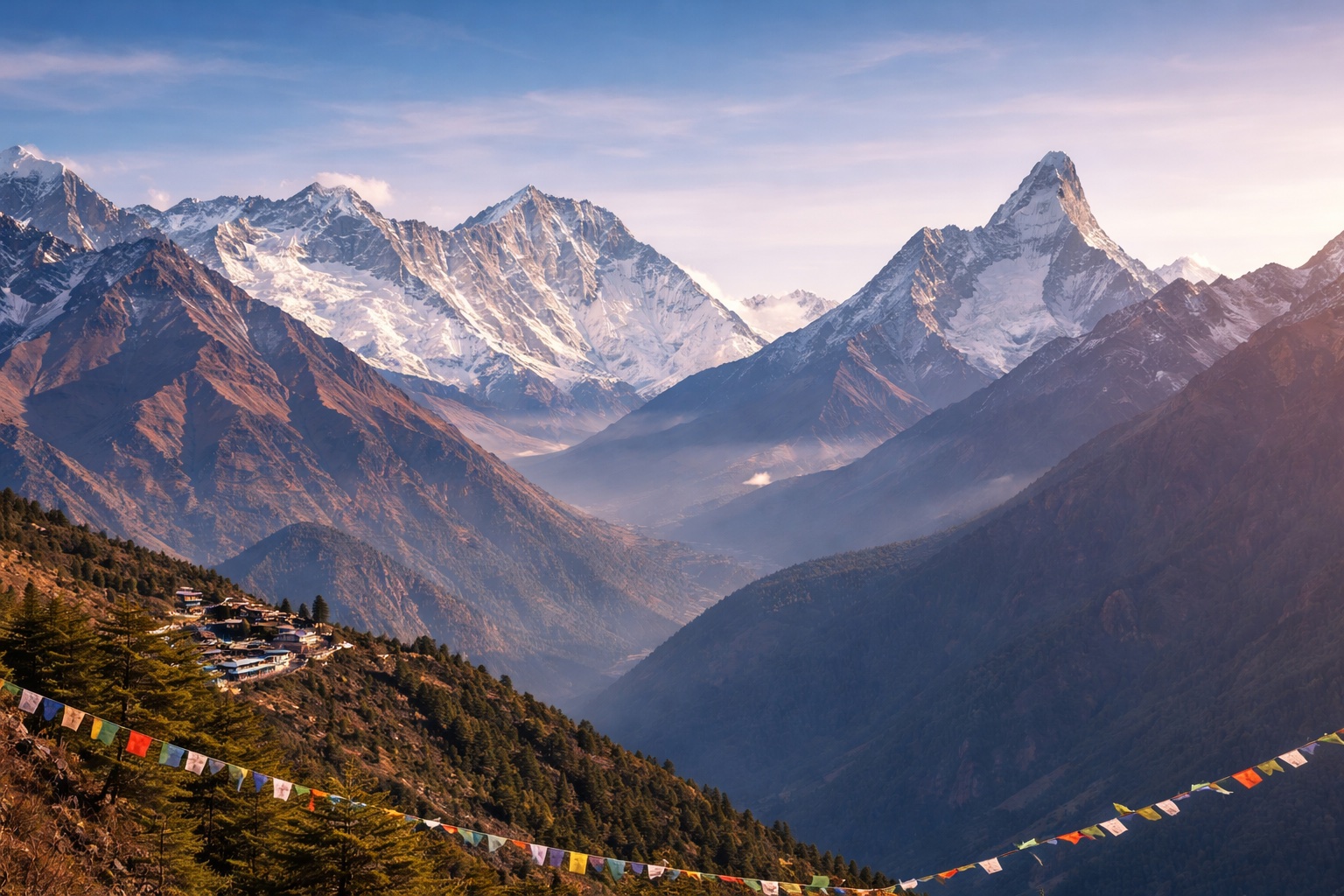
Trek to the base of Mardi Himal (5,587 m) through dense rhododendron forests and open ridgelines above Pokhara. A 7-day off-the-beaten-path adventure with jaw-dropping views of Machapuchare (Fishtail), Annapurna South, and Hiunchuli — without the crowds of the main Annapurna routes.
The Mardi Himal Trek is the Annapurna region's best-kept secret. While thousands of trekkers pour along the Annapurna Circuit and Annapurna Base Camp routes every season, the ridge trail that climbs from Pokhara's forest belt to the high camp directly beneath Mardi Himal (5,587 m) remains blissfully quiet — a genuine off-the-beaten-path experience in one of Nepal's most dramatic mountain settings.
Opened to independent trekkers in 2012, the Mardi Himal route has become one of the fastest-growing treks in Nepal because it delivers everything travellers come to the Himalayas for — alpine forests, high ridgelines, close-range glacier views, and the warmth of Gurung mountain hospitality — packed into a manageable 7-day itinerary that does not require the two-week commitment of the classic circuits.
The trek begins at Kande, just 45 minutes from Pokhara by road, and immediately enters the rhododendron and oak forest of the Annapurna Conservation Area. The first two days are a gradual ascent through dense forest corridors, passing through small Gurung villages and emerging onto the upper ridge at Forest Camp (2,620 m) and Low Camp (2,985 m).
From Low Camp onwards, the trail follows the open ridge with the Annapurna massif emerging in full on the right and the entire Pokhara Valley visible far below on the left. The forest thins, the wind picks up, and the scale of the mountains becomes overwhelming. High Camp (3,580 m) is the trek's main base — from here, most trekkers make the same-day push to the upper viewpoint at 4,200–4,500 m for the closest possible view of Machapuchare (6,993 m) — Nepal's sacred and permanently unclimbed peak — and the full south face of Annapurna South (7,219 m).
The Mardi Himal Trek is the ideal introduction to Himalayan trekking. At 7 days, it fits comfortably within a 10–14 day Nepal trip. The maximum elevation of 4,500 m at the upper viewpoint is high enough to feel genuinely Himalayan — with the associated cold, the altitude effects, and the thin-air exhilaration — but well within reach of any reasonably fit person who walks regularly. There is no technical climbing, no glacier crossing, and no requirement for mountaineering equipment.
The tea house infrastructure on the Mardi Himal route is newer and cleaner than on the older Annapurna routes — most lodges have been built within the last decade and many offer attached bathrooms, hot showers, and reliable charging facilities. Food quality is good throughout, with the standard Himalayan tea house menu of dal bhat, noodle soup, fried rice, pasta, and baked goods supplemented by excellent local honey and buckwheat pancakes.
Machapuchare, the Fishtail Mountain, is the defining visual feature of the Mardi Himal Trek. From the upper ridge and High Camp, this peak is not a distant spike on the horizon but a vertical wall of rock and ice that fills the northern view from top to bottom. The mountain has been closed to climbing since 1957 — a single British expedition reached within 50 metres of the summit before turning back out of respect for the peak's sacred status as the home of the god Shiva. It has never been climbed, and the Nepalese government has shown no sign of reopening it. Seeing Machapuchare from the Mardi Himal ridge, at a distance where you can make out individual ice cliffs and rock buttresses, is one of the most visceral mountain experiences in Nepal.
The lower sections of the Mardi Himal Trek pass through Gurung villages — communities of Nepal's most famous martial ethnic group, historically the backbone of the Gurkha regiments. Gurung village architecture is distinctive: stone-walled houses with carved wooden windows and rooftop grain stores, arranged around central community platforms and communal water spouts. The people are warm and direct, proud of their culture, and accustomed to hosting foreign trekkers without losing the genuine character of village life.
The entire route lies within the Annapurna Conservation Area Project (ACAP) — Nepal's largest protected area at 7,629 sq km. ACAP has been internationally recognised as a model for community-based conservation — one that integrates local economic benefit with wildlife protection and sustainable tourism. Your ACAP permit fee funds local conservation programmes directly.
One of the great advantages of the Mardi Himal Trek is its proximity to Pokhara — Nepal's adventure capital and the country's most beautiful city. The trek begins and ends in or near Pokhara, making it easy to spend two or three extra days on Phewa Lake, try paragliding from Sarangkot, visit the International Mountain Museum, or take a sunrise drive to Sarangkot for the Annapurna panorama. Pokhara is also the gateway for rafting on the Seti and Kali Gandaki rivers, mountain biking in the Annapurna foothills, and zip-lining above the lake.
Our standard itinerary includes one night in Pokhara before the trek and one night after — bookending the mountain experience with the comfort of lakeside restaurants, good coffee, and hot showers in a proper hotel room.
The Mardi Himal Trek is graded moderate — suitable for anyone with a reasonable base fitness level who walks regularly. The maximum elevation is around 4,500 m at the upper viewpoint, which is high enough to cause mild altitude symptoms in some people (headache, fatigue, disturbed sleep) but well below the threshold where serious altitude sickness becomes common. The steepest section is the final push from High Camp to the viewpoint — about 600 m of altitude gain on a rocky path. No technical climbing, glacier travel, or mountaineering experience is required.
October to December is peak season — post-monsoon skies are crystal clear and the mountain views are at their sharpest. March to May is the spring season and arguably the most beautiful time: rhododendron forests along the lower ridge bloom explosively in red and pink, and temperatures are warmer at altitude. December to February is cold (below -10°C possible at High Camp) but clear and snow-covered — beautiful but requires proper cold-weather gear. The monsoon (June–September) makes the lower forested sections slippery and the views poor; this season is not recommended.
The trail is relatively straightforward and increasingly well-signed, but we strongly recommend a guide for three reasons: first, the upper ridge and the approach to the viewpoint require local knowledge in poor visibility or snow conditions; second, tea house booking in advance is important during peak season and guides handle this; third, Nepal requires a registered guide for ACAP permit compliance. Our licensed guides are fluent in English, trained in Wilderness First Aid, and carry satellite communication devices on all treks.
Two permits are required: the ACAP (Annapurna Conservation Area Project) permit (NPR 3,000 / approx. USD 22.50) and the TIMS (Trekkers' Information Management System) card (NPR 2,000 / approx. USD 15 for organised groups). Both are included in our package price and arranged by our team before the trek departs. You will need your passport and two passport photos.
The fastest option is a 25-minute domestic flight — there are 6–8 flights daily between Kathmandu and Pokhara operated by Buddha Air, Yeti Airlines, and Shree Airlines. One-way fares are typically USD 80–120. The tourist bus from Thamel (Kathmandu) to Lakeside (Pokhara) takes 6–7 hours and costs USD 12–18. Our package includes arrival and departure transfers within Pokhara. For clients adding Pokhara to a Kathmandu arrival itinerary, we can arrange all Kathmandu–Pokhara–Kathmandu transport.
Yes. Nepal is consistently rated one of the safer adventure travel destinations in Asia, and the Annapurna region specifically is well-established for solo female trekkers. Our guides are trained professionals who accompany all clients throughout the trek. The tea house communities on the Mardi Himal route are welcoming and experienced with international visitors. We have guided many solo female clients on this trek and have received consistently positive feedback about the experience.