
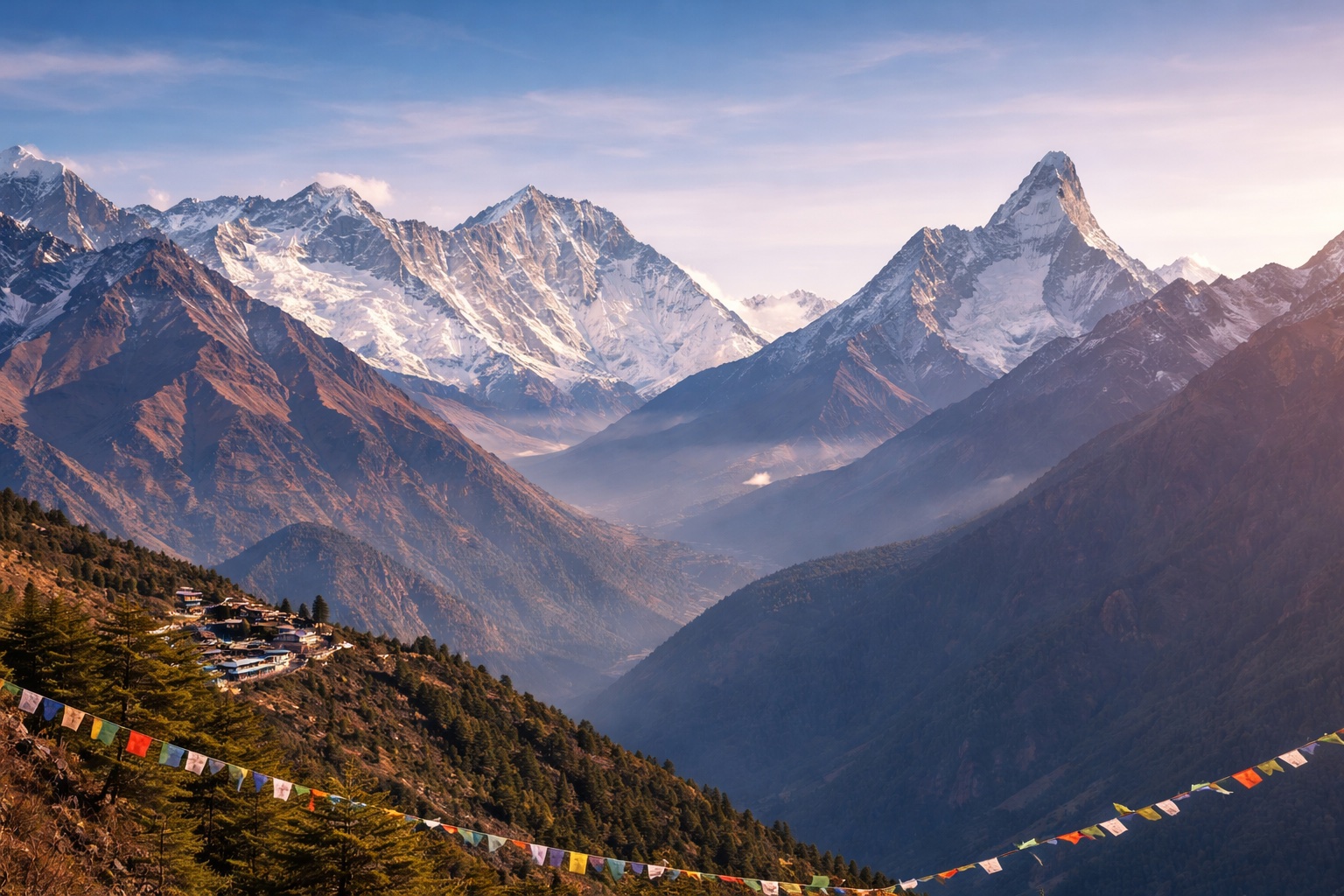
Trek through the legendary Khumbu valley, crossing iconic suspension bridges and Buddhist monasteries to reach Everest Base Camp (5,364 m) and Kala Patthar (5,545 m) — the most iconic trek in the world.
The Everest Base Camp (EBC) trek is a high-altitude trekking route in the Khumbu region of northeastern Nepal, leading to the southern base camp of Mount Everest at 5,364 metres (17,598 feet) above sea level. It is widely regarded as one of the greatest trek experiences on earth — not because of technical difficulty, but because of the sheer grandeur of the landscape, the deeply spiritual Sherpa culture woven into every village, and the magnetic pull of the world's highest peak looming larger with every day's walk.
Unlike mountaineering expeditions, no ropes, ice axes, or special climbing skills are required. What you need is solid cardiovascular fitness, a patient acclimatization schedule, and genuine respect for altitude. Thousands of trekkers from all walks of life — students, retirees, first-time hikers — successfully complete this route every season.
The journey typically begins with a short, adrenaline-charged flight from Kathmandu to Lukla (2,840 m), and then unfolds over 12 to 16 days through terraced hillside villages, rhododendron forests, suspended steel bridges over roaring glacial rivers, Buddhist monasteries fragrant with juniper incense, and finally the austere moraine fields of the Khumbu Glacier.
Nepal's trekking calendar is defined by its monsoon cycle. The two prime windows offer strikingly different moods on the trail.
The EBC trek is rated moderate to strenuous — a category that means most healthy, moderately active people can complete it with 2–3 months of dedicated preparation. There is no technical climbing, no glacier crossing, and no ropes required. The trail is a well-worn footpath for its entire length.
The primary challenge is altitude. Above 3,000 m, your body requires time to adjust to thinner air. Acute Mountain Sickness (AMS) can affect anyone regardless of fitness level, age, or experience. The golden rule is simple: climb high, sleep low — ascend during the day, descend to sleep, and never gain more than 400–500 m of sleeping altitude per day above 3,000 m.
Every trekker must carry two official documents on the Everest trail. Checkpoints are enforced — you will be turned back without them.
The entire EBC route is serviced by tea houses — family-run guesthouses that provide a basic private or shared room, blankets, and a communal dining room. Standards range from surprisingly comfortable lodges in Namche Bazaar (some with en-suite bathrooms and wifi) to more spartan wooden rooms at Gorakshep and Lobuche.
Expect shared squat toilets above Namche, no central heating (just a communal wood or yak-dung stove in the dining room), and beds with thick woollen blankets. A quality sleeping bag is essential — tea house blankets alone will not be sufficient above 4,500 m.
Higher-end lodges like the Yak Hotel in Dingboche or the Pyramid International Laboratory in Lobuche offer slightly elevated comfort at a premium. During peak season (October, April–May), book in advance through your agency.
Keep your pack light (8–10 kg max in your day bag; porters carry heavier duffel bags). Layers are the key strategy for managing wide temperature swings — it can be 15°C at noon and −10°C at night above 4,500 m.
The EBC trek is rated Challenging. You do not need technical climbing skills, but you must be physically fit and mentally prepared for high-altitude hiking (up to 5,545 m at Kala Patthar). Daily walks of 5–8 hours on rocky trails require good cardiovascular fitness. Prior trekking experience is strongly recommended.
Everest Base Camp sits at 5,364 m (17,598 ft). However, the highest point of the trek is Kala Patthar at 5,545 m (18,192 ft), which you reach on Day 10 for the famous sunrise panorama of Everest and surrounding peaks.
Our standard itinerary is 14 days from Kathmandu to Kathmandu, including two critical acclimatisation days — one in Namche Bazaar (Day 4) and one in Dingboche (Day 7). These rest days are non-negotiable for safe ascent above 4,000 m.
You need two permits: (1) TIMS Card (Trekkers' Information Management System) and (2) Sagarmatha National Park Entry Permit. Both are included in our package price and arranged by our team before departure from Kathmandu.
The two best trekking windows are Spring (March–May) and Autumn (September–November). Spring offers rhododendron blooms and pre-monsoon clarity. Autumn has the clearest skies and most stable weather. Winter (Dec–Feb) is possible but very cold above 4,000 m. Monsoon (June–August) brings heavy rain, leeches, and trail closures.
Prior trekking experience is strongly recommended, though not mandatory. Ideally, you should have completed at least one multi-day hike at altitude before attempting EBC. Fitness training for 2–3 months before the trek — including cardio, hiking with a loaded pack, and stair climbing — significantly improves your experience and success rate.
Acute Mountain Sickness (AMS) occurs when your body fails to acclimatise to reduced oxygen at altitude. Symptoms include headache, nausea, fatigue, and dizziness. Prevention: ascend slowly (our itinerary follows "climb high, sleep low"), stay well hydrated, avoid alcohol, and take the acclimatisation days seriously. Our guides carry supplemental oxygen and Diamox (acetazolamide) for emergencies. Descend immediately if symptoms worsen.
You stay in tea houses (mountain lodges) throughout the trek. Rooms are basic — twin beds with mattresses, pillows, and blankets — but clean and safe. Most tea houses have shared bathrooms (squat or Western toilet, cold shower or bucket shower). In Namche Bazaar and Lukla, some lodges offer hot showers and Wi-Fi. Electricity is available (small fee for charging). Sleeping bags are recommended for extra warmth.
Tea house menus include dal bhat (lentil soup and rice — the trekker's staple), pasta, noodles, soups, omelettes, fried rice, pancakes, porridge, and local Tibetan bread (roti). Prices increase with altitude — a meal in Gorak Shep costs 2–3 times more than in Lukla. Our package includes full-board on trek. Avoid meat above Namche Bazaar as freshness cannot be guaranteed.
Our EBC trek package starts from USD 1,350 per person for a group of 2. This includes domestic flights, permits, guide, porter, and full-board tea house accommodation. Excluded: international flights, Nepal visa (USD 30 for 15 days), travel insurance, personal gear, and tips. Solo trekkers may incur a small supplement.
Yes — travel insurance with helicopter evacuation cover is mandatory. You must have a policy that covers trekking above 5,500 m and emergency helicopter rescue (which can cost USD 3,000–8,000 without insurance). We strongly recommend World Nomads, SafetyWing, or similar specialist adventure travel insurers.
A licensed guide is not legally required for EBC, but it is strongly recommended for safety, navigation, cultural insight, and emergency response. Our experienced Sherpa guides are licensed by the Nepal Tourism Board, know the trail in all weather conditions, and carry first aid equipment. They also liaise with local tea houses and manage logistics seamlessly.
Essential items: down jacket (rated to -15°C), trekking boots (broken in before the trek), waterproof shell jacket and pants, fleece mid-layer, thermal base layers (x2-3), trekking poles, sleeping bag (rated to -10°C), sun hat, warm hat and gloves, sunscreen SPF 50+, lip balm, water bottles (2L), water purification tablets or filter, headlamp with spare batteries, and basic first aid kit with Diamox prescription.
Yes. Tea houses in most villages sell Wi-Fi cards (USD 3–8 per hour or per day). Signal is strongest in Namche Bazaar and weakest near Gorak Shep. NCell and Nepal Telecom SIM cards work in most villages below 4,500 m. Above that, communication is more limited. We recommend downloading offline maps (Maps.me or Gaia GPS) before departure.
You should be able to hike 6–8 hours per day on uneven terrain carrying a daypack of 5–7 kg. A recommended 8-week training programme includes daily walking (building to 2 hours), stair climbing, cycling, and 2–3 weekend hikes with elevation gain. You don't need to be an athlete, but consistent cardiovascular fitness is essential.
Yes. Everest Base Camp has designated toilet facilities managed by expedition teams and the national park authority. Along the trail, tea houses have toilet facilities (varying from Western to squat styles). Bring your own toilet paper and hand sanitiser. Above Namche, expect more basic facilities and please follow Leave No Trace principles.
EBC is not recommended for children under 12 due to the extreme altitude, duration, and physical demands. Children aged 12–16 should have significant prior hiking experience and must be cleared by a doctor. The high altitude poses genuine health risks for young people whose bodies are still developing. We recommend Poon Hill or Langtang Valley for family treks.
Kala Patthar (5,545 m / 18,192 ft) is a prominent peak above Gorak Shep and the highest point of our EBC itinerary. It offers the most accessible and panoramic view of Mount Everest's summit pyramid, Lhotse, Nuptse, Pumori, and the Khumbu Glacier. Most trekkers and mountaineers photograph Everest from here at sunrise, as the summit is partially obscured from EBC itself.
All our licensed guides speak English fluently. Many also speak Nepali, Hindi, and some Sherpa/Tibetan dialects. For other language requirements (French, German, Japanese, Chinese), we can arrange specialist guides with advance notice, subject to availability.
In a medical emergency, our guides will assess the situation and arrange immediate descent on foot or by helicopter. Helicopter evacuations from the Khumbu region are swift — typically 20–45 minutes to Kathmandu hospitals. This is why travel insurance with helicopter evacuation coverage is mandatory. Our guides are trained in wilderness first aid and carry emergency oxygen and an AED kit.
Absolutely. Popular extensions include: Gokyo Lakes (combine EBC with Gokyo Ri via Cho La Pass — 18-20 days), Three High Passes (Kongma La, Cho La, Renjo La — 20 days), Island Peak climbing (add 5 days), and Kalapatthar sunrise photography tours. We can build a fully custom itinerary to match your fitness, timeframe, and interests.
Trekking Langtang in December with snow dusting the forest and almost no other visitors was a completely different experience to the busy seasons. The cold was manageable with the right gear and the clarity of the winter sky made Langtang Lirung look impossibly sharp. The team adapted perfectly to winter conditions.
For two weeks I was genuinely off the grid - no phone signal, no other tourists, just ancient forest, yak herders and the third highest mountain on Earth looming above. Trekking to both North and South Base Camps was a privilege. The agency's logistics in such a remote area were impressive.
A friend convinced me to choose Gokyo over EBC and I am deeply grateful. The turquoise lakes, the quiet of the upper valley, and the Gokyo Ri summit panorama - four 8,000m peaks in one frame - were everything I hoped for. The agency's team was professional, warm and incredibly competent.
Standing at Everest Base Camp was something I had dreamed about for fifteen years. The guides were incredible - patient, knowledgeable, and genuinely passionate about the mountains. Every teahouse meal felt like a warm welcome after a hard day of trekking. I returned home a different person.
I spent a week shooting the Gokyo Lakes region and came home with the best portfolio of my photographic life. The agency accommodated my early morning and late evening schedules without complaint, the guide carried extra lenses without being asked, and the light quality at 4,800 metres is simply extraordinary.