
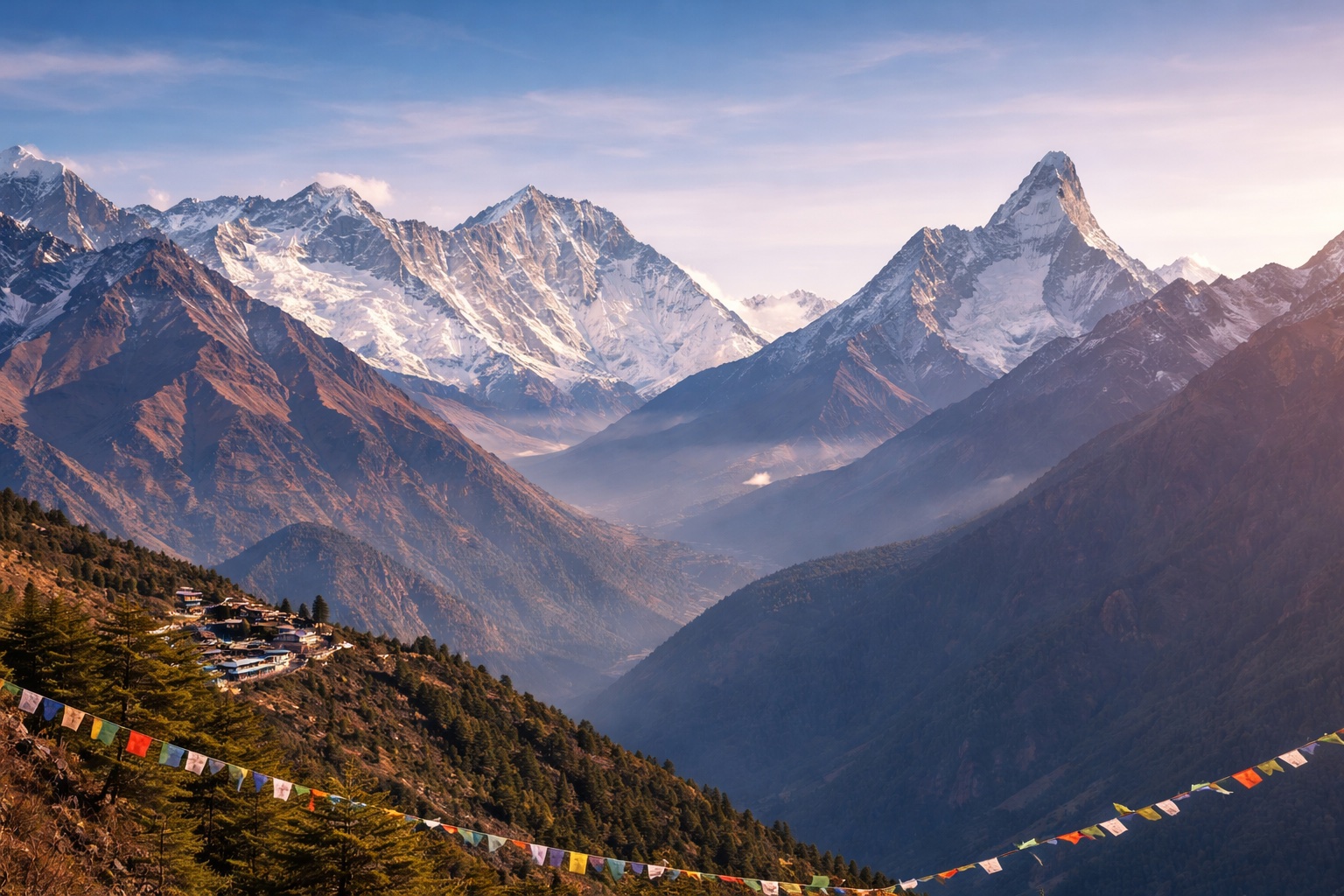
Expedition in Nepal - High-Altitude Mountaineering on the World's Greatest Peaks
Nepal is the undisputed capital of high-altitude expedition mountaineering. Of the world's fourteen peaks above 8,000 metres, eight stand within Nepal's borders - including Everest (8,849 m), the absolute highest point on Earth. Since Edmund Hillary and Tenzing Norgay Sherpa made the first confirmed summit in May 1953, Nepal has been the destination where every serious high-altitude mountaineer ultimately arrives. The expedition culture that has grown around these mountains over seven decades - the permit systems, the Sherpa teams, the Base Camp logistics, the technical knowledge accumulated across thousands of attempts - is the most sophisticated and deep-rooted in the world. There is nowhere else on the planet that offers the same concentration of extreme altitude objectives, the same quality of local expedition support, or the same weight of mountaineering history pressing on every step above Base Camp.
Nepal's Eight 8,000-Metre Peaks
The eight 8,000-metre peaks in Nepal define the absolute top of high-altitude mountaineering ambition. Everest (8,849 m) requires no introduction - the world's highest mountain is Nepal's most famous and most attempted expedition objective, drawing over five hundred permitted climbers in peak spring seasons. Lhotse (8,516 m) shares Everest's South Col approach and is climbed by some teams as a second summit on the same expedition. Makalu (8,485 m), the world's fifth highest, is technically demanding and significantly less climbed than Everest or Lhotse. Cho Oyu (8,188 m), the sixth highest, is approached from the Tibet side but visible from the Gokyo Lakes trek and considered one of the more accessible 8,000-metre climbs. Dhaulagiri (8,167 m), the seventh highest, rises directly from the Kali Gandaki valley in the Annapurna region - a mountain of extraordinary profile and serious technical demands. Manaslu (8,163 m), the eighth highest, is climbed each spring by teams approaching through the Manaslu Circuit valleys. Annapurna I (8,091 m), the tenth highest, is statistically the most dangerous 8,000-metre peak per summit attempt and a mountain of tremendous complexity and history. Kanchenjunga (8,586 m), the third highest, is remote and by tradition partially unclimbed in deference to its sacred status among the Sikkimese people.
Trekking Peaks: Expeditions for Non-Expedition Mountaineers
Nepal's Nepal Mountaineering Association (NMA) trekking peak system was established in 1978 to create a category of expedition objective accessible to motivated non-expedition mountaineers - peaks where the commitment, technical demands, and logistical complexity are real but not at the level of a full 8,000-metre campaign. Thirty-three peaks ranging from 5,587 to 6,654 metres are designated as trekking peaks. The two most popular - Mera Peak (6,476 m) and Island Peak (6,189 m) - receive several thousand climbers annually and are the primary objectives for trekkers making the transition from high-altitude walking to genuine mountaineering.
The trekking peak system's genius is its integration with Nepal's existing teahouse trekking infrastructure. You walk to Base Camp on the same trails used by standard trekkers, sleep in the same lodges, eat the same food - and then, above Base Camp, the experience transitions into genuine mountain camping, glacier travel, and technical climbing. The psychological and physical preparation for the summit day is built into the approach itself, and the altitude acclimatisation gained during the trekking approach is precisely what is needed for the summit attempt. This design makes trekking peak expeditions accessible to a category of adventurer who would never undertake a full mountaineering expedition, while delivering a summit experience that is genuinely extraordinary.
The Three High Passes: An Expedition-Style Trek
The Everest Three High Passes Trek - crossing Kongma La (5,535 m), Cho La (5,420 m), and Renjo La (5,360 m) over twenty days - occupies a category between trekking and expedition mountaineering. The Cho La crossing involves glacier travel and requires crampons; the Kongma La and Renjo La involve sustained effort at above 5,000 metres in conditions that can be severe. The route covers every major feature of the Khumbu region - the Gokyo Lakes, Everest Base Camp, and Kala Patthar - in a single comprehensive journey that most trekkers describe as the most demanding and rewarding experience of their mountain careers. It is appropriate for trekkers with prior high-altitude experience and the physical fitness for sustained effort above 5,000 metres for multiple consecutive days.
Expedition Permits in Nepal
The Nepal government manages expedition permits through a tiered system based on peak height and strategic significance. 8,000-metre peak permits are issued by the Department of Tourism and cost between USD 11,000 (Cho Oyu) and USD 11,000 (Everest spring season) per expedition team, with per-person supplements. The Everest permit alone costs USD 11,000 per person for a spring season attempt - a price that reflects both the mountain's status and the significant rescue and environmental infrastructure that the permit system funds. Trekking peak permits from the NMA cost USD 125-500 per person depending on the season and peak.
In addition to the climbing permit, all Nepal expeditions require: a liaison officer (provided by the Department of Tourism for 8,000-metre peaks), environmental deposit, Sagarmatha National Park or equivalent protected area permit, and TIMS card. For restricted areas (Manaslu, Kanchenjunga), additional restricted area permits apply. All our expedition packages include complete permit management - our team handles all paperwork with the relevant government departments so that expedition members can focus on preparation rather than administration.
Sherpa Expedition Teams
The Sherpa people of the Khumbu valley are the backbone of Nepal's expedition industry, providing the high-altitude technical support that makes most 8,000-metre expeditions possible. High-altitude Sherpa guides - who may summit Everest multiple times per season, fixing ropes, carrying loads, and managing logistics above 7,000 metres - are among the most skilled and experienced high-altitude workers in any industry in the world. Their knowledge of specific route conditions, their ability to function effectively at extreme altitude, and their local community relationships are irreplaceable assets for any expedition operating in Nepal's mountains.
For trekking peak expeditions, our NMA-certified climbing guides provide comprehensive technical instruction at Base Camp, lead the technical sections of the summit day, monitor altitude health and make summit/descent decisions, and manage the camp-to-summit logistics with the precision that comes from dozens of previous ascents. The quality of the climbing guide is the single most important factor in a trekking peak expedition's success and safety - it is not an area where cost-cutting serves any interest.
Expedition Base Camp Life
A Nepal expedition's Base Camp is a temporary community that comes to reflect the character of the mountain it serves. Everest Base Camp in April is a city of coloured tents, satellite communications, helicopter landing zones, and the constant background sound of ice collapsing into the Khumbu Icefall above. Mera Peak Base Camp is a handful of tents on a glacial moraine under an open sky, with the mountain's snow slopes rising directly above and silence broken only by wind. Both are genuine expedition environments, and both demand respect, preparation, and the right team. Our expedition packages include all Base Camp infrastructure: tents, cooking equipment, communication systems, medical kit, and the experienced Sherpa support teams that make the difference between a managed expedition and an adventure in the less constructive sense.
Planning Your Nepal Expedition
The spring season (April-May) is the primary Everest and 8,000-metre peak climbing window - the jet stream typically shifts north in April, creating the weather windows that allow summit attempts above 8,000 m. Autumn (October-November) is the primary season for trekking peaks (Mera, Island) and technically demanding but non-8,000m objectives. Expedition planning should begin twelve to eighteen months before the target summit date for 8,000-metre objectives, and six to twelve months for trekking peaks. Our expedition logistics team is available to discuss permit requirements, team composition, acclimatisation schedules, and gear lists for any Nepal expedition objective from the smallest trekking peak to the highest summit on Earth.