
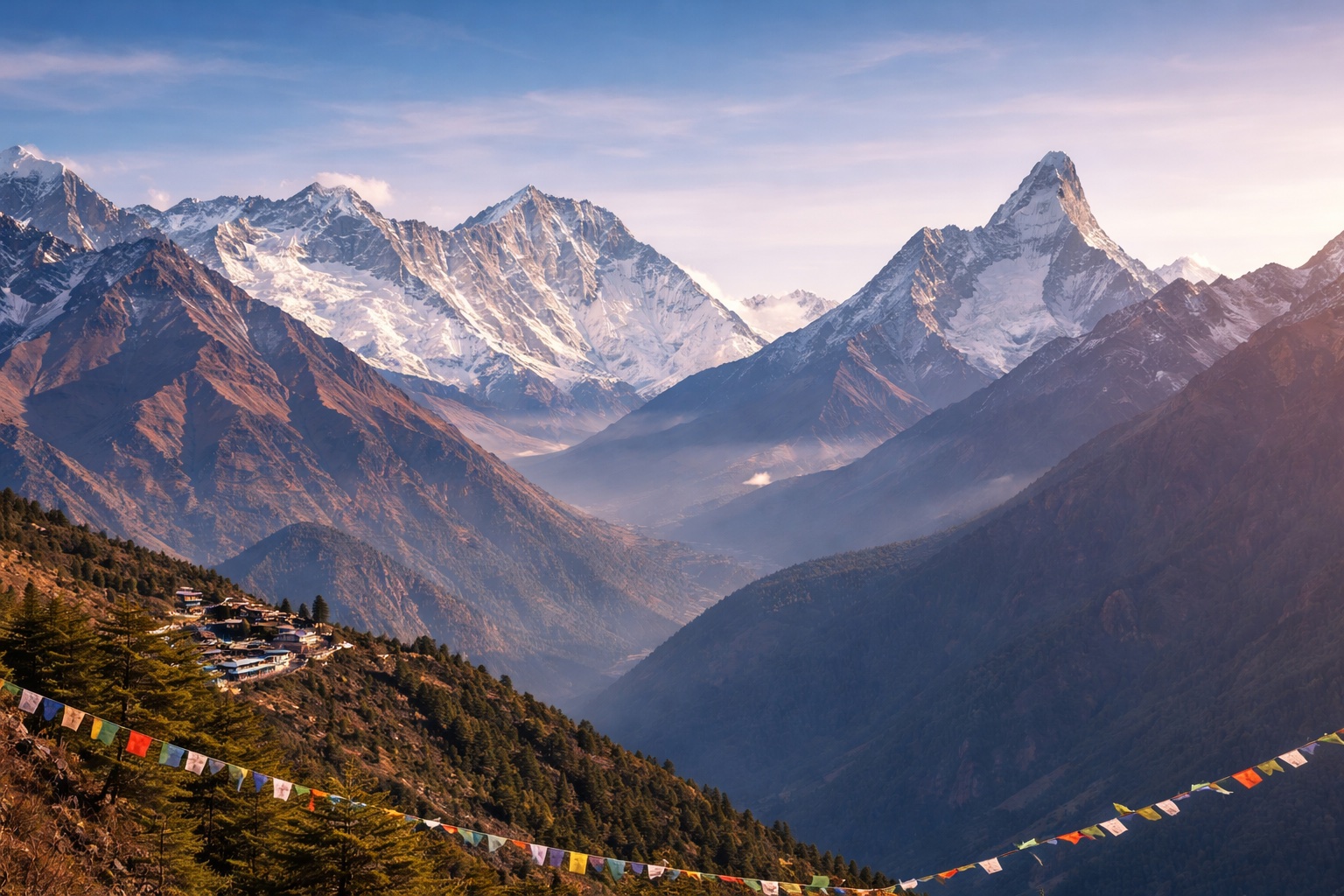
The Shivapuri day hike from Kathmandu climbs through Shivapuri Nagarjun National Park — the forested northern rim of the Kathmandu Valley — to Shivapuri Peak (2,732 m), the highest point on the valley rim accessible as a day hike from the city. Himalayan panorama including Langtang Lirung (7,227 m), Dorje Lakpa (6,966 m), Jugal Himal, and the full Rolwaling range from the summit. The finest combination of pristine forest, Buddhist monastery, and genuine Himalayan views available in a single day from Kathmandu.
The Shivapuri day hike — ascending from the Budhanilkantha gate of Shivapuri Nagarjun National Park through 1,400 metres of pristine sub-tropical and temperate forest to the Shivapuri Peak summit (2,732 m) — is the finest and most complete day hike available within a 30-minute drive of Kathmandu. The combination of factors that makes Shivapuri the benchmark Kathmandu day hike is specific: a summit elevation of 2,732 m (higher than any point in the United Kingdom or Western Europe) that delivers a genuine high-altitude perspective and a significant Himalayan panorama; a continuous forest corridor from the national park gate to the summit ridge that includes one of the valley's best-preserved sub-tropical broadleaf forest zones; the Nagi Gompa monastery (a Tibetan Buddhist nunnery at 2,350 m, one of the most active and architecturally impressive Tibetan monastic communities accessible on a day hike from any capital city in the world); and a return route option through the Shivapuri watershed that provides the rare experience of walking through a functioning Himalayan spring system within the national park boundary.
The national park itself — Shivapuri Nagarjun National Park (159 km²) — is Kathmandu's most important ecological buffer, protecting the northern rim of the valley from the urban sprawl that has consumed every other available hillside. The park is home to red panda (rare but present in the bamboo zones above 2,000 m), leopard (present but nocturnal — visible on camera traps), sambar deer, barking deer, and an outstanding bird community: over 318 species recorded in the park, including the satyr tragopan (one of Nepal's most spectacular pheasants), Himalayan monal (national bird, regularly sighted on the upper ridge), spiny babbler (Nepal's only endemic bird — found nowhere else in the world — confirmed in the park's mid-elevation scrub), and numerous warblers, babblers, and flycatchers in the lower forest zones.
Nagi Gompa is a Tibetan Buddhist nunnery established by the influential teacher Tulku Urgyen Rinpoche in 1976 on a natural terrace at 2,350 m on the Shivapuri ridge — one of the highest and most beautifully situated monasteries accessible on a day visit from Kathmandu. The nunnery houses approximately 200 nuns from across Nepal and Tibet, practising the Nyingma lineage of Tibetan Buddhism. The complex includes a primary lhakhang (prayer hall) with elaborate thangka (scroll painting) collections, a stupa garden, and a retreat centre used for multi-month intensive meditation practice. Visitors are welcomed for respectful exploration of the exterior and the public areas of the prayer hall during non-puja hours. The monastery's physical setting — on a sunlit south-facing terrace with the Kathmandu valley visible through the forest below and the Shivapuri ridge rising above — is one of the most evocative religious landscapes accessible on a day visit from the capital.
The Shivapuri summit (2,732 m) provides the finest Himalayan viewpoint accessible as a day hike from Kathmandu — a panorama that extends from Ganesh Himal (7,422 m) in the west through the Langtang range (Langtang Lirung 7,227 m, Dorje Lakpa 6,966 m, Shishapangma 8,027 m on the Tibet border) to the Jugal Himal and the Rolwaling Himal in the east. On exceptionally clear days in October and November, the distinctive pyramid of Gauri Shankar (7,134 m) is visible to the east — one of the most sacred mountains in Nepal, associated with the divine couple Shiva and Parvati (Gauri Shankar) and regarded as among the most beautiful of the high-elevation Himalayan peaks.
The Shivapuri hike to the summit at 2,732 m is a moderate hike — not technical and without exposed sections, but genuinely demanding in terms of elevation gain (approximately 1,400 m from the Budhanilkantha gate to the summit) and duration (4–5 hours of continuous walking). The trail is well-maintained within the national park and is clearly marked. The steepest section is the initial forest climb from the park gate to the 2,000 m level — after which the gradient eases on the upper ridge. Good fitness and comfortable trail shoes or light hiking boots are required. The hike is not appropriate for complete beginners or those with knee problems — the sustained descent from the summit (1,400 m over 5–6 km) is more demanding on the knees than the ascent.
The spiny babbler (Turdoides nipalensis) is Nepal's only endemic bird species — a bird found nowhere else in the world — and one of only a handful of bird species in Asia with such restricted distribution. It is a medium-sized, dull-brown babbler with distinctive spine-tipped feathers on the throat and breast, inhabiting the scrubby hillside vegetation at mid-elevations (1,000–2,000 m) in Nepal's Middle Hills. Shivapuri Nagarjun National Park is one of the most reliable locations in Nepal for observing the spiny babbler in its natural habitat. Our guides are experienced birders who know the specific scrub zones within the park where spiny babbler groups are regularly encountered — sighting probability on a dedicated morning visit is approximately 70–80%.
Yes — the Budhanilkantha Temple is located at the Shivapuri National Park's southern gate and is a natural start-of-day addition to the hike. The temple houses one of Nepal's most unusual and sacred sculptures: a 5th-century reclining Vishnu figure carved from a single black basalt boulder, lying in a rectangular pool of water. The sculpture is approximately 5 metres long and depicts the god in the cosmic sleep (Yoga Nidra) from which the universe is created. Hindus believe the image to be self-manifested (Swayambhu) rather than carved by human hands. The temple is open to Hindu visitors for puja; non-Hindu visitors can view the image from the outer terrace. The 15-minute visit adds cultural and historical context to the day before the forest trail begins.
The most commonly encountered wildlife on the Shivapuri trail is birds — with 318 species recorded in the park, almost any section of trail produces sightings. Commonly seen species include: Himalayan monal pheasant (upper ridge, spectacular male with iridescent plumage), satyr tragopan (mid-elevation forest, cryptic but present), blue-throated barbet, scarlet minivet, rufous-throated partridge, various laughingthrushes and babblers (including the spiny babbler at mid-elevation scrub), and Himalayan flameback woodpecker. Mammals regularly sighted or tracked include barking deer (muntjac — heard more often than seen), sambar deer (large, forest-interior), and Himalayan striped squirrel. Red panda inhabit the bamboo zones above 2,000 m but are elusive and primarily nocturnal — camera trap images confirm their presence but day sightings are uncommon. Leopard are present but entirely nocturnal.