Country
Khumbu, Solukhumbu, Nepal
Max Elevation
5,483 m - Gokyo Ri
Best Time
March-May, October-November
Trek to the sacred Gokyo Lakes and climb Gokyo Ri (5,483 m) for a panorama of Everest, Lhotse, Makalu, and Cho Oyu above the Ngozumpa Glacier - the longest glacier in the Himalayas.
Trip Highlights
- Gokyo Ri (5,483 m) — panorama of four 8,000m peaks from one summit
- Gokyo Lakes — six sacred turquoise glacial lakes (Ramsar Wetland)
- Ngozumpa Glacier — the longest glacier in the Himalayas
- Quieter and less crowded than the main EBC route
- Cho Oyu (8,188 m) close views from Gokyo valley
- Classic Khumbu Sherpa villages and Buddhist monasteries
- Sagarmatha National Park — UNESCO World Heritage Site
Gokyo Lakes Trek - Sacred Turquoise Lakes and Four 8,000m Peaks
The Gokyo Lakes Trek offers one of the Khumbu's most dramatic and least-crowded routes. Instead of the main Everest Base Camp trail, this route follows the western edge of the Ngozumpa Glacier - the longest glacier in the entire Himalayas - to reach the sacred Gokyo Lakes, a Ramsar-listed chain of six turquoise glacial lakes above 4,700 m.
The summit of Gokyo Ri (5,483 m) provides arguably the finest panoramic view in all of Nepal: four of the world's six highest mountains - Everest (8,849 m), Lhotse (8,516 m), Makalu (8,485 m), and Cho Oyu (8,188 m) - arranged in a single breathtaking sweep, with the frozen Ngozumpa Glacier stretching below.
The intense blue of the Gokyo lakes against the glacier white and the deep blue Himalayan sky creates some of the most extraordinary photography in Asia. This trek offers the perfect balance of altitude achievement, natural spectacle, and Sherpa cultural immersion.
Day-by-Day Itinerary
Arrival and welcome dinner. Trek briefing and gear check.
Kathmandu
Dinner
Hotel, Kathmandu
Mountain flight to Lukla. Begin trekking through pine forest along the Dudh Koshi to Phakding.
Phakding
3-4 hours
Breakfast, Lunch, Dinner
Tea house, Phakding
Cross the Hillary Suspension Bridge and enter Sagarmatha National Park. Steep climb to Namche Bazaar.
Namche Bazaar
5-6 hours
3,440 m
Breakfast, Lunch, Dinner
Tea house, Namche Bazaar
Hike to Everest View Hotel (3,880 m). Visit Sherpa Museum. Rest and acclimatise.
Namche Bazaar
Breakfast, Lunch, Dinner
Tea house, Namche Bazaar
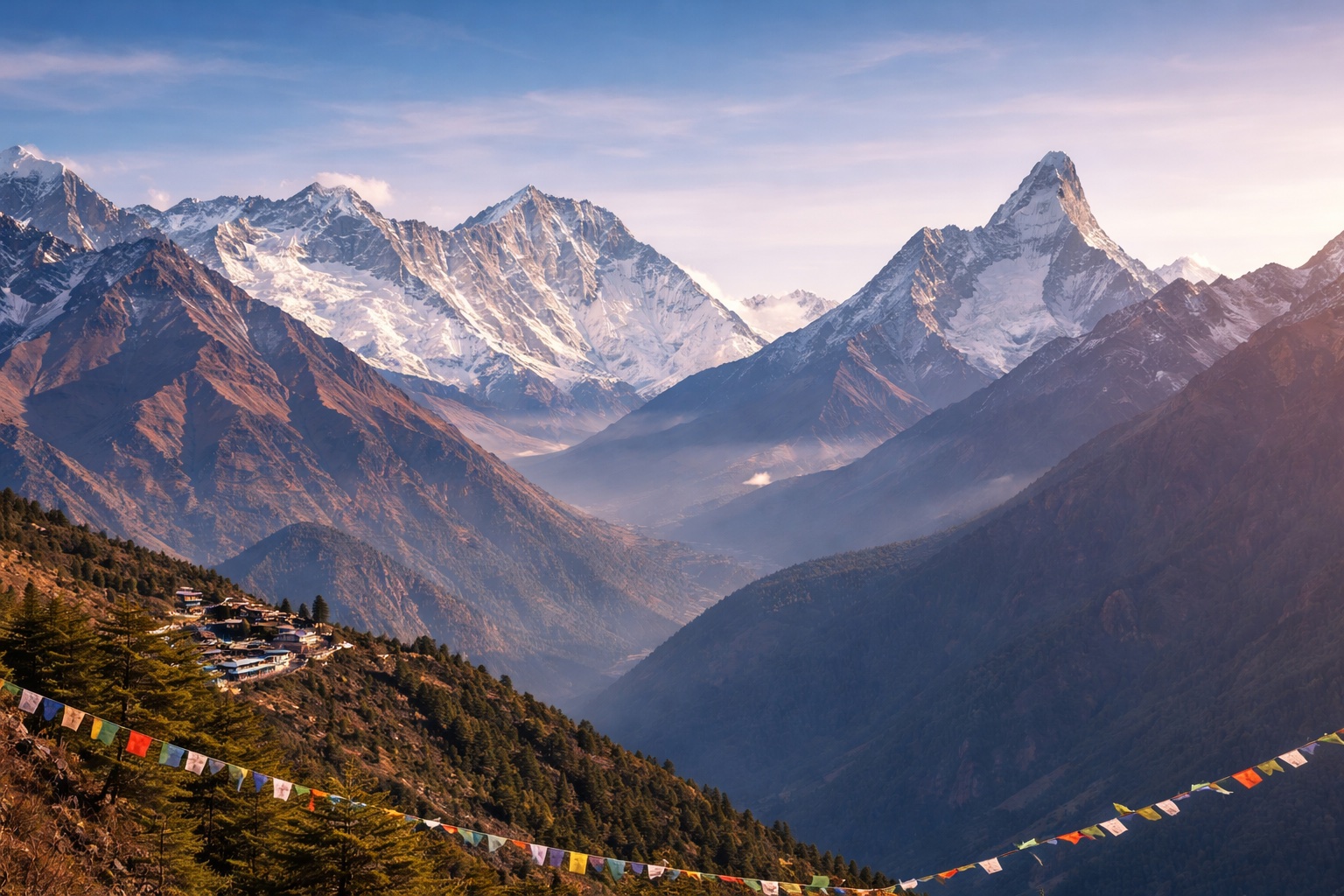
Leave the main EBC trail northwest toward the Gokyo valley. Climb through Mong La and Phortse Thanga. Views of Ama Dablam and Kangtega. Dole is a small yak herders' settlement above the tree line.
Dole
5-6 hours
4,200 m
Breakfast, Lunch, Dinner
Tea house, Dole
Alpine meadow trail with Cho Oyu ahead and the Gokyo valley opening above. Machhermo hosts a snow leopard research station - sightings are rare but possible.
Machhermo
4 hours
4,470 m
Breakfast, Lunch, Dinner
Tea house, Machhermo
Reach the first, second, and third Gokyo lakes. The colour - a deep glacier-fed turquoise - against the Ngozumpa Glacier white is extraordinary. Cho Oyu (8,188 m) fills the skyline to the north.
Gokyo
4-5 hours
4,790 m
Breakfast, Lunch, Dinner
Tea house, Gokyo
Early morning climb of Gokyo Ri for the four-8,000m-peak sunrise panorama. Afternoon: walk to 4th and 5th Gokyo Lakes, or explore the glacier moraine.
Gokyo Ri
5-6 hours
5,483 m
Breakfast, Lunch, Dinner
Tea house, Gokyo
Long descent retracing south through the Gokyo valley back to the warmth of Namche Bazaar.
Namche Bazaar
6-7 hours
Breakfast, Lunch, Dinner
Tea house, Namche Bazaar
Final trekking day down the Dudh Koshi valley to Lukla. Farewell dinner with the crew.
Lukla
6-7 hours
Breakfast, Lunch, Dinner
Tea house, Lukla
Morning flight to Kathmandu. Free afternoon and farewell dinner.
Kathmandu
Breakfast, Dinner
Hotel, Kathmandu
Transfer to Tribhuvan International Airport. Safe onward travels.
Kathmandu
Breakfast
What’s Included
Included
- Airport transfers (Kathmandu)
- Domestic flights as per itinerary
- TIMS card and national park/area permits
- Experienced English-speaking licensed trekking guide
- Porter service (1 porter per 2 trekkers)
- Full-board accommodation on trek (tea house)
- Duffel bag and sleeping bag (returnable)
- First-aid kit and emergency oxygen
- All government taxes and service charges
Excluded
- International flights
- Nepal visa fees
- Travel and medical insurance (mandatory)
- Meals in Kathmandu unless specified
- Personal trekking gear and equipment
- Gratuities for guide and porter
- Extra nights due to flight delays or weather
- Personal expenses and bar bills
Useful Info
Best Time for the Gokyo Lakes Trek
The Gokyo valley shares the Khumbu’s seasonal pattern. The turquoise lake colour is most vivid against fresh snow in autumn and spring.
Spring
- March – May
- Pre-monsoon clarity, rhododendron blooms below Namche, and expedition activity on Cho Oyu.
- Best Season
Summer / Monsoon
- June – August
- Heavy cloud, very poor visibility, wet trails. Not recommended for this lake-and-view trek.
- Avoid
Autumn
- September – November
- Peak season. Post-monsoon clarity delivers the finest Gokyo Ri panoramas. October is ideal.
- Best Season
Winter
- December – February
- Very cold, some high trails may be snowed in. Gokyo is accessible but requires extra cold-weather gear.
- Possible
How Difficult Is the Gokyo Lakes Trek?
The Gokyo trek is rated Challenging — comparable to the Everest Base Camp trek. You sleep above 4,000 m for five consecutive nights and reach 5,483 m at Gokyo Ri. The trail is non-technical but the altitude demands the same respect as EBC. Acclimatisation days in Namche and Gokyo village are essential.
Signs of Altitude Sickness to Watch For
- Persistent headache not relieved by paracetamol
- Nausea, vomiting, or loss of appetite
- Fatigue disproportionate to effort
- Dizziness or loss of coordination
- Dry cough that worsens at rest
- Confusion or difficulty concentrating (serious — descend immediately)
Permits Required
- Sagarmatha National Park Entry Permit – NPR 3,000 (~USD 23) per person.
- TIMS Card – USD 10 (group) or USD 20 (independent).
- Khumbu Pasang Lhamu Rural Municipality Fee – NPR 2,000 (~USD 15), collected at Lukla or Monjo.
Accommodation in the Gokyo Valley
Gokyo village has around 20 tea houses, all improved since 2015. Accommodation is comfortable by high-altitude Himalayan standards — private twin rooms, thick blankets, attached or shared bathrooms. Some lodges have solar-heated hot showers (fee). The dining room views across the lake directly to Cho Oyu are extraordinary. Full-board is included in our package.
Gokyo Lakes Trek Packing List – What to Bring
Keep your pack light (8–10 kg max in your day bag; porters carry heavier duffel bags). Layers are the key strategy for managing wide temperature swings.
Clothing & Insulation
- Moisture-wicking base layers (top & bottom)
- Mid-layer fleece jacket
- Down jacket (600+ fill, critical above 4,000 m)
- Waterproof hardshell jacket and pants
- Trekking trousers (2 pairs)
- Warm hat and sun hat
- Gloves (liner + waterproof outer)
- Merino wool or thermal socks (4–6 pairs)
- Gaiters (light, for snow/mud)
Footwear
- Waterproof trekking boots (ankle support, broken in before trek)
- Camp sandals / lightweight shoes
- Trekking poles (collapsible, highly recommended)
Health & Safety
- Diamox (acetazolamide) – consult doctor before taking
- Paracetamol, ibuprofen, rehydration salts
- Blister kit, bandages, antiseptic
- Water purification tablets / filter
- High-SPF sunscreen (SPF 50+) and lip balm
- UV-protection sunglasses (essential above 4,000 m)
- Pulse oximeter (monitors blood oxygen saturation)
Essentials
- Sleeping bag (−10°C comfort rating)
- Headlamp + spare batteries
- Daypack (25–30 L with rain cover)
- Duffel bag (provided by agency, 80–100 L)
- Power bank (charging scarce at higher altitudes)
- Offline map (Maps.me, Gaia GPS)
- Cash in NPR (very few card machines on trail)
Gokyo-Specific Items
- High-quality sunglasses with side shields (intense glacier glare)
- Polarised camera filter or lens hood (lake photography)
- Extra battery for camera (cold kills batteries above 4,500 m)
- Buff and face protection (wind from Ngozumpa Glacier can be fierce)
- Waterproof gaiters (glacier moraine walk on acclimatisation day)
Frequently Asked Questions
The Gokyo Lakes are a chain of six glacial lakes above 4,700 m in the Khumbu region, listed as a Ramsar Wetland of International Importance — one of the highest wetland systems in the world. The lakes are sacred in Hinduism and Buddhism, and the intense turquoise-blue colour against the white of the Ngozumpa Glacier and the surrounding peaks creates one of the most extraordinary visual landscapes in the Himalayas.
There are six main lakes in the Gokyo system: (1) Longponga (4,690 m), (2) Taujung (4,688 m), (3) Dudh Pokhari — the main Gokyo Lake (4,750 m), (4) Thonak (4,830 m), (5) Ngozumpa (4,891 m), and (6) Gyazumpa. The third lake — Dudh Pokhari — is where the main village and tea houses are located. On the acclimatisation day, you can walk to the fourth and fifth lakes.
Gokyo Ri (5,483 m) offers arguably the finest panoramic mountain view in Nepal. Standing on the summit, you can see four of the world's six highest mountains simultaneously: Everest (8,849 m), Lhotse (8,516 m), Makalu (8,485 m), and Cho Oyu (8,188 m). The Ngozumpa Glacier stretches below, and the Gokyo Lakes sparkle against the ice. The sunrise view is particularly extraordinary.
Gokyo is quieter (fewer trekkers), reaches a higher viewpoint (Gokyo Ri at 5,483 m vs EBC at 5,364 m), and offers the added spectacle of the turquoise lakes and the Ngozumpa Glacier. EBC has more historical and expedition significance. Many experienced trekkers rate the view from Gokyo Ri as superior to EBC. Combining both in the "Three Passes Trek" (20 days) via Cho La Pass is the ultimate Khumbu experience.
The Ngozumpa Glacier (30 km long) is the longest glacier in the Himalayas, flowing south from Cho Oyu (8,188 m) through the Gokyo Valley. The entire eastern side of the trek is defined by the glacier's moraine — a chaotic landscape of ice pinnacles (seracs), meltwater pools, and boulders. Walking along the glacier edge on the acclimatisation day gives a visceral sense of the scale of Himalayan glaciation.
They are of similar overall difficulty, both rated Challenging. Gokyo reaches 5,483 m at Gokyo Ri (slightly higher than EBC at 5,364 m) and involves a similar number of high-altitude days. The Gokyo route is generally considered slightly more remote and has fewer emergency facilities than the main EBC trail. Acclimatisation is equally important on both routes.
The same as EBC: (1) Sagarmatha National Park Entry Permit and (2) TIMS Card. Both are included in our package and arranged before departure from Kathmandu.
Spring (March–May) and Autumn (September–November) are best. October–November offers the clearest skies, most stable weather, and best visibility for the Gokyo Ri panorama. Spring brings rhododendron blooms in the lower sections and pre-monsoon clarity at altitude.
Yes — this classic combination via Cho La Pass (5,420 m) is one of the finest treks in the world, taking 18–20 days. From Gokyo, you cross the dramatic Cho La Pass to Lobuche, then continue to EBC and Kala Patthar. The "Three Passes Trek" (Renjo La + Cho La + Kongma La) is for very fit and experienced trekkers. We can arrange all combination itineraries.
Cho Oyu (8,188 m) is the world's sixth highest mountain and sits directly above the Gokyo Valley at its northern end. It is one of the most frequently climbed 8,000m peaks due to its relatively straightforward route. From the Gokyo village and Gokyo Ri, Cho Oyu dominates the northern skyline in spectacular fashion. The Base Camp of Cho Oyu is a 2–3 day extension from Gokyo for experienced trekkers.
Gokyo village has around 20 tea houses, all significantly improved since 2015. Accommodation is comfortable by Himalayan standards — private twin rooms, thick blankets, attached or shared bathrooms (cold water). Some lodges have solar-powered hot showers (fee). The dining room is communal and the views from the lodge windows directly across the lake to Cho Oyu are extraordinary.
From Lukla, the trail follows the standard EBC route to Namche Bazaar (2 days), then branches northwest instead of east. The route goes via Phortse Thanga, Dole (4,200 m), and Machhermo (4,470 m) to Gokyo (4,790 m) — 5 days total from Lukla. This western branch of the Khumbu trail is significantly quieter than the main EBC route after Namche.
Yes — the same risks as EBC apply. You sleep above 4,000 m for 5+ consecutive nights and reach 5,483 m at Gokyo Ri. Acclimatisation days in Namche and Gokyo are essential. Follow the same precautions: ascend slowly, hydrate well, avoid alcohol, and descend immediately if symptoms worsen. Our guides carry supplemental oxygen and are trained in altitude emergency response.
Snow leopards have been documented in the Gokyo valley — you are more likely to see their tracks than the animal itself. Himalayan tahr graze on the rocky slopes, and Tibetan snow cocks call from the ridges. Blue sheep (bharal) are commonly seen near Machhermo. The Gokyo Wetland is a resting point for migratory bar-headed geese (the highest-flying bird in the world) which cross the Himalayas at 8,000+ m.
In 2007, the Gokyo Lakes and surrounding wetland were listed as a Ramsar Wetland of International Importance — a global treaty designation recognising the ecological significance of the wetland system. At nearly 5,000 m above sea level, it is one of the highest Ramsar sites in the world, providing critical habitat for migratory waterfowl and sustaining unique high-altitude ecosystems.
Yes — clearly and close. From Gokyo Ri (5,483 m), Mount Everest is visible 28 km to the east, its distinctive pyramid profile unmistakeable. Many photographers and trekkers prefer the Gokyo Ri vantage point to Kala Patthar for Everest views because: (1) you see the full summit pyramid rather than just the upper section; (2) you also see Lhotse, Makalu, and Cho Oyu in the same frame; and (3) there are fewer people.
Tea house menus offer the standard Himalayan selection: dal bhat (best choice for energy), pasta, noodles, fried rice, soup, omelettes, and Tibetan bread. Choices are more limited than in Namche, and prices are higher (expect to pay 30–50% more than at lower altitudes). Our package includes full-board so you don't need to budget for meals on trek.
Yes — the Khumbu region, including the Gokyo route, is considered safe for solo female trekkers. The trail is well-populated with local Sherpa communities and other trekkers. Tea house staff are respectful and well-accustomed to international visitors. We recommend always trekking with our guide service for safety and the enhanced experience it provides.
Our 12-day Gokyo Lakes Trek package starts from USD 1,250 per person. This includes Kathmandu–Lukla–Kathmandu flights, all permits, licensed guide, porter, and full-board accommodation. Excluded: international flights, Nepal visa, travel insurance, personal gear, and tips.
The same preparation as EBC: 8–12 weeks of cardiovascular training including hiking, stair climbing, and cycling. You should be comfortable hiking 6–8 hours with a 5–7 kg daypack. Focus on uphill endurance — the climb to Gokyo Ri (1,100 m vertical in 3–4 hours) is the hardest single day. If possible, complete a lower-altitude multi-day hike as a warm-up.
Several excellent extensions exist: (1) Cross Renjo La (5,360 m) to Thame and return to Namche — spectacular and remote; (2) Cross Cho La (5,420 m) to reach Lobuche and EBC — the classic combination; (3) Side trip to Cho Oyu Base Camp (4,900 m) north of Gokyo — 2 days, very wild; (4) Three Passes Trek including all three Khumbu passes. All can be arranged with advance notice.
Reviews
The Manaslu Circuit is everything the popular routes are not - no crowds, no roads, just ancient monastery walls and the eighth highest mountain looming above you. Crossing Larkya La in pre-dawn darkness, headlamp cutting through the cold, was the most dramatic moment of my trekking life.
Priya Nair
Verified Trekker
I was nervous bringing my daughter on her first trek but the team was incredible with her. They carried her pack when she was tired, told her stories about the mountains, and made sure she got the front spot at sunrise on Poon Hill. She asked to come back before we even left Nepal.
Rachel Kim
Verified Trekker
I had never worn crampons before this trip. Three days of technical preparation and patient instruction by the climbing guide had me ascending the fixed headwall with confidence. At the summit, looking across to Lhotse at eye level, I understood for the first time why people climb mountains.
Zoe Williams
Verified Trekker
The Everest Three High Passes trek is genuinely demanding and the agency's pre-trek fitness guidance helped me prepare properly. Twenty days, three passes above 5,350m, and the full Khumbu experience from multiple angles. The Renjo La descent to Gokyo with the lakes below is the finest views I have ever seen.
Natalie Dubois
Verified Trekker