
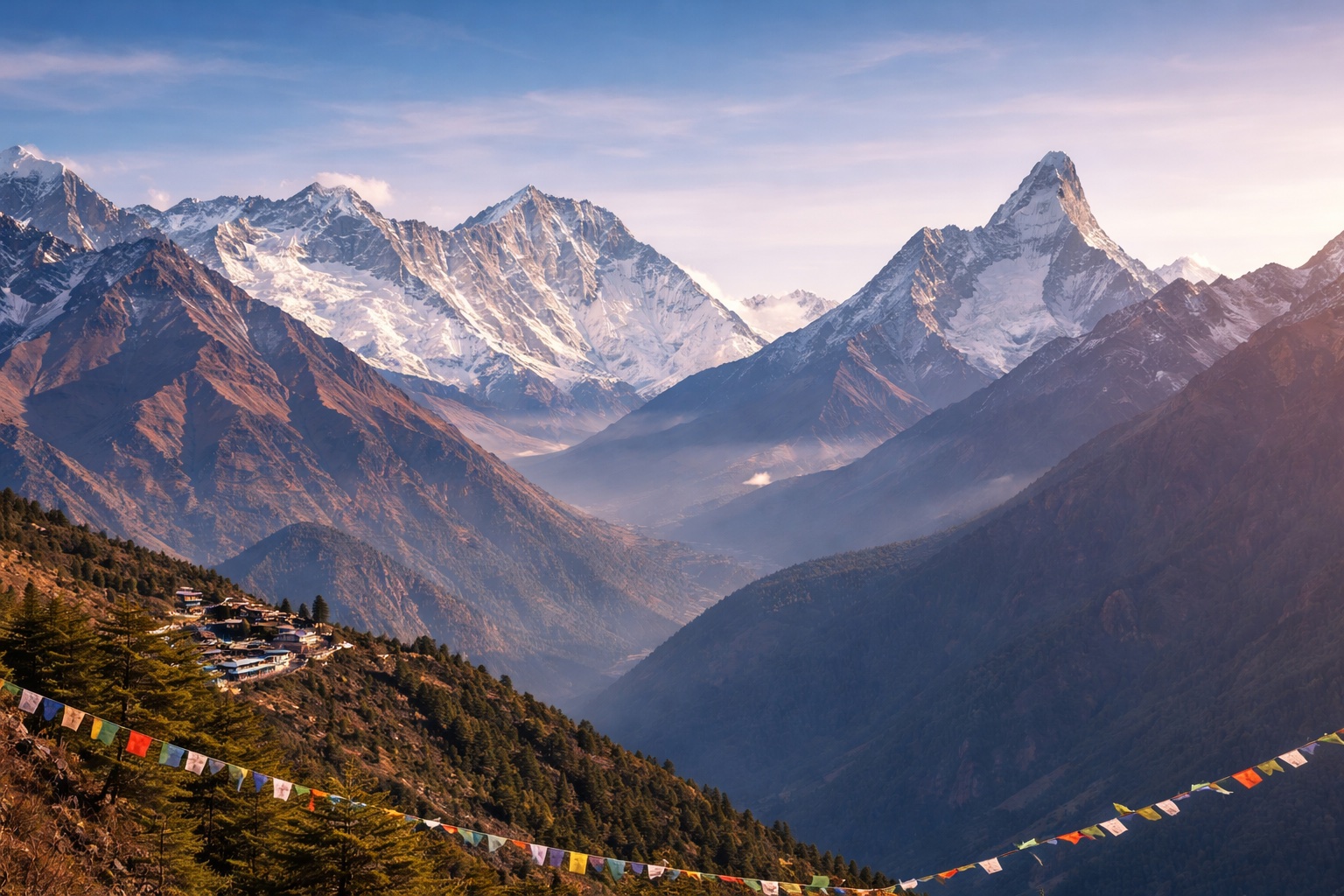
Nepal's most complete short tour — three days in Kathmandu's UNESCO heritage sites, two days on Chitwan wildlife safari (tiger, rhino, elephant), and two days in Pokhara with Annapurna mountain views. The perfect Nepal introduction.
Nepal contains three entirely different worlds within the borders of a country smaller than England: the ancient civilisations of the Kathmandu Valley, the sub-Himalayan wildlife wilderness of the Terai lowlands, and the mountain-and-lake beauty of Pokhara. The Nepal Classic Tour combines all three in eight days — the most frequently booked Nepal tour itinerary for first-time visitors, designed over twenty years of listening to what travellers most want to experience when they have one to two weeks in Nepal.
No other country in the world offers this combination within eight days of travel. You begin in Kathmandu surrounded by centuries of Newari art and living Hindu and Buddhist religious practice, fly to the sub-tropical lowlands to track one-horned rhinos and Bengal tigers through national park grassland on the back of an elephant, and end in Pokhara — arguably the most beautiful mid-sized city in Asia — where the mirror surface of Phewa Lake reflects the snow summit of Machhapuchhare (the Fish Tail peak) on calm mornings. Each of the three destinations would be a complete holiday destination on its own. Together they form the deepest possible immersion in Nepal's extraordinary diversity.
The first three days of the Nepal Classic Tour cover the Kathmandu Valley's most significant heritage sites with an expert guide who contextualises what you are seeing rather than simply naming it. Pashupatinath Temple and the Bagmati cremation ghats, Boudhanath Stupa at dusk (the most atmospheric time — the monks are circumambulating and the butter lamps are being lit in the surrounding monastery windows), Swayambhunath for the sunset view, and the medieval plaza of Patan Durbar Square — arguably the finest example of Newari architecture surviving anywhere — fill Days 1 and 2. Day 3 goes to Bhaktapur, whose car-free medieval city centre is the closest Nepal comes to stepping completely out of the 21st century, and to Changu Narayan, the valley's oldest temple and least-visited UNESCO site.
A 25-minute flight from Kathmandu delivers you to Chitwan National Park in Nepal's Terai lowlands — a UNESCO World Heritage Site protecting 932 square kilometres of sal forest, tall elephant grassland, and riverine habitat at the foot of the Himalayan foothills. Chitwan is one of Asia's great conservation success stories: the greater one-horned rhinoceros (Rhinoceros unicornis), reduced to fewer than 100 animals in Nepal by the early 1970s, now numbers over 700 in Chitwan alone. The park supports a significant population of Bengal tigers — the highest density of tigers per square kilometre of any protected area in Asia.
Your two full days in Chitwan include: morning and afternoon jeep safaris through the forest core zone; a dugout canoe trip on the Rapti River for gharial crocodile and waterbird sightings (the gharial, the world's longest crocodilian, is critically endangered — Chitwan is one of the few places you can reliably see them); an elephant breeding centre visit to see young elephants (the park no longer offers elephant-back rides, a conservation decision we fully support); a nature walk in the buffer zone with a trained naturalist guide; and an evening Tharu cultural programme — traditional stick dance and songs from Nepal's Terai indigenous community whose culture is as fascinating as the wildlife.
Pokhara at 822 metres elevation is Nepal's most naturally beautiful city. The city's western edge is bordered by Phewa Lake — two kilometres of glassy water that, on still mornings, reflects the perfect snow cone of Machhapuchhare (Fish Tail, 6,993 m) so accurately that it is impossible to tell which is the mountain and which is the reflection. The northern horizon is the full Annapurna massif — Dhaulagiri (8,167 m) to the west, Annapurna I (8,091 m), Annapurna South, Hiunchuli, and Machhapuchhare stretching across 60 kilometres of sky.
Your two days in Pokhara include: a sunrise visit to Sarangkot (1,592 m) for the Annapurna panorama before the clouds build; a rowboat trip on Phewa Lake to the Tal Barahi Island Temple; the International Mountain Museum (the best museum of mountaineering history in the world, covering the history of Himalayan exploration with artefacts from major expeditions); a walk to the World Peace Pagoda (Japanese Buddhist stupa above the lake with full valley views); and the optional but highly recommended tandem paraglide from Sarangkot — 30 minutes soaring above the lake with the Annapurna range filling the northern horizon, operated by Nepal Paragliding Association-licensed pilots.
The Nepal Classic Tour is operated by our team of locally-born, degree-educated guides who are native to the regions they guide in. Your Kathmandu guide grew up in the valley and has deep personal relationships with the cultural sites. Your Chitwan naturalist trained in wildlife biology at Tribhuvan University and has spent years in the national park learning to read animal signs. Your Pokhara guide is a licensed paragliding pilot who also guides mountain walks. This local expertise at every stop creates the difference between a tour that shows you Nepal and one that helps you understand it.
Yes — the Nepal Classic Tour is one of the best Nepal itineraries for families. Children love the Chitwan wildlife safari (seeing rhinos and elephants), the Monkey Temple (swayambhunath macaques delight children), and the boat ride on Phewa Lake. The tour involves no trekking, no altitude above 1,400 m, and all accommodation is comfortable hotel and resort standard. We recommend ages 6+ for the wildlife activities.
Chitwan is home to: greater one-horned rhinoceros (700+ individuals — very high sighting probability), Bengal tiger (significant population — sightings possible but not guaranteed), gharial crocodile and mugger crocodile, Asian elephant, sloth bear, leopard, spotted deer, barking deer, sambar, wild boar, and over 500 bird species. Rhino sightings on a two-day visit are extremely likely; tiger sightings depend on the season and zone — autumn and spring morning safaris offer the best probability.
Yes. Our Nepal Classic Tour includes three domestic flights: Kathmandu–Chitwan (Bharatpur), Chitwan–Pokhara, and Pokhara–Kathmandu. These 25-minute flights are operated by Buddha Air, Yeti Airlines, or Shree Airlines. Mountain views from the Kathmandu–Pokhara flight can be extraordinary on clear days.
Absolutely — this is our most commonly customised package. Popular extensions: Poon Hill Trek (5 days) from Pokhara at the end of the tour; Langtang Valley Trek (7 days) from Kathmandu at the beginning; or Everest Base Camp Trek (14 days) as a full add-on. We design combined itineraries that flow naturally between tour and trek without duplication or backtracking.
Kathmandu and Pokhara: 3-star hotels in central locations (Thamel and Lakeside respectively) with en-suite bathrooms, hot water, WiFi, and breakfast included. Chitwan: a purpose-built jungle resort on the national park buffer zone boundary, with individual cottages or lodge rooms, a swimming pool, restaurant, and naturalist team on-site. All accommodation is vetted annually by our operations team.
October–November is ideal — post-monsoon clarity gives perfect mountain views from Sarangkot and Pokhara, wildlife concentrates around water in Chitwan (excellent rhino and bird sightings), and weather is warm and dry throughout. March–April is the second-best season with spring blooms and rhododendrons. December–February is cool but clear and less crowded. Monsoon (June–September) is not recommended — Chitwan is frequently flooded and mountain views are obscured.