
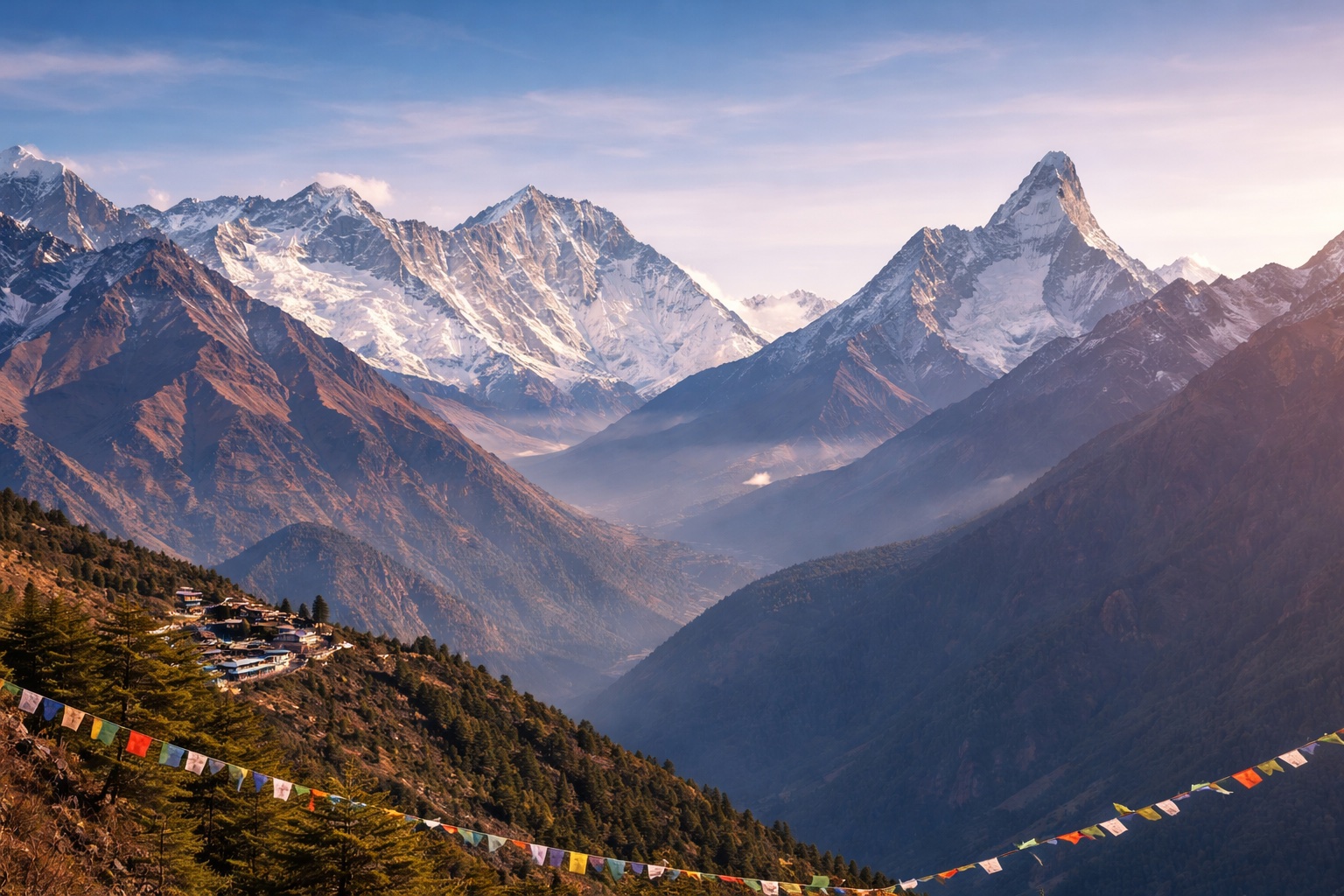
Rara Lake — Nepal's largest lake and one of the most remote and pristine freshwater lakes in Asia — by private helicopter from Nepalgunj or Kathmandu. The 10.8 km² alpine lake at 2,990 m in the far northwest of Nepal changes colour from sapphire to turquoise to wine-red through the day, surrounded by 4,000 m peaks and dense forests of pine and blue pine. One overnight at the lake. The ultimate Nepal off-the-beaten-track helicopter experience.
Rara Lake (2,990 m) is Nepal's largest lake by area — 10.8 km² of pristine alpine water in the far northwest of the country, surrounded by a sub-alpine forest of blue pine, spruce, and fir within Rara National Park, Nepal's smallest national park by area and the country's most isolated protected landscape. The lake lies in the remote Mugu District of Karnali Province, accessible on foot only after a 5–7 day walk from the nearest roadhead (or 2–3 days from Talcha Airport, the closest airstrip, reachable by Twin Otter from Nepalgunj). The helicopter eliminates all of this approach time, delivering you from Kathmandu or Nepalgunj to the lakeshore in 1.5–2.5 hours and allowing a two-day stay — the minimum time necessary to properly experience the lake's extraordinary light changes, wildlife, and silence — before returning the same way.
Rara Lake is famous among those who have been there for a quality that is genuinely difficult to convey in photographs or words: an absolute, profound stillness combined with a palette of colours that the lake presents through the day as the light angle, cloud cover, and reflection change. In the morning under clear skies, Rara is a deep navy blue — the reflection of the open sky and the surrounding dark conifers creating a colour so saturated that it seems almost unnatural. By midday the colour shifts toward turquoise in the shallower sections near the shore, before transitioning to wine-red and amber as the afternoon sun lowers and the surrounding slopes begin to reflect orange light across the water. At dusk, with the snow peaks of the Mugu Himal visible to the north, the lake surface takes on the appearance of hammered silver. Experienced Nepal photographers consistently rank Rara among the country's top three landscape subjects — alongside the Annapurna Sanctuary and the Upper Mustang plateau — precisely because of these colour transitions and the absence of any human visual interference beyond the remote park lodge.
Rara National Park (106 km²) was established in 1976 specifically to protect the Rara Lake catchment and the surrounding sub-alpine forest. The park is home to one of Nepal's most significant high-altitude wildlife communities: red panda (vulnerable), snow leopard (occasional sightings in the Mugu Karnali watershed above the park), musk deer, Himalayan black bear, common leopard, and a resident population of Himalayan tahr on the lake's northern slopes. The park's birdlife is exceptional — Himalayan monal (Nepal's national bird) are regularly seen near the lakeshore, lammergeier (bearded vulture) patrol the ridge above, and the lake supports a year-round population of bar-headed geese and Brahminy duck. For birdwatchers, the Rara area is one of the finest high-altitude birding destinations in Nepal.
The forest surrounding the lake — primarily blue pine (Pinus wallichiana), West Himalayan spruce, and cypress — has been left entirely intact within the park boundary and represents one of the last large unlogged sub-alpine forest patches in Nepal's Karnali zone. The forest floor in October–November is carpeted with fallen pine needles and wild mushrooms; in spring, the rhododendron and wild iris bloom in the open glades above the treeline. Walking the 2-hour circumambulation trail around the lake's shoreline through this forest — alone or nearly so, since Rara receives fewer than 2,000 visitors per year — is a wildly different experience from any other trail in Nepal.
The Murma Top (3,087 m), the forested ridge immediately north of Rara Lake, provides the finest panoramic view of the lake and its mountain backdrop. A 1.5-hour walk from the park lodge climbs through the blue pine forest to the ridge crest, where the full extent of the lake is visible — the 10.8 km² surface spread below, the encircling forest, and the snow peaks of Chuchemara Danda (4,087 m), Kaike Peak (3,680 m), and the more distant Dolpo Himalaya to the north. The view from Murma Top is the defining visual experience of the Rara visit and the source of most of the iconic Rara photographs. Our guide leads the Murma Top walk on the morning of Day 2, before the helicopter departure.
The two-day Rara helicopter tour includes one overnight at the Rara National Park lodge (basic but comfortable accommodation in the park headquarters area, with attached bathrooms and simple Nepali meals) or, for groups who prefer it, a tented camp on the lakeshore — the only accommodation in Nepal where you fall asleep to the sound of a completely undisturbed alpine lake. The evening at Rara — after the day's photography and exploration — is defined by the sound of the wind in the pines, the occasional call of a Himalayan monal, and a sky full of stars at 2,990 m that, absent from any city light pollution for 100 km in all directions, presents a Milky Way display that most urban visitors have never seen.
Rara Lake is unique in Nepal for several reasons: it is the country's largest lake by area (10.8 km²), it sits at a sub-alpine elevation (2,990 m) that puts it well above the timberline in many parts of the world but is surrounded by intact blue pine and spruce forest due to the specific climatic and topographic conditions of the Mugu District. It receives fewer than 2,000 visitors per year — an almost unimaginable low count for a UNESCO-potential natural heritage site — which means the experience of visiting is genuinely uncrowded and pristine. The lake's colour-change phenomenon (sapphire to turquoise to wine-red through the day) is produced by the lake's depth (167 m at maximum), the mineral composition of the Himalayan glacial meltwater feeding it, and the changing angle of reflected light — a combination that makes Rara one of the most photographed natural subjects in Nepal among those who have seen it.
The direct helicopter flight from Kathmandu to Rara takes approximately 2.5 hours, including a refuelling stop at Surkhet or Nepalgunj. The standard routing for private helicopter charters is Kathmandu–Nepalgunj (domestic flight, 1 hour, same day or previous day) then Nepalgunj–Rara by helicopter (45 minutes). The via-Nepalgunj routing requires an overnight in Nepalgunj on the outbound journey but is more fuel-efficient and operationally straightforward. Direct Kathmandu–Rara charters are available at a premium and are the fastest option if your schedule does not permit the Nepalgunj stopover. We offer both routings — enquire for current pricing.
Rara National Park's wildlife is exceptional for a relatively small protected area. The most commonly sighted species are: red panda (regularly observed in the oak and bamboo patches below the blue pine zone, particularly on the lake's southern slopes), Himalayan monal (Nepal's national bird — seen regularly on the lakeshore trails and in the forest clearings), and bar-headed geese (resident year-round on the lake). Other frequently reported species include musk deer, Himalayan tahr, common leopard (nocturnal), and Himalayan black bear. Snow leopard inhabits the higher reaches of the Mugu Karnali watershed above the park and is occasionally seen in winter from the Murma Top area. The park's birdlife is outstanding — over 214 bird species have been recorded, including lammergeier, golden eagle, and Himalayan griffon.
October and November are the finest months for Rara — the post-monsoon clarity produces exceptional visibility, the deciduous trees on the lakeshore are in autumn gold, and the temperature is cool but comfortable (5–15°C by day, 0–5°C at night). March and April are the second-best window — rhododendron and wild iris bloom in the surrounding park, the angle of spring light is beautiful, and the bar-headed geese have typically arrived for nesting season. June–September (monsoon) is the most difficult period — the approach flights can be disrupted by cloud, and the park trails are wet and slippery. December–February is cold but clear — the lake occasionally freezes at the margins in January and February, creating an extraordinary ice-and-snow landscape, but nighttime temperatures drop to -10°C and the accommodation is minimally heated.
Yes — the Rara tour requires no trekking fitness beyond the ability to walk on moderate terrain for 2–3 hours per day. The lakeshore circumambulation trail is flat to gently rolling, and the Murma Top ascent (1.5 hours, 100 m elevation gain) is suitable for most healthy adults with a reasonable walking pace. The helicopter eliminates all of the traditional approach difficulty (5–7 days of trekking from the nearest roadhead). At 2,990 m, Rara is at an altitude comfortable for the vast majority of visitors — significantly lower than the Gosaikunda, Everest, or Annapurna helicopter destinations. Most clients experience no altitude discomfort at Rara beyond mild breathlessness in the first hour.