
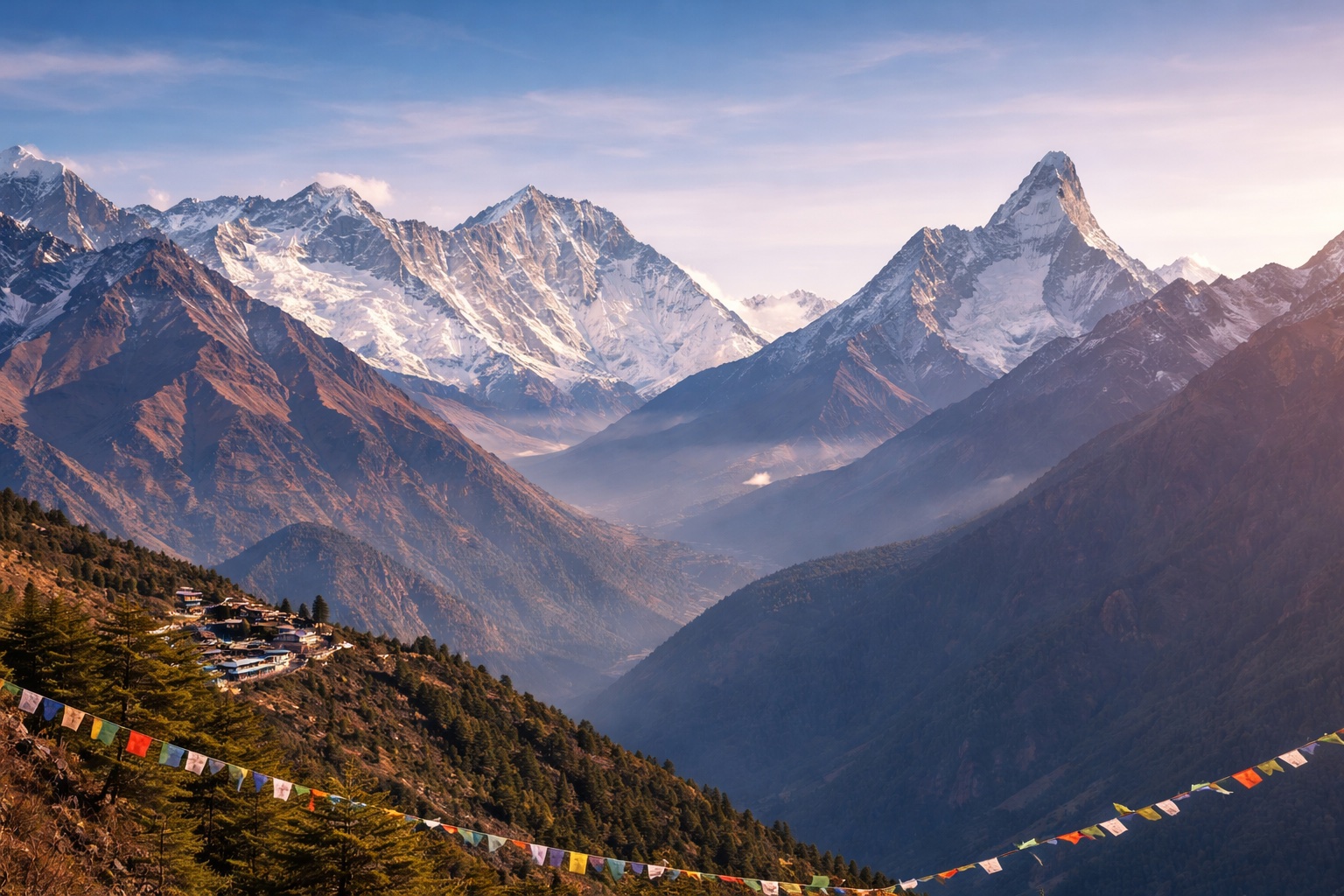
Adventure in Nepal - Himalayan Thrills, Wild Rivers & Mountain Skies
Nepal offers a concentration of adventure activities that no other country in the world can match for variety, scale, and sheer physical drama. The combination of extreme altitude, wild rivers descending from glaciated peaks, open mountain skies, and a trekking infrastructure developed over sixty years creates a playground for adventure travellers that ranges from the accessible - a morning paraglide above Pokhara's lake - to the genuinely extreme - crossing the world's highest trekking pass at 5,416 metres in pre-dawn darkness. Whether your adventure ambition is a week of white-water rafting, a fifteen-day Himalayan circuit, a 6,000-metre summit, or all three combined into a single Nepal expedition, the infrastructure, the expertise, and the terrain are all here.
Himalayan Trekking: Adventure on Foot
Nepal's high-altitude trekking routes are the country's defining adventure category - the experience that most people associate with Nepal and the one that consistently generates the most profound long-term impact on those who undertake it. The routes range from the accessible five-day Poon Hill walk (maximum 3,210 m, suitable for fit beginners) through the Everest Base Camp trek (5,545 m at Kala Patthar, two weeks, rated Challenging) to the Three High Passes expedition-style route (5,535 m maximum, three passes above 5,300 m, twenty days, rated Strenuous). Every level of trekking ambition and experience is catered for, and every route delivers mountain scenery, cultural encounters, and physical achievement that justify every preparation effort.
What makes Nepal's trekking routes an adventure in the genuine sense - rather than simply a long walk - is the altitude dimension. Above 4,000 metres, the reduced atmospheric oxygen turns every uphill step into a physiological challenge that trained legs alone cannot fully address. The combination of fitness, acclimatisation, and mental reserves required to complete a high-altitude Himalayan trek is a genuine adventure test, not a tourist activity. The guides and tea house system make the routes accessible; the mountains themselves ensure they remain demanding.
White-Water Rafting: Nepal's Wild Rivers
Nepal's rivers are among the world's finest white-water rafting destinations, fed by glacial meltwater from the highest peaks on Earth and descending through gorges that concentrate their energy into rapids ranging from beginner-friendly Class III to genuinely expert-only Class V. The Trisuli River, accessible from Kathmandu with a two-hour drive, is Nepal's most popular rafting destination - a two-day journey through Class III-IV rapids with excellent scenery and comfortable riverside camping. The Seti Gandaki near Pokhara offers a more relaxed half-day experience suitable for families and beginners. The Sun Koshi - a nine-day journey from the Nepal-Tibet border to the Terai lowlands - is considered one of the world's great multi-day river expeditions, covering 270 kilometres and offering Class IV-V rapids in remote, spectacular gorge country.
The Marsyangdi River, running through the gorge on the lower Annapurna Circuit, is technically demanding and wildly scenic - a two-to-three-day expedition for experienced rafters. The Karnali River in western Nepal is Nepal's most remote and challenging rafting river, an eight-to-ten-day expedition through virtually uninhabited gorges with Class V rapids that attract experienced kayakers and rafters from around the world. Nepal's rafting season runs October-November and March-May, coinciding with the prime trekking seasons when river levels are appropriate and weather conditions stable.
Paragliding: Soaring Above the Himalayas
Pokhara is one of the world's premier paragliding destinations, offering a combination of consistent thermal lift, easy landing zones at Phewa Lake shore, and the most dramatic mountain backdrop available at any paragliding site in the world. The standard tandem paragliding flight launches from Sarangkot Hill (1,600 m) above the city and soars for twenty to forty minutes over the lake, with the Annapurna range - Machhapuchhare's Fish Tail summit most dramatically - filling the northern horizon. On clear days, the views include Dhaulagiri (8,167 m) to the west and the entire Annapurna massif to the north. Experienced local pilots read the thermal conditions with precision built from hundreds of flights - the experience is both safe and extraordinary.
For qualified paragliders, Pokhara offers cross-country flying opportunities on longer equipment with experienced local guides, and the Annapurna region's valleys generate reliable soaring conditions through the trekking seasons. The Nepal Paragliding Association regulates licensed operators and maintains safety standards appropriate for a site that has introduced hundreds of thousands of first-time flyers to the air over three decades.
Bungee Jumping and Zip-Lining
Nepal's bungee jumping scene has a legitimate claim to some of the world's most dramatic jump sites. The Last Resort bungee near the Nepal-Tibet border involves a 160-metre jump from a suspension bridge above the Bhote Koshi River gorge - one of the highest bungee jump installations in the world, at a location where the sheer drop into the gorge creates a visual and physical experience that flat-ground bungee sites cannot approach. The Pokhara region's High Ground Adventures zip-line, at 1,800 metres long with a 600-metre drop, is one of the world's steepest commercial zip-lines - riders reach speeds of up to 120 km/h with the Annapurna range as backdrop.
Mountain Biking: Himalayan Trails by Two Wheels
Mountain biking in Nepal combines the visual rewards of the trekking routes with the specific physical and technical demands of off-road cycling at altitude. The classic Kathmandu-Pokhara mountain bike route via the Prithvi Highway and off-road alternatives covers 200 kilometres over four to five days through mid-hill Nepal, visiting Gurung and Magar villages, terraced farming landscapes, and the first Himalayan mountain views as you approach Pokhara. The Mustang mountain bike circuit - cycling portions of the Upper Mustang restricted area route - is considered one of the finest mountain biking routes in Asia, combining the extraordinary desert landscape and medieval culture of the Forbidden Kingdom with the physical challenge of high-altitude cycling on unpaved roads and trails.
Rock Climbing and Via Ferrata
The limestone cliffs above Hattiban and the rock faces near Nagarjun Forest Reserve on Kathmandu's rim offer accessible sport climbing for those combining a Nepal visit with a climbing interest. Pokhara's surroundings have developing climbing crags with routes from beginner grade through advanced. For the most dramatic rock experience, the via ferrata routes in the Pokhara valley - fixed-iron routes on near-vertical limestone faces with Annapurna views - offer the sensation of high-exposure climbing without the technical demands of traditional rock climbing.
Planning Your Nepal Adventure
Nepal's adventure calendar runs year-round with activity-specific optimal seasons. Trekking and peak climbing: October-November and March-May. White-water rafting: October-November and March-May (avoid monsoon when rivers are dangerously high). Paragliding: October-November (clearest conditions and strongest thermals), March-April also excellent. Bungee and zip-line: year-round except monsoon high season. Mountain biking: October-November and February-April. Our adventure packages can be combined in any configuration - a standard approach is three days of Kathmandu cultural exploration followed by ten days of Himalayan trekking, with rafting or paragliding on the return journey through Pokhara.