
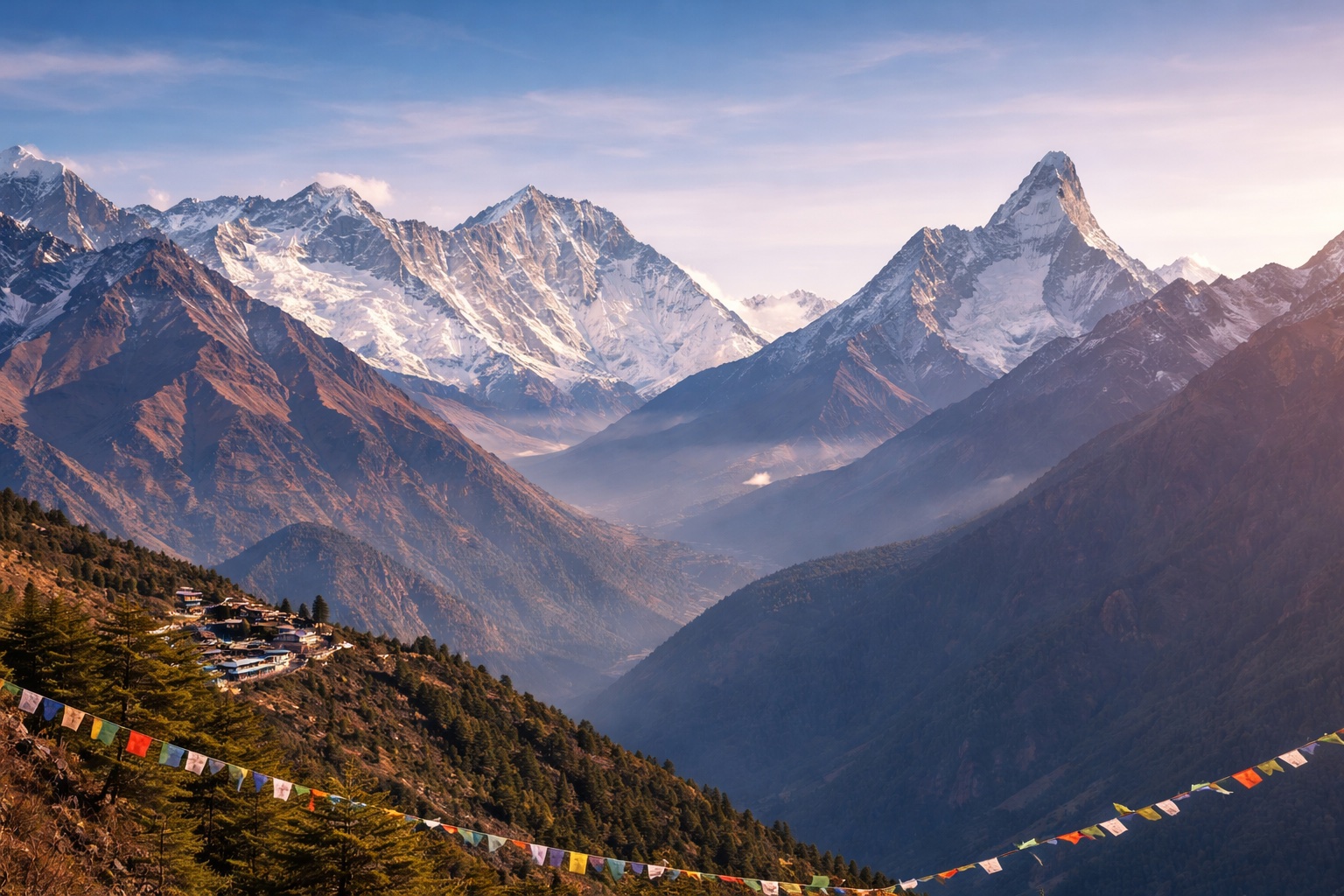
Nepal's two most essential destinations in five days: UNESCO World Heritage Sites at Pashupatinath, Boudhanath, and Bhaktapur in Kathmandu, then Sarangkot sunrise and Phewa Lake in Pokhara. The perfect first Nepal trip — a complete introduction to Himalayan culture, Buddhism, Hinduism, and mountain scenery in one compact itinerary.
Nepal's two most visited and most rewarding destinations — Kathmandu and Pokhara — distilled into five days: this is the itinerary that gives you the essential Nepal experience within the time constraints of a typical international trip. Two days in the Kathmandu Valley covering the UNESCO World Heritage Sites that represent twelve centuries of Newar civilisation, followed by two and a half days in Pokhara with the Annapurna Himalaya overhead and Phewa Lake at your feet.
This is not a compromised version of a longer tour — it is a carefully sequenced itinerary designed to deliver maximum depth in minimum time. Every site is chosen because it is irreplaceable and because it works with the others to build a coherent understanding of Nepal: what the country is, what it has been, and why it draws millions of travellers every year. The guide we provide is not a driver who points at things — they are a specialist in the cultural and historical context that makes these sites meaningful rather than merely photogenic.
Kathmandu's seven UNESCO World Heritage Sites are concentrated within a valley 25 km across — the most densely packed collection of sacred monuments in South Asia, representing the artistic and religious achievement of the Newar civilisation across twelve centuries. In two focused days with an expert guide, you visit the five sites that give the deepest understanding of Nepal's cultural identity:
Pashupatinath Temple on the Bagmati River — Nepal's holiest Hindu site and the most important Shaivite temple in the world outside Varanasi. The ghats where public cremation rites are conducted daily are accessible to all visitors and constitute one of travel's most visceral encounters with mortality, ceremony, and the Hindu relationship with the river. The ash-smeared sadhus in the temple complex opposite, the families carrying flower offerings to the main temple, the burning pyres — this is not a museum exhibit but a living religious practice of extraordinary intensity.
Boudhanath Stupa — one of the world's largest Buddhist stupas and the spiritual centre of Nepal's Tibetan Buddhist community. The stupa's all-seeing eyes look out from the tower in all four cardinal directions; at the base, a ring of 108 idols of Amitabha Buddha sits within a concentric mandala of shrines. The evening circumambulation — swept along by the flow of Tibetan monks, Tamang pilgrims, and Sherpa grandmothers — is the single moment most visitors describe as the most memorable of their Nepal trip.
Patan Durbar Square — the finest medieval architecture in South Asia, and the Patan Museum, which houses the best collection of Newar religious art in existence. The Krishna Mandir in the centre of the square, a shikhara-style temple built entirely of stone in 1637 with relief carvings from the Mahabharata and Ramayana running around its base, is the Kathmandu Valley's single most extraordinary piece of architecture. The museum itself — three floors of bronze, stone, and copper repousse religious objects across 1,500 years of Newar artistry — rewards 2–3 hours of careful attention.
Bhaktapur — the best-preserved medieval city in Nepal, a car-free historic centre where the 15th-century street plan is intact, the Nyatapola Pagoda (Nepal's tallest traditional structure) still towers over the main square, and the ancient pottery quarter at Dattatreya Square still produces the distinctive black Bhaktapur pottery using techniques unchanged since the Malla dynasty. The juju dhau (king curd) at Bhaktapur — served in a clay pot at the square's tea houses — is the finest yoghurt in Nepal and possibly Asia.
Pokhara is everything Kathmandu is not — open, lakeside, surrounded by the most dramatic mountain scenery in Nepal, and oriented entirely toward outdoor life. The Annapurna massif rises directly from the valley floor 30 km to the north: Dhaulagiri, Annapurna I (8,091 m), Annapurna South, Hiunchuli, Machapuchare (the sacred Fishtail Peak), Lamjung Himal — a wall of mountains that fills the northern horizon from every point in the city.
Sarangkot (1,592 m) provides Nepal's finest accessible mountain sunrise: a 4:30 am departure, a 45-minute drive, and the full Annapurna range igniting from Dhaulagiri to Manaslu as the sun rises behind the eastern peaks. The sunrise at Sarangkot, in good weather, is one of the most reliable great-view experiences in Asia.
Phewa Lake — rowing in a traditional wooden boat to the Tal Barahi Island Temple, watching Machapuchare reflect in the water, is the defining Pokhara experience. The lake is 4 km long, 2 km wide, and fed by glacial streams from the Annapurna watershed. The island temple — a Shakta shrine dedicated to the goddess Barahi — is one of the most photogenic buildings in Nepal, surrounded by water with a 7,000-metre peak directly above it.
The International Mountain Museum in Pokhara is the world's finest mountaineering history museum — covering the first ascents of all 14 eight-thousanders, the story of Himalayan exploration, and the extraordinary contribution of Nepal's own climbing communities with exhibits that include original expedition equipment and detailed accounts of every major Himalayan climb.
The sequence — Kathmandu first, Pokhara second — is intentional. Kathmandu provides cultural and historical context: it explains what Nepal is, where it came from, and why the country's sacred geography matters. Pokhara then delivers the natural spectacle — the mountains, the lake, the open air — with a depth of appreciation that is significantly enhanced by having spent two days understanding the civilisation that built this valley and continues to inhabit it. Many travellers who visit Pokhara without Kathmandu first find it beautiful but slightly hollow; the reverse sequence rarely produces that response.
Five days is a genuinely satisfying introduction to Nepal if the itinerary is focused. Our Kathmandu–Pokhara short tour is designed specifically for this constraint — it prioritises depth over breadth, spending meaningful time at each location with an expert guide who can explain what you're seeing. You will not see Chitwan, the trekking regions, or Lumbini on a 5-day trip, but you will understand Kathmandu's cultural heritage and experience Pokhara's mountain setting in a way that feels complete rather than rushed. Most 5-day visitors leave wanting more time — which is the right feeling to leave with.
Our short Nepal tour uses the domestic flight between Kathmandu and Pokhara (25 minutes, USD 80–120 one way) — the fastest and most comfortable option. The tourist bus is also available (6–7 hours, USD 12–18) if you prefer the scenic overland route through the Prithvi Highway along the Trishuli River. We recommend the flight for a 5-day tour to maximise time in each destination. Our package includes all inter-city and local transfers.
Yes — this is our most frequently extended tour. Adding Chitwan National Park Safari (2 nights / 3 days) creates a comprehensive 8-day Nepal Classic Tour: Kathmandu (2 days), Pokhara (2 days), and Chitwan (2 nights). This is our most popular complete Nepal package and covers the country's most essential experiences: cultural heritage, mountain scenery, and wildlife. We can also extend the Kathmandu section to include Nagarkot sunrise, add paragliding in Pokhara, or begin with a Lumbini pilgrimage visit from the Pokhara or Kathmandu end.
Nepal is consistently rated one of Asia's safest destinations for international tourists, including solo travellers. The tourist infrastructure in Kathmandu's Thamel district and Pokhara's Lakeside area is well-established, with international-standard hotels, registered tour operators, and a tourism police presence at major sites. Standard urban precautions apply — keep valuables secure, use authorised transport, and drink bottled or filtered water. Our guide accompanies you at all heritage sites on Days 1–4, so you are never navigating unfamiliar environments alone.
Most nationalities require a tourist visa for Nepal, obtainable on arrival at Tribhuvan International Airport (Kathmandu) or in advance at a Nepalese embassy. The fees are: USD 30 for a 15-day single entry, USD 50 for a 30-day single entry, USD 125 for a 90-day multiple entry. You need one passport photo and the fee in cash (USD preferred; EUR and GBP accepted). Citizens of India do not require a visa. The process at Kathmandu airport takes 20–40 minutes — we recommend using the online visa pre-registration system at the Nepal Immigration website to speed up arrival.
October–November is the most popular season — post-monsoon skies are clear, the Sarangkot Himalayan views are at their sharpest, and temperatures are warm and stable (20–28°C in both cities). March–April is the spring season — rhododendron blooms, good visibility, and warming temperatures. December–February is clear and cooler (15–20°C days, 5–10°C nights) — excellent for mountain views but bring a jacket. June–September is monsoon season — warm and green but with frequent heavy rain and reduced mountain visibility. The Kathmandu heritage sites are fully accessible year-round; the Sarangkot sunrise is most reliable outside the monsoon months.