
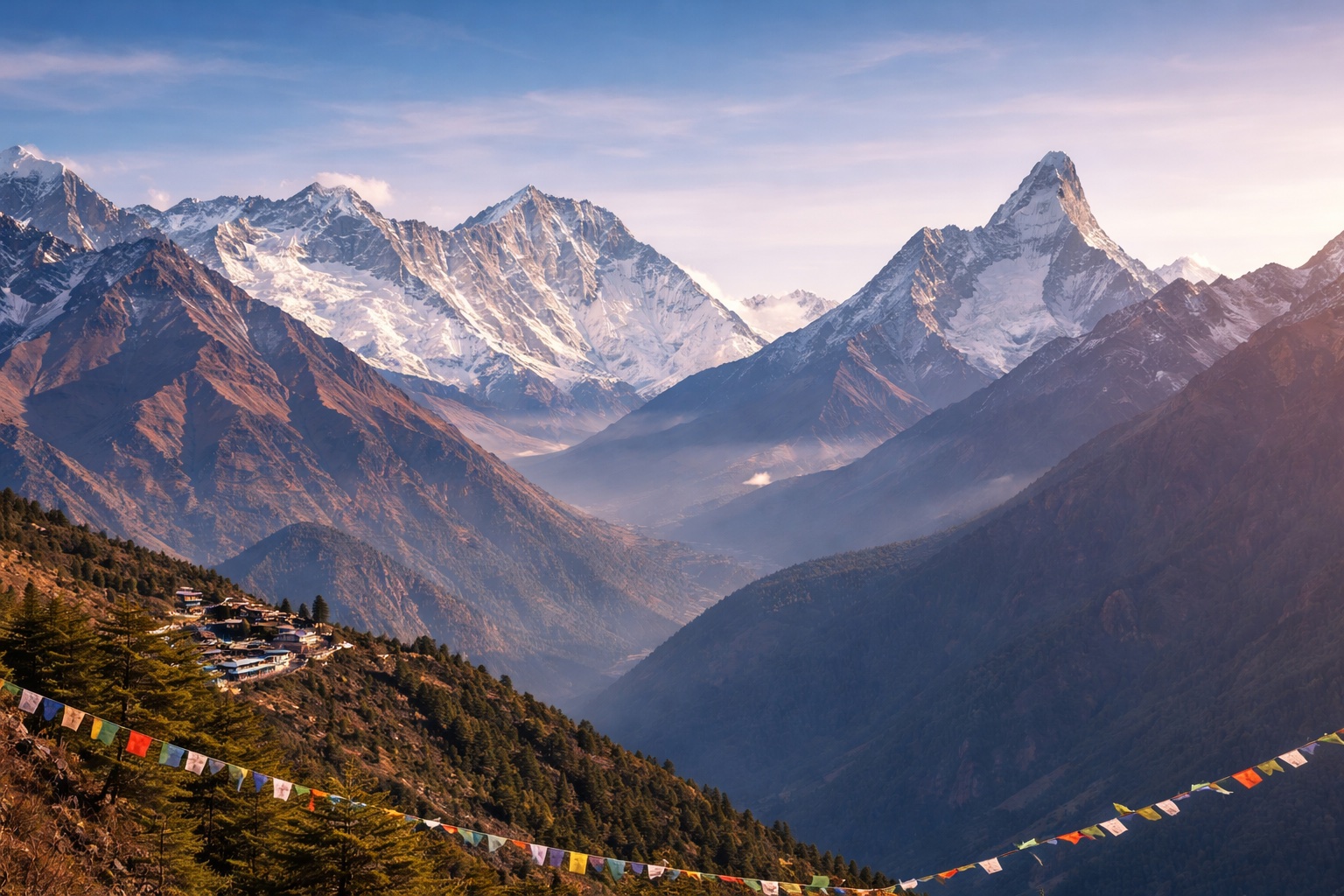
Tandem paragliding from Sarangkot (1,592 m) above Pokhara — the Annapurna range filling the northern horizon, Phewa Lake gleaming below, and 20–40 minutes of soaring on Himalayan thermals above one of the world's most spectacular landscapes. Consistently rated one of the top 5 paragliding experiences on Earth. No experience required. Fly with CIVL-certified pilots on DHCP-certified equipment.
Paragliding in Pokhara is the most popular adventure activity in Nepal and one of the most celebrated paragliding experiences in the world — a tandem flight from Sarangkot (1,592 m), the hill above Pokhara's lakeside district, that delivers pilots and passengers into the thermal currents rising from the Pokhara valley with the full Annapurna range filling the northern horizon. The combination of factors that makes Pokhara paragliding extraordinary is specific, non-replicable, and frequently discussed in the global paragliding community: a launch site at 1,592 m directly above a valley whose floor sits at only 827 m (providing 750 m of immediate vertical clearance), reliable thermal development from the Phewa Lake surface and the surrounding hillside farmland, a mountain backdrop that places some of the world's highest peaks within 30 km of the launch point, and landing options ranging from the Phewa Lake waterfront to the Begnas Lake basin 15 km east — a range of landing destinations that allows pilots to use the valley's thermal geography for flights lasting from 20 minutes to several hours depending on conditions.
The standard tandem flight experience operates from the Sarangkot launch site, reached by vehicle from Pokhara Lakeside in approximately 30 minutes. Sarangkot itself is one of Nepal's most famous sunrise viewpoints — the panorama from the ridge top includes Annapurna I (8,091 m), Annapurna II (7,937 m), Annapurna III (7,555 m), Annapurna IV (7,525 m), Annapurna South (7,219 m), Machapuchare (6,993 m), Hiunchuli (6,441 m), and on exceptionally clear days, Dhaulagiri (8,167 m) to the west — eight Himalayan giants in a single northward arc. The paragliding flight from Sarangkot places the passenger within this panorama rather than below it, with the thermal columns generated by the valley's warm air rising through the flight altitude providing smooth, sustained lift that experienced pilots use to extend flights well beyond the minimum landing time.
Pokhara's paragliding conditions are exceptional because of a combination of topographical and meteorological factors that create reliable, strong, and smooth thermal columns through most of the year. The Phewa Lake surface (roughly 4 km² of open water at 827 m) generates a consistent lake-land thermal differential throughout the morning, with warm air rising from the surrounding farmland and the lake surface providing a slightly cooler sink area that pilots use as a navigation reference. The Sarangkot ridge itself acts as a deflection point for the prevailing southerly winds, creating a consistent ridge-lift band that extends the ridge's soaring potential beyond pure thermal flying. In the optimal October–November and March–May windows, experienced pilots regularly achieve flights of 45–90 minutes on the Sarangkot thermals — and the valley's thermal geometry allows cross-country flights to the Begnas Lake area (15 km) and the Seti River gorge (8 km) for pilots with the skill to use it.
The standard tandem flight for visitors — conducted with a CIVL-certified (Fédération Aéronautique Internationale) tandem pilot on equipment certified to DHCP (Directorate of Hydrology and Climate of Nepal) standards — typically lasts 20–40 minutes in average conditions and 40–60 minutes when thermal development is strong. The flight begins with a 20–30 metre running launch from the Sarangkot slope — a straightforward, physically non-demanding process that even elderly or mobility-limited passengers manage without difficulty — and ends with a smooth stand-up or sit-down landing on the designated landing strip above the Pokhara Lakeside waterfront.
Beyond the standard scenic tandem flight, Pokhara's paragliding schools offer a range of upgraded experiences for those seeking more than a passive scenic tour. Acrobatic tandem flights — with trained aerobatic pilots performing SAT, spiral dives, wingovers, and the memorable infinite tumbling manoeuvre — are available at a premium and attract a significant number of repeat visitors who have done the scenic flight and want the physical intensity of performance aerobatics over the Himalayan backdrop. Cross-country tandem flights — using the valley's thermal system to fly from Sarangkot to the Begnas Lake basin (15 km, 45–90 minutes) with a vehicle shuttle return — provide the closest approximation of solo cross-country flying available to non-licensed visitors. Pokhara also offers paragliding courses (P1 to P4) through accredited schools — the mountain flying conditions and the year-round flyable weather make Pokhara one of the world's finest locations for learning the sport from scratch.
The paragliding flight from Sarangkot places the passenger at an altitude that provides a specific and unusual view of Machapuchare (6,993 m) — the sacred and permanently unclimbed Fishtail Peak that is Nepal's most recognisable mountain profile when seen from Pokhara. From the ground, Machapuchare appears as a distant pyramid above the northern horizon. From the Sarangkot flight altitude (typically 1,500–2,200 m above the valley floor during thermal flying), the mountain's profile changes: the twin summits that give it the "fishtail" name become apparent in a way that the ground view from Pokhara does not reveal, and the mountain's position relative to the full Annapurna massif — set forward of the main range by the Modi Khola valley geometry — is visible from the air in a way that maps and photographs cannot convey. The paragliding flight's mobile perspective — moving through the air rather than observing from a fixed viewpoint — reveals the mountain range's three-dimensional structure in a way that no static viewpoint can achieve.
Pokhara paragliding has an excellent safety record when booked through ACPN (Association of Paragliding Pilots and Instructors of Nepal) member operators, which are required to use CIVL-certified pilots and DHCP-approved equipment. The key safety factors are the certification of the pilot (ask for CIVL tandem rating certificate), the certification and age of the equipment (harnesses and wings should be within their certified lifespan), and the operator's weather monitoring (reputable operators cancel or delay flights in unsafe conditions, even if clients are disappointed). We exclusively use ACPN-member operators with CIVL-certified pilots who have a minimum of 200 logged tandem flights. The primary cause of paragliding incidents in Pokhara is booking with uncertified street touts who use unqualified pilots and sub-standard equipment — always book through a registered operator.
Thermal development in the Pokhara valley begins approximately 2–3 hours after sunrise and reaches its daily peak between 10 am and 1 pm. Morning flights (9–10 am) are smooth and scenic but typically shorter (20–25 minutes) because thermals are just developing. Mid-morning to midday flights (10 am–12 pm) are the most dynamic — thermals are strong enough to sustain 40–60 minute flights and acrobatic manoeuvres. Afternoon flights (after 2 pm) become progressively turbulent as valley thermals cross-flow and may be cancelled by our pilots if conditions are unacceptable. We recommend booking for 9:30–11:00 am for the best combination of visibility, thermal activity, and mountain views.
October and November are the finest months — the post-monsoon air is exceptionally clear, the Annapurna range is snowcapped, and thermal conditions are consistent and strong. March, April, and May are equally excellent — the rhododendron forests in bloom on the Sarangkot hillside, the spring haze is less than in October, and the longer days allow more afternoon flying time. December and January are possible but the mornings are cold at Sarangkot (temperatures at 1,592 m can be 2–5°C at launch time) and valley haze can reduce mountain visibility. The monsoon season (June–September) brings frequent cloud, afternoon thunderstorms, and unreliable conditions — paragliding operations typically run only in the morning window (6–9 am) during the monsoon and are frequently cancelled.
The standard weight limit for tandem paragliding in Pokhara is 100 kg (220 lbs) for most operators — above this weight, the pilot must use a specialised heavier tandem wing, which some operators do not carry. Passengers between 100 and 120 kg should enquire specifically when booking. There is no standard minimum age, but most Pokhara operators require passengers to be at least 5 years old and able to follow basic instructions. Children under 14 require parental consent and are assessed on the day for readiness. There is no official maximum age — we have flown passengers in their 80s — but those with serious cardiac or respiratory conditions should consult their doctor first. Pregnant passengers should not fly.
Yes — Pokhara is one of the world's finest locations for learning paragliding, and several ACPN-member schools offer accredited courses from beginner (P1, 3 days, ground handling and short flights) through to P4 (advanced cross-country, 14+ days). The combination of consistent thermals, diverse terrain (valley, ridge, and lake flying all within 15 km), reliable good-weather windows, and affordable instruction costs makes Pokhara a global destination for paragliding students. Many international pilots visit specifically to complete their P3 (Pilot) rating in Pokhara's mountain flying environment, which is more challenging and formative than most European or Australian training locations. Enquire for current course schedules and pricing.