
Everest Region Trekking - Routes, Guides & Complete Information
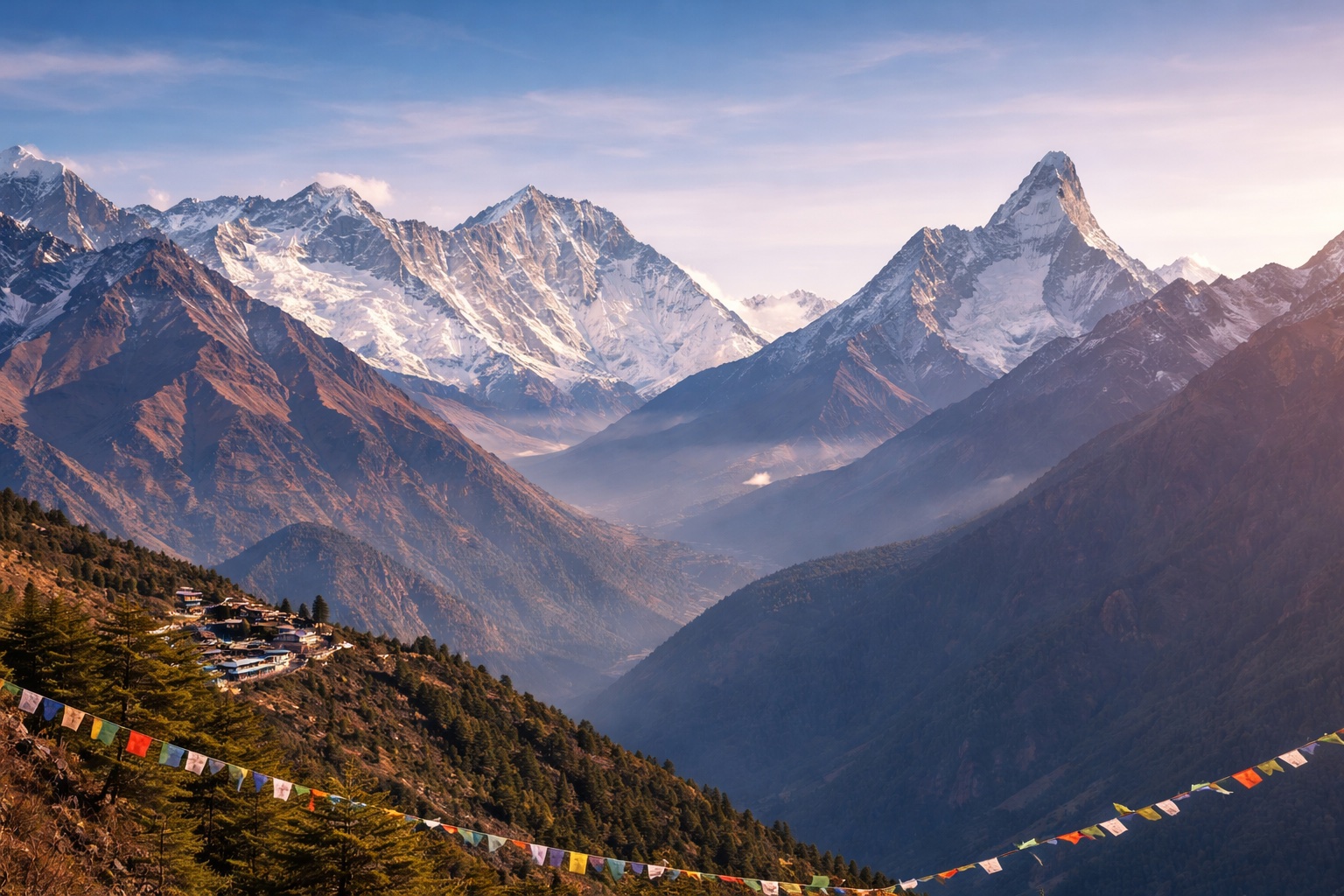
The Everest region — known to the Sherpa people as the Khumbu — is the world's most celebrated trekking destination and the spiritual home of high-altitude mountaineering. The valley system that leads north from Lukla to the flanks of the world's highest mountain contains a concentration of Himalayan grandeur, cultural depth, and trekking infrastructure that no other mountain region on Earth can match. Every route in this region passes through Sagarmatha National Park, a UNESCO World Heritage Site established in 1976 to protect not only the extraordinary landscape but the equally extraordinary Sherpa culture that has inhabited these valleys for centuries.
The Khumbu: A Valley of History and Scale
The Khumbu Valley earned its global prominence through mountaineering history. The first successful Everest summit in May 1953 by Edmund Hillary and Tenzing Norgay Sherpa transformed this remote valley overnight from an obscure geographical feature into the most famous mountain address on Earth. In the seven decades since, the Khumbu has become the site of more high-altitude mountaineering achievement than any other place in history — every major expedition to Everest, Lhotse, Cho Oyu, and the surrounding peaks has passed through Namche Bazaar, trekked the stone paths above the Dudh Koshi River, and camped at the Base Camp on the Khumbu Glacier's moraine.
But the Khumbu is far more than a mountain backdrop. The Sherpa people — whose name has become synonymous with high-altitude capability worldwide — have farmed these valleys, maintained these monasteries, and guided mountaineers since the 1920s. Their culture, shaped equally by Tibetan Buddhism and the demands of extreme altitude living, gives every trek in this region a human dimension that pure mountain scenery alone cannot provide. The monastery at Tengboche, the Saturday market at Namche Bazaar, the mani walls above Khumjung — these are not tourist reconstructions but living expressions of a culture that predates organised mountaineering by centuries.
Everest Base Camp Trek
The Everest Base Camp Trek is the flagship route of the Khumbu region and the most walked high-altitude trek in the world. The fourteen-day journey from Lukla to Base Camp (5,364 m) and Kala Patthar (5,545 m) follows the stone path that every Everest expedition team has walked since 1953. Along the way, the route passes through Phakding, Namche Bazaar (the Sherpa capital), Tengboche Monastery, Dingboche, Lobuche, and Gorak Shep before reaching the glacier-ringed amphitheatre of Base Camp itself.
The EBC trek is rated Challenging — not technically difficult, but demanding sustained effort at altitude over two weeks. Two acclimatisation days (at Namche and Dingboche) are built into the itinerary and are medically non-negotiable. The reward for this investment is one of the great mountain experiences available to any traveller: standing at the foot of the world's highest mountain, surrounded by the prayer flags and ice seracs that define the staging ground for all Everest expeditions, and then watching the sun rise over the summit pyramid from Kala Patthar.
Gokyo Lakes Trek
The Gokyo Lakes Trek branches northwest from Namche Bazaar into a valley that most EBC-focused trekkers never visit — and which many experienced Himalayan travellers rate as the finer of the two Khumbu routes. The six sacred Gokyo Lakes are a Ramsar-listed wetland system, their turquoise colour fed by glacial meltwater from the Ngozumpa Glacier — the longest glacier in the Himalayas at thirty kilometres. The summit of Gokyo Ri (5,483 m) provides a panoramic view that professional landscape photographers consistently rank as the finest achievable from a non-technical summit in Nepal: Everest, Lhotse, Makalu, and Cho Oyu visible simultaneously, the glacier stretching below.
The Gokyo route carries perhaps twenty percent of the EBC trail's traffic, making it significantly quieter and more intimate. Tea houses in Gokyo village are uncrowded, the Sherpa families who run them have more time for genuine hospitality, and the walk along the lake shore at dawn — perfectly still water reflecting the surrounding peaks — is one of Nepal's most quietly magical experiences.
Everest Three High Passes Trek
The Three High Passes Trek is the Khumbu's most demanding and comprehensive route, combining both the EBC and Gokyo destinations with the crossing of three passes above 5,350 metres: Kongma La (5,535 m), Cho La (5,420 m), and Renjo La (5,360 m). Over twenty days, the route visits every major feature of the Khumbu — the Gokyo Lakes, Cho La's glacier crossing with crampons, Everest Base Camp, and Kala Patthar — in a single journey that most trekkers describe as the finest extended adventure in the Himalayan range.
The Three Passes Trek is rated Strenuous. Each pass requires an early start, confident movement on snow and ice, and strong acclimatisation. It is appropriate for experienced trekkers who have completed at least one previous high-altitude trek (EBC or equivalent) and are prepared for demanding conditions above 5,000 metres for multiple days.
Sagarmatha National Park
Every Everest region trek passes through Sagarmatha National Park, established in 1976 and inscribed as a UNESCO World Heritage Site in 1979. The park covers 1,148 square kilometres of spectacular mountain terrain between 2,845 and 8,849 metres above sea level. It protects a remarkable range of ecosystems: sub-alpine forest, alpine meadow, and glacial terrain at the highest elevations. Wildlife within the park includes the endangered snow leopard, Himalayan tahr, musk deer, red panda (at lower elevations), Tibetan snow cock, and dozens of bird species including the yellow-billed chough that accompanies trekkers through the upper valley. The park entry permit (NPR 3,000) directly funds conservation and trail maintenance.
Sherpa Culture: The Soul of the Khumbu
No account of the Everest region is complete without genuine attention to its people. The Sherpa are an ethnic Tibetan group who migrated to the Khumbu from Tibet approximately 500 years ago. Their name — which means "People from the East" in Tibetan — has become a global synonym for mountain strength and reliability. The Khumbu Sherpa community has produced more high-altitude mountaineering achievement than any other ethnic group in history: from Tenzing Norgay's 1953 Everest summit to the current generation of guides who routinely climb Everest multiple times per season in support of international expeditions.
Sherpa Buddhism — a Tibetan Nyingma tradition — permeates every aspect of Khumbu life. Tengboche Monastery, rebuilt after a 1989 fire, is the spiritual centre of the region and conducts annual festivals (Mani Rimdu in November) that draw Sherpa communities from across the valley. Smaller monasteries at Khumjung, Pangboche, and Thame serve individual village communities. The prayer flags that mark every ridge, pass, and summit in the Khumbu are not decorations but religious objects — each flag carries a printed prayer that the wind disperses across the mountain landscape with every flutter.
Planning Your Everest Region Trek
The best seasons for Everest region trekking are autumn (October-November) and spring (March-May). October delivers the clearest skies and most reliable weather for all routes, including the high passes. April and May overlap with the Everest climbing season, adding the atmosphere of expedition activity at Base Camp. The mandatory permits — Sagarmatha National Park entry (NPR 3,000), TIMS card (NPR 2,000), and Khumbu Pasang Lhamu Rural Municipality fee (NPR 2,000) — are arranged by our agency before departure. All our Everest region packages include the Lukla domestic flights (approximately USD 210 return), a licensed Sherpa guide, porter service, all permits, and full-board accommodation in tea houses throughout the route.
Sherpa Guides: The Foundation of Khumbu Trekking
Every Everest region trek we offer is led by a licensed Sherpa guide. Our guides are not simply trail navigators — they are cultural interpreters who explain the significance of a mani wall, translate the monastery prayer flags, introduce you to the tea house families by name, and assess your altitude acclimatisation with the practiced eye of someone who has watched hundreds of trekkers make this journey. The relationship between trekker and Sherpa guide is the defining human element of any Khumbu trek.
Environmental Responsibility in Sagarmatha National Park
Sagarmatha National Park faces significant environmental pressure from the trekking and mountaineering activity that generates the revenue needed to protect it. Our treks follow strict waste management protocols: all non-organic waste is carried out of the park, we do not use wood fires for heating or cooking, and we choose tea houses that have invested in solar and hydropower energy systems. The park's long-term health depends on every visitor making responsible choices.
Book Your Everest Region Trek
Our Everest region packages are available with departures in both spring and autumn seasons. All include licensed Sherpa guide, porter, Sagarmatha National Park permit, TIMS card, Khumbu municipality fee, Lukla domestic flights, and full-board accommodation in quality tea houses throughout. Contact our team to discuss the right route and timing for your specific goals and fitness level.
The Everest region attracts trekkers of every nationality and background because it offers something genuinely irreplaceable: the chance to stand in the physical presence of the world's highest mountain, in a valley shaped by one of the great human adventure stories of the 20th century, guided by the community whose courage and knowledge made that story possible. No travel experience replicates this combination. The Khumbu waits for those willing to invest the time and preparation to experience it properly.