
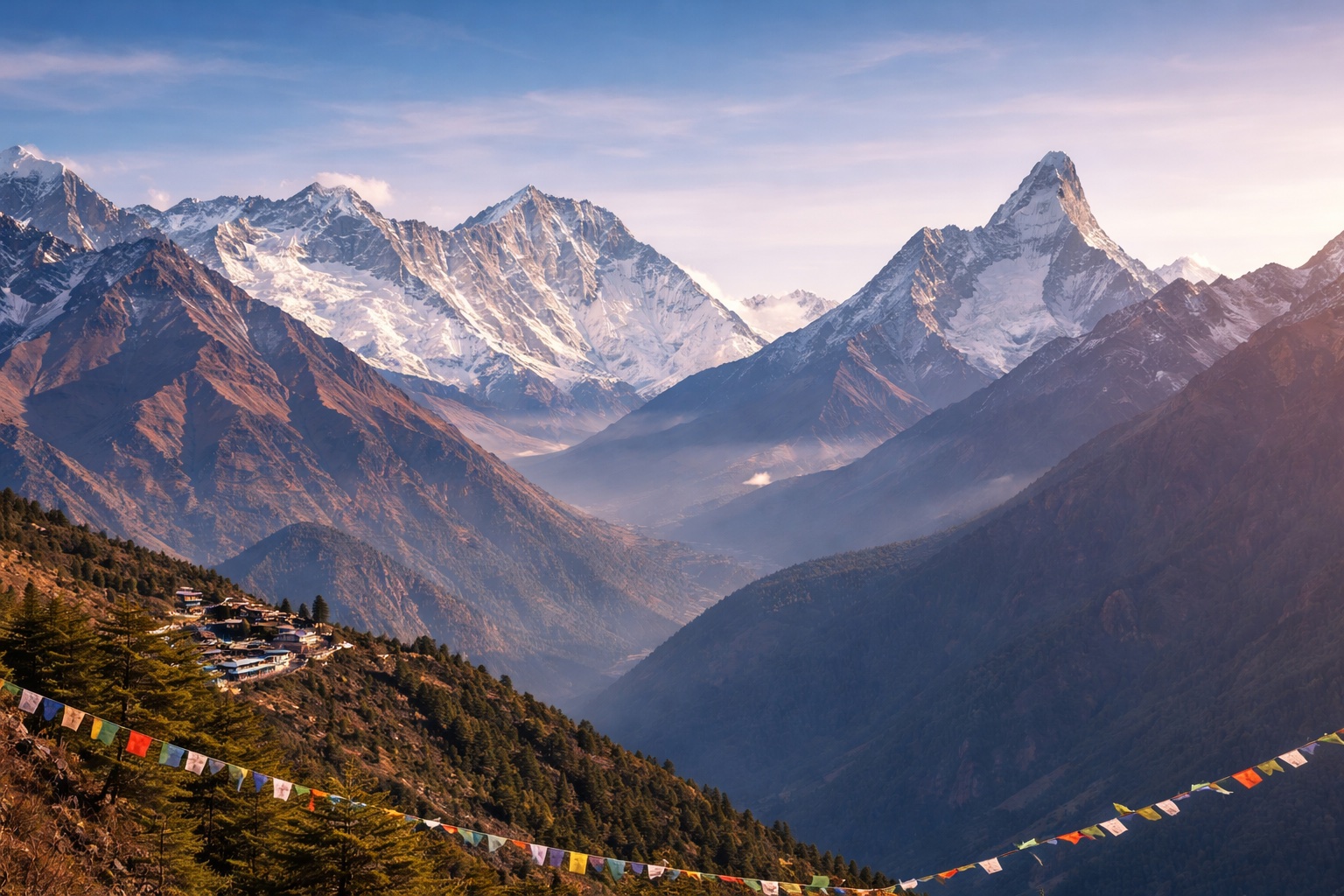
Tandem skydive from 15,000 feet (4,572 m) above Pokhara — 60 seconds of freefall at 200 km/h with the Annapurna Himalaya and Dhaulagiri directly below, Phewa Lake gleaming beneath the parachute, and Machapuchare's Fishtail summit at eye level during the canopy descent. The most scenically extraordinary skydive in the world, consistently cited by international skydiving publications. No experience required. Operated by Skydive Nepal with USPA-licensed instructors.
Skydiving in Nepal — and specifically the tandem skydive from 15,000 feet (4,572 m) above Pokhara — is, by the consistent assessment of the international skydiving community, the most scenically extraordinary civilian skydive available anywhere in the world. The claim is supported by geography: a jump altitude of 15,000 feet places the aircraft at an elevation where the Annapurna range — Annapurna I (8,091 m), Annapurna II (7,937 m), Annapurna III, IV, and South, Machapuchare (6,993 m), and Hiunchuli — fills the northern horizon from the aircraft window at the same altitude as the jump, meaning that the freefall (60 seconds, 200 km/h, 10,000 feet of vertical) takes place with the Himalayan giants directly in the field of view and, by the canopy phase, Machapuchare's summit is approximately at eye level. No other civilian skydive in the world takes place against a backdrop of 8,000-metre peaks at comparable proximity.
Skydive Nepal — the operator running commercial tandem skydiving from Pokhara Airport since 2013 — operates with USPA-licensed (United States Parachute Association) tandem instructors, international-standard ram-air parachute equipment serviced to manufacturer specifications, and standard protocols for weather and aircraft safety. The operation uses a Cessna Caravan aircraft (10-seat jump aircraft) for the climb to altitude, which typically takes 15–20 minutes above Pokhara — a scenic ascent in itself, as the Annapurna range builds progressively in the aircraft's north-facing windows during the climb.
The freefall phase of a 15,000-foot tandem skydive lasts approximately 60 seconds and covers approximately 10,000 feet of vertical descent at speeds between 180 and 220 km/h (terminal velocity for a tandem pair). During the exit from the aircraft — a door-step sitting position followed by a backward roll into the airstream — the initial sensation is dominated by the wind force (equivalent to standing in a 200 km/h gale) and the visual of the aircraft receding rapidly above. Once stable in the arch position, the visual field opens: the Pokhara valley directly below, the Phewa Lake a turquoise oval in the valley floor, the Annapurna range filling the northern sky at approximately the same altitude as the jumper at exit, and the southern plains of Nepal extending to the horizon.
The parachute opens at approximately 5,000 feet (1,524 m) above the Pokhara valley — approximately 700 metres above the valley floor — and the canopy phase (4–6 minutes) provides a qualitatively different experience from the freefall: silence replaces the wind noise, the speed reduces to approximately 15–20 km/h forward and 5 m/s descent, and the instructor can steer the canopy to face the Annapurna panorama directly. At canopy altitude, Machapuchare's summit (6,993 m) is visible at approximately the same elevation as the jumper — a perspective that no other position in the Pokhara sky delivers. Phewa Lake, Pokhara Lakeside, and the entire northern approach of the Annapurna massif are visible simultaneously in a panoramic composition that most participants describe as the finest single visual moment of any Nepal experience.
Nepal skydiving attracts a specific type of participant: not the adrenaline-seeking urban skydiver who goes to a local drop zone for the thrill, but the Nepal traveller — typically someone who has already done the trekking, the rafting, and the paragliding — who wants the single most extreme version of the aerial Nepal experience. The tandem format means no prior experience is necessary: participants do a 30-minute ground training session, connect to their instructor, and are genuinely passive for the aircraft exit (the instructor manages the jump) while experiencing the full physical reality of freefall. The activity is increasingly popular with older participants (40–70) who have completed their Nepal travel bucket list and want one more experience that genuinely could not be done anywhere else in the world with this backdrop.
Skydive Nepal operates to USPA (United States Parachute Association) standards — the most widely recognised international certification framework for commercial tandem skydiving. USPA-licensed tandem instructors are required to have a minimum of 500 logged jumps and hold a current USPA Instructor Examiner endorsement. Equipment is maintained to manufacturer service schedules and uses a dual-parachute system: a primary ram-air parachute and an automatic activation device (AAD) that deploys the reserve parachute independently if the primary is not deployed by a set altitude. The AAD is the safety backstop that eliminates the risk of impact in the event of instructor incapacitation. Tandem skydiving's safety record globally is excellent — the USPA reports approximately 0.002 fatalities per 1,000 tandem jumps. Personal travel insurance that specifically covers skydiving is mandatory for our booking.
Skydive Nepal requires participants to be at least 18 years old (no parental consent for under-18, as the activity is not approved for minors). Maximum weight is 90 kg (due to the combined weight limit for the tandem harness and instructor load). Minimum weight is 45 kg. There is no absolute maximum age, but participants over 60 should complete a pre-activity medical declaration, and those over 70 with cardiovascular conditions should consult their doctor before booking. The physical demand of the skydive itself is minimal — the instructor manages the exit and parachute, and the freefall is passive — but the rapid altitude change (from Pokhara Airport at 827 m to 4,572 m at exit altitude and back to 827 m at landing) generates a pressure change that can affect people with ear, sinus, or cardiac conditions.
No — Skydive Nepal suspends operations during the monsoon (June–September) due to persistent low cloud, afternoon thunderstorm activity, and poor visibility that make jump altitude operations unsafe. The operation runs October through May with the best conditions in October–November (post-monsoon exceptional clarity, Annapurna range snowcapped) and March–May (spring, longer days, good thermal stability at altitude). February and early March can produce haze from agricultural burning in the Terai plains that reduces visibility at jump altitude, though mountain views are typically still clear.
The comparison that most frequently comes up is with the Fox Glacier skydive in New Zealand (13,000 ft, Southern Alps backdrop) and the Interlaken skydive in Switzerland (15,000 ft, Bernese Oberland). The Pokhara skydive is distinctive in three ways: the mountain scale (the Annapurna range's peaks are 8,091 m — compared to 4,158 m for the Eiger) means the mountains at exit altitude are genuinely above the jumper and visible throughout freefall rather than just providing a distant backdrop; the jump altitude of 15,000 ft places the aircraft at approximately the same elevation as the mid-section of the mountains (the jumper is not looking up at the mountains from a low-altitude jump but is at the same level); and Machapuchare's summit is visible at approximately eye level during the canopy phase — a sight that is specific to this location and impossible at any other drop zone in the world.